The Guardian
The Guardian··3 min read
Hawaii ruling praised by US gun rights groups – are more rollbacks coming?
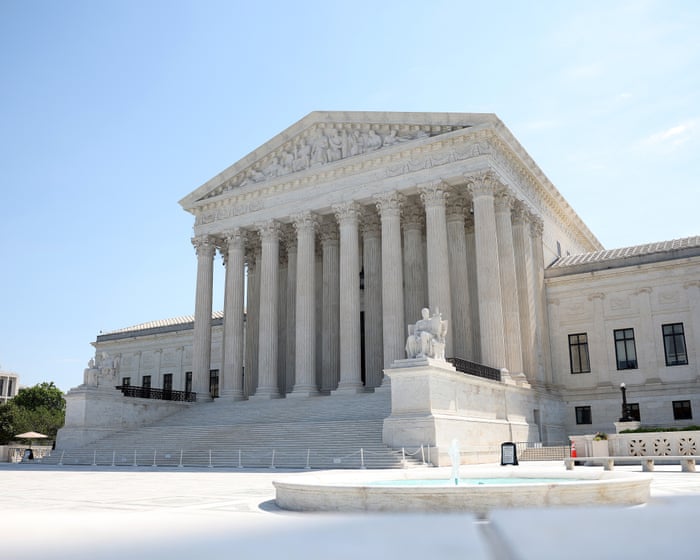
Experts say a supreme court ruling that struck down a Hawaii law banning people from carrying guns on private property without permission could present problems for business owners – and is a bellwether of what steps the majority-conservative court may take toward undoing policies they see as placing an undue burden on legal gun owners.
The US supreme court handed down the ruling in Wolford v Lopez on Thursday in a 6-3 decision. Second-amendment law centers and advocates praised the ruling as another win and important step toward challenging other restrictions that are out of line with gun laws that existed at the nation’s founding. Gun control and gun violence groups, meanwhile, lambasted the decision as a dangerous one that prioritizes the rights of gun owners over public safety.
Before the ruling, just five states – Hawaii, California, Maryland, New York and New Jersey – required express permission before someone could come on to private property with a gun. Those state laws are now void.
But individual property owners still retain the right to decide if they want guns or not on their premises.
While the default rule is now that people are permitted to carry firearms on private property unless its owners say otherwise, the ruling does not extend to public spaces that state or local government has designated as sensitive places, such as parks, libraries and schools, says Hayley Lawrence, the executive director of the Center for Firearms Law at Duke Law School.
“It has no bearing on sensitive-places law. That is still the status quo,” she said. “Homeowners [and] business owners still have the right to stop people from bringing firearms to their property. But the state can’t set the default rule.”
This is the second time this month that the supreme court has struck down a firearms policy based on the precedent set by the 2022 Bruen decision, which requires gun laws to have a historical twin. In the recent Hemani decision, the court sided with a Texas gun owner who argued that the federal law that bans gun ownership among anyone who uses drugs illegally violates the second amendment.
Before the Wolford ruling, the state’s default position was that guns are banned on private property unless express permission to the contrary is given by the owner. Now that has flipped. Unless carrying is explicitly banned, the default is that guns are permitted.
This reversal can put owners of businesses such as malls and hardware stores, run by private companies but open to the public, into tricky positions, said Jeffrey Fagan, a professor of law at Columbia Law School.
Now business owners will have to explicitly make their position on gun-carrying clear, which risks alienating customers who may want to carry their gun inside and those who don’t want to be in the same space with firearms.
“[The Wolford decision] creates an extraordinary burden on private property owners. They’re going to have to take new steps now because the rules about carrying in private property are thrown into question,” Fagan said.
While the Wolford ruling does not spell a total end to prohibiting guns in public and private spaces, it’s another step toward the conservative justices’ goal of undoing laws that burden gun owners, as the one in Hawaii did.
Lawrence said she expected the court to begin tackling more cases that make owning and carrying a gun easier for legal owners. This could mean striking bans on assault weapons and magazines that carry more than 10 rounds, or undoing laws around who can possess a gun and where they can carry it. Or as Lawrence sees it, the “who, what and where” of gun laws.
“It certainly gives a look at where the court is going,” Lawrence said of the Wolford decision. “Alito talks about this cumulative burden that Hawaii’s firearms law had. The extensive references reflect that the court is thinking about this in a cumulative sense. So if there is an undue burden on second amendment rights it will be struck down.”
View original source — The Guardian ↗
Related stories

The Punch
NewsJun 26, 2026 · 1 min
$4.5bn fraud: Emefiele challenges EFCC statements, cites torture, detention
The Punch

ESPN
SportsJun 26, 2026 · 1 min
Sources: Pistons to land Joe in trade with OKC
ESPN
The Punch
NewsJun 26, 2026 · 1 min
NSCDC nabs three suspects over illegal ethanol haul in A’Ibom
The Punch
The Punch
NewsJun 26, 2026 · 1 min
Taraba gets permanent police HQ 35 years after creation
The Punch