Indian Express
UPSC Essentials daily subject quiz : Environment and Geography MCQs (Week 168)
UPSC Essentials brings to you its initiative of subject-wise quizzes. These quizzes are designed to help you revise some of the most important topics from the static part of the syllabus. Attempt today’s subject quiz on Environment and Geography to check your progress.
🚨 Click Here to read the UPSC Essentials magazine for June 2026. Share your views and suggestions in the comment box or at [email protected]🚨
1. It is found at an altitude between 15 km and 50 km from the Earth’s surface.
2. The ozone protects the Earth from the harmful ultraviolet rays in the sunlight.
3. Ozone, when close to the ground, is considered an air pollutant.
4. Ozone concentrations of about 100 parts per billion (ppb) at the ground level is usually considered safe.
Select the correct answer using the codes given below:
(a) 2, 3 and 4 only
(b) 3 only
(c) 4 only
(d) 1 and 3 only
Story continues below this ad
Relevance: Ozone is a recurring UPSC topic due to concerns related to air pollution, climate change, and atmospheric chemistry. The topic is also important from the perspective of human health, ecosystem impacts, and environmental governance.
Explanation
— Heatwaves are not just a direct threat to human health, they also drive up concentrations of ground-level ozone that sharply aggravate mortality risks, a new study by Indian researchers has shown. In 2024 alone, more than 830 deaths in India could be attributed to increased ozone concentrations caused by extreme heat, according to the study.
About Ozone
— Ozone is naturally produced, and found, in the middle atmosphere, at an altitude between 15 km and 50 km from the Earth’s surface. Hence, statement 1 is correct.
— This ozone protects the Earth from the harmful ultraviolet rays in the sunlight. It absorbs these rays, acting as a natural sunscreen for the Earth. But ozone close to the ground is an air pollutant. Hence, statements 2 and 3 are correct.
Story continues below this ad
— Surface-level ozone is not naturally produced, but is a by-product of chemical reactions between other common air pollutants like nitrogen oxides (NOx) and volatile organic compounds (VOCs) in the presence of sunlight. Heat has the effect of accelerating these reactions.
— Ozone concentrations of about 30 parts per billion (ppb) at the ground level is usually considered safe. In most parts of India, this background ozone concentration is around 50-55 ppb. This is particularly true of northwestern India and the Gangetic plains, which carries a very high pollution load. During heatwaves, the ozone concentration is driven up even higher. Hence, statement 4 is not correct.
Therefore, option (c) is the correct answer.
QUESTION 2
With reference to the proposed hydropower projects in news, consider the following pairs:
1. Oju hydroelectric project – Subansiri River
2. Kamala hydroelectric project – Barak River
3. Kalai-II hydroelectric project – Lohit River
4. Kirthai-II hydroelectric project – Jhelum River
How many of the pairs given above are correctly matched?
(a) Only one
(b) Only two
(c) Only three
(d) All four
Story continues below this ad
Relevance: UPSC Prelims frequently asks questions on the association of infrastructure projects with rivers, states, and river basins, particularly in the Himalayan and Northeastern regions.
Explanation
Proposed hydropower projects
River
Description
Oju hydroelectric project
Subansiri River
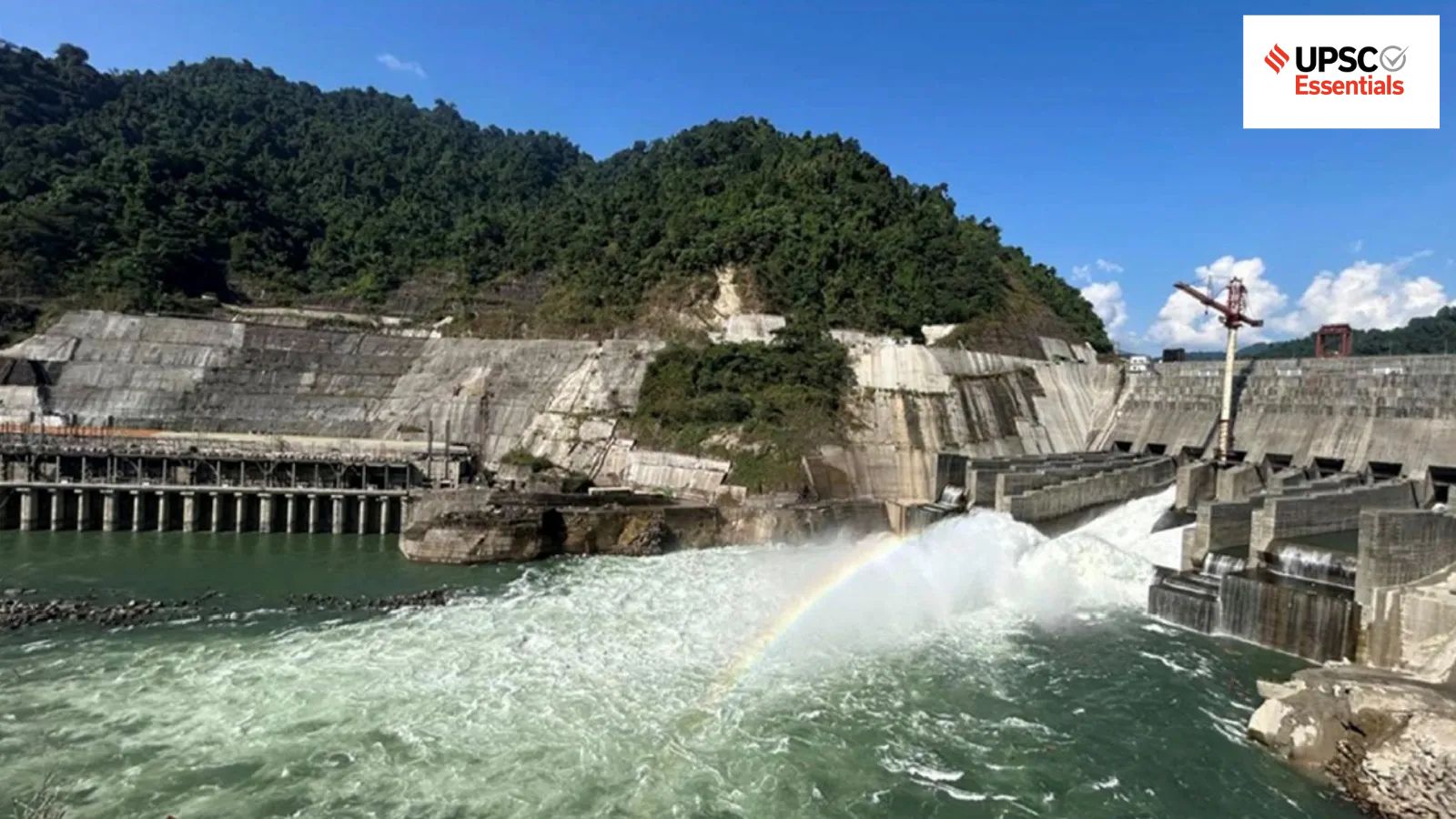
An expert panel of the Union Environment Ministry has recommended environmental clearance for the 2,220 MW Oju hydroelectric project proposed on the Subansiri river in Taksing near the China border. It is located uppermost among a cascade of hydroelectric projects planned in the Subansiri basin, and will be the largest in terms of its approved capacity.
Kamala hydroelectric project
Kamla River (tributary of Subansiri River)
NHPC’s 1,720 MW Kamala hydroelectric project on the Kamla river, a right-bank tributary of the Subansiri, in Arunachal Pradesh has been granted clearance for construction.
Kalai-II hydroelectric project
Lohit River
The Environment Ministry’s Forest Advisory Committee (FAC) has granted in-principle forest clearance to the 1,200 MW Kalai-II hydroelectric project, proposed on the Lohit River, which is one of the key habitats of the critically endangered White-Bellied Heron. The nod paves the way for clearing 869 hectares of forest for the project, including the submergence of 638 hectares in the Anjaw and Namsai forest divisions, Arunachal Pradesh.
Kirthai-II hydroelectric project
Chenab River
The Forest Advisory Committee (FAC) of the Ministry of Environment, Forest and Climate Change has recommended in-principle approval for diversion of 197 hectares of forest land for the 820 MW Kirthai-II hydroelectric project on the Chenab River in Jammu and Kashmir.
Therefore, option (b) is the correct answer.
QUESTION 3
The term ‘Doublets’ was recently in the news. It is associated with:
(a) Volcanoes
(b) Landslide
(c) Tsunami
(d) Earthquake
Relevance: UPSC frequently asks conceptual questions related to natural hazards, their classification, underlying processes, and associated scientific terminology.
Explanation
Story continues below this ad
— The twin earthquakes in and around Venezuela’s capital Caracas are feared to have killed tens of thousands. The first quake, of magnitude 7.2, hit about 160 km west of Caracas late on Wednesday night. Just 39 seconds later, it was followed by a 7.5 magnitude quake.
— The US Geological Survey (USGS) described the disaster as a “seismic doublet”. The second quake was the largest to strike Venezuela or just off its coast since 1900, according to the USGS.
— In a typical sequence, the larger quake is followed by a series of smaller aftershocks. Doublets, however, are generally defined as earthquakes of similar magnitude that originate from distinct but closely related ruptures and occur in quick succession.
What caused the earthquakes?
— Venezuela sits in one of the most seismically active regions in northern South America, along the boundary between the Caribbean and South American tectonic plates. These two plates can slide horizontally past each other along faults, in a phenomenon called a strike-slip fault (see box below), causing earthquakes.
Story continues below this ad
Different kinds of faults
— “Doublets or twin earthquakes are slightly different from aftershocks that are routine after any major earthquake. Aftershocks are largely a result of disturbances or ruptures caused by the main earthquake. Some stress is already present, and it is then amplified by the main earthquake, resulting in another quake. Aftershocks are usually one or more magnitude smaller than the main earthquake, although these are not very tight definitions, and have to be assessed on a case-by-case basis,” Vineet Gehlot, director of Dehradun-based Wadia Institute of Himalayan Geology, told The Indian Express.
Therefore, option (d) is the correct answer.
QUESTION 4
The Western Ghats are stretched across:
1. Karnataka
2. Telangana
3. Gujarat
4. Kerala
5. Andhra Pradesh
Select the correct answer using the codes given below:
(a) 1, 2, 4 and 5 only
(b) 1, 3, 4 and 5 only
(c) 1, 2 and 5 only
(d) 1, 3, and 4 only
Relevance: The Western Ghats remain a recurring topic in current affairs due to issues related to Ecologically Sensitive Areas (ESA), biodiversity conservation, climate resilience, and development–environment debates. The topic is also important from the perspectives of physical geography, ecology, conservation policy, and environmental governance.
Explanation
— Twelve years after it issued the first draft notification, the Centre is finally ready to finalise and notify the demarcation of Ecologically Sensitive Areas (ESA) in the Western Ghats region.
— Over 56,000 square km of land in six states (Gujarat, Maharashtra, Goa, Karnataka, Kerala and Tamil Nadu) are proposed to be demarcated as ESA, based on the 2013 recommendations of a high-level working group led by former ISRO chairman K Kasturirangan.
Story continues below this ad
— Activities like new mining and quarrying projects, setting up of thermal power plants, operation of most-polluting red-category of industries, new and expansion projects of buildings and construction with a built-up area of 20,000 square metres or above, are proposed to be completely banned or heavily restricted.
Therefore, option (d) is the correct answer.
QUESTION 5
With reference to the golden langur, consider the following statements:
1. The golden langur is an endangered species.
2. It is endemic to the Western Ghats.
3. Golden Langurs primarily feed on insects and small vertebrates.
How many of the statements given above are correct?
(a) Only one
(b) Only two
(c) All three
(d) None
Relevance: The Golden Langur is frequently in the news due to conservation initiatives, habitat fragmentation, and wildlife corridor projects, making it relevant for UPSC Prelims. UPSC often asks factual questions on endemic species, IUCN status, geographical distribution, habitat, and legal protection status of threatened fauna.
Explanation
— A week after eight endangered golden Langurs were rescued from alleged wildlife traffickers in Assam, all except one have been released back into the wild. The one left died during the rescue and rehabilitation process.
Story continues below this ad
— The golden langur is an endangered species endemic to Western Assam and Bhutan. Hence, statement 1 is correct and statement 2 is not correct.
— According to a population estimate released in 2024, there were 7,396 golden langurs in India at the time.
— They are primarily folivorous and frugivorous, feeding mainly on leaves, fruits, flowers, and seeds. Hence, statement 3 is not correct.
Therefore, option (a) is the correct answer.
Previous Daily Subject-Wise-Quiz
Daily Subject-wise quiz — History, Culture, and Social Issues (Week 159)
Daily subject-wise quiz — Polity and Governance (Week 168)
Daily subject-wise quiz — Science and Technology (Week 168)
Daily subject-wise quiz — Economy (Week 168)
Daily subject-wise quiz — Environment and Geography (Week 167)
Daily subject-wise quiz – International Relations (Week 167)
Subscribe to our UPSC newsletter and stay updated with the news cues from the past week.
Stay updated with the latest UPSC articles by joining our Telegram channel – IndianExpress UPSC Hub, and follow us on Instagram and X.
View original source — Indian Express ↗
Related stories

TechRadar
TechnologyJun 26, 2026 · 1 min
I've been looking for a smart speaker for the kitchen and this is my last chance to pick up the Amazon Echo Spot for…
TechRadar

ZDNet
TechnologyJun 26, 2026 · 1 min
7 WFH gadgets that seriously improved my workflow (and they're on sale)
ZDNet

TechRadar
TechnologyJun 26, 2026 · 1 min
New report reveals the Nintendo Switch 2 is the second fastest-selling video game hardware in US history, as Xbox and…
TechRadar

TechRadar
TechnologyJun 26, 2026 · 1 min
How to watch Senegal vs Iraq: Free Streams & TV Channels online from anywhere at FIFA World Cup 2026
TechRadar