The Guardian
The Guardian··7 min read
Christian Brothers sold real estate worth millions for $1. Now it claims in court it lacks money to pay abuse survivors
Adam* pauses briefly, his voice catching slightly down the phone line. He’s contemplating how to describe the unprecedented new legal tactic the Christian Brothers Catholic order is deploying against him and hundreds of other abuse survivors.
“It’s not human,” he said. “It’s just not human.”
The Christian Brothers had an oversized role in the church’s industrial-scale abuse of children. A staggering 22% of its brothers were alleged perpetrators – the second highest rate of any Catholic order.
Like many church institutions, royal commission findings revealed the Christian Brothers was aware of abuse complaints but continued to circulate paedophile clergy through its vast network of schools and orphanages, a practice that allowed offending to continue.
Between 1980 and 2015, 1,015 people made child abuse claims against the Christian Brothers, the highest number of claims against any Catholic order. The claims identified 483 different alleged perpetrators across 100 Christian Brothers schools.
Now, the order is telling a court it is broke.
This week, the Christian Brothers applied for a court-ordered moratorium on all remaining civil cases lodged against it by survivors. If granted, it would permanently halt at least 200 civil claims.
The order says it wants to instead sell its remaining property portfolio – 36 properties, worth about $216m – and divvy up the leftovers between a range of creditors, including survivors, using a scheme run by retired judges. It has already confirmed the sell-off will not provide enough cash for it to pay creditors all of what they are owed.
But a trove of church property records obtained by Guardian Australia tells another story – one that survivors have not been made aware of.
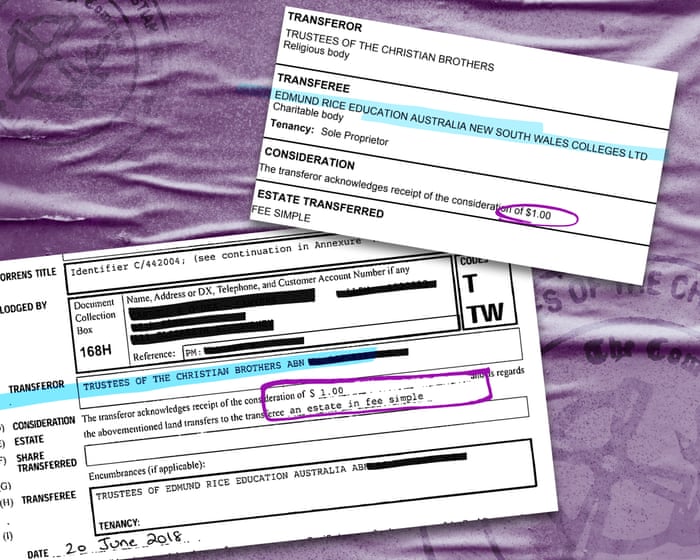
A Guardian investigation can reveal that the Christian Brothers has spent the last decade transferring large, multimillion-dollar property holdings for amounts of $1 to a separate Catholic church entity which is not part of the proposed sell-off scheme.
The beneficiary of the $1 property deals is Edmund Rice Education Australia, an independent organisation created in 2007 to assume control of schools previously associated with the Christian Brothers like Waverley College in Sydney, Trinity College in Perth and St Joseph’s Nudgee College in Brisbane.
Property records reveal that, in NSW alone, the Christian Brothers transferred 26 separate properties to Edmund Rice Education Australia for amounts of $1 or $0 between 2013 and 2024, with most of the transfers occurring in 2018.
The properties are currently worth well over $50m. They include multimillion dollar homes around schools in the Sydney suburbs of Waverley and Strathfield, as well as school buildings and vacant land.
The most recent transfer involved a five-bedroom Strathfield home, complete with a backyard pool, in November 2024.
The property currently has an estimated value of $4.7m. Edmund Rice got it for $1.
“The transferor [Christian Brothers] acknowledges receipt of the consideration of $1.00,” a document detailing the transaction says.
Many of the transfers were signed off by Christian Brothers’ Oceania leader Peter Clinch.
Edmund Rice Education Australia was designed as an administratively and financially separate entity to the Christian Brothers, despite being named after the Christian Brothers’ founder. It continues to hold vast wealth, reporting net assets of $2.3bn and $345m in cash as of December 2024.
The $1 transfers have now left the Christian Brothers without control of a significant pool of assets they could use to pay out survivors.
An EREA spokesperson signalled it would not be selling property to help the Christian Brothers. The spokesperson said EREA was “not responsible for the financial affairs or liabilities of the Christian Brothers”.
“In 2007, EREA was established as a separate legal entity and it was entrusted with responsibility for governing, operating and stewarding the schools solely for the advancement of its educational mission. As part of the process, the school assets were transferred from the Christian Brothers Oceania Province to EREA, together with the associated school property,” the spokesperson said.
“The diversion of school assets or funds to support the liabilities of another organisation would raise significant governance, fiduciary and regulatory issues,” they said.
“We sincerely hope the Christian Brothers find a path through their challenges, including planned asset sales, to allow them to continue their commitment to supporting survivors and victims of historic sexual abuse.”
The spokesperson said the 26 properties identified by the Guardian were all either buildings or vacant land near existing EREA schools.
That land and property was transferred as part of a slow, progressive process of turning over Christian Brothers school land and property to EREA, a process delayed by what the spokesperson described as the “complexity of transferring individual titles across multiple jurisdictions”.
“The transfers represent the completion of a governance transition that commenced almost a decade earlier,” the spokesperson said.
A spokesperson for Christian Brothers Oceania said the scheme it was proposing would be able to scrutinise the property transfers to EREA.
“Our current advisors in respect of the scheme of arrangement were not involved in the establishment of EREA or the transfers of property by the Province to EREA,” a spokesperson said.
“Under a scheme of arrangement or liquidation, there will be scrutiny of the property transfers to EREA, and the parties involved in those transactions.”
Christian Brothers said EREA had not responded to requests to provide financial assistance.
“We confirm that as of 26 June 2026 no funding from Catholic bodies, including ACBC and EREA, in response to our requests has been forthcoming,” the spokesperson said.
Adam has been fighting for justice for five years, including in the high court. He was abused by Br Robert Best, who was convicted of the crimes, and allegedly abused by Br Gerald Fitzgerald, who died before any conviction, while at the St Alipius Boys’ school in Ballarat in the 1960s.
He suffered a serious heart attack about 18 months ago. The latest legal manoeuvre has left him reeling.
“It’s so hard to just keep my head above water,” Adam said. “I went out to one of the counsellors yesterday, in person … to try and get some sort of sense into my head.”
“When are they going to admit it, have accountability, and be human about it? It makes me feel disgusting that I’m even listening to what they’re doing.”
Plaintiff lawyers representing hundreds of abuse survivors say they were blindsided by the moratorium push.
Judy Courtin, a lawyer who represents Adam, says she first learned of the church’s plan on Monday and was handed hundreds of pages of documents on Tuesday evening just before a Wednesday morning hearing in the NSW supreme court.
Plaintiff lawyers were granted an extension and the court will return next week to consider the matter.
Courtin says the plan has caused immense harm to her clients.
“This reflects their whole MO, using the black letter of the law to destroy and crush victim-survivors,” she said.
Other lawyers with claims against the order have reported a similar impact.
“No-one else has done this in Australia, this is the first time,” Jason Parkinson, principal at Porters Lawyers, said. “In the early days, the church would say: we don’t exist, we can’t be sued ... quite frankly, this just seems to be a variation on that theme.”
“We’ve got people who are in for hearings in September, and are distraught. This is just rubbing salt into the wounds of victims of child abuse.”
The Australian Lawyers Alliance said it was appalled at the legal strategy. The alliance’s national president, Ian Murray, said its members would fight the church on behalf of their clients.
“This latest legal manoeuvre by the Christian Brothers follows a pattern the royal commission documented in damning detail: delay and deny justice to survivors,” Murray said.
“These are not abstract legal disputes. They concern children who were harmed by individuals in positions of trust, and in circumstances where the church failed in their duty of care.
“Every procedural tactic used to avoid compensation compounds that original betrayal.”
During evidence to the royal commission in 2017, Clinch, the then Christian Brothers’ Oceania leader, said the order was “in our final years”. It had stopped seeking new candidates and its existing cohort of brothers was ageing, Clinch said.
“It’s my opinion that if you look at the statistics and you look at the evidence that is around us, we need to be gracious in our final years and make sure things are in place – for example, Edmund Rice Education Australia – who can do that work effectively and well,” Clinch said.
In 2018, Clinch’s signature appeared on many of the documents transferring property to Edmund Rice Education Australia. He died in 2024.
A Christian Brothers spokesperson said it was not attempting to stop survivors suing other institutions, including EREA.
The moratorium and property sell-off scheme would only be created with the support of creditors, the spokesperson said.
“The proposed scheme of arrangement is entirely in the hands of our creditors who will be invited to vote on the scheme,” the spokesperson said. “If the creditors do not wish for there to be a moratorium on claims and do not support the scheme, then the Province entities will enter liquidation.”
“As stated publicly on 22 June 2026, neither the moratorium nor the proposed scheme of arrangement, or indeed liquidation if that scenario eventuates, is in any way intended to prevent any future civil claim being brought by claimants against EREA and other Catholic institutions (or any other potential defendants),” the spokesperson said.
Adam remembers how alive he felt during the child abuse royal commission. It was the first time he felt heard.
“Now when they’re manipulating the laws the way they are, it’s like we don’t exist.”
View original source — The Guardian ↗
Related stories

The Punch
NewsJun 26, 2026 · 1 min
Govt doing everything to ensure I do not contest in 2027 — Obi
The Punch

ESPN
SportsJun 26, 2026 · 1 min
Sources: Haaland to miss France World Cup clash
ESPN
The Punch
NewsJun 26, 2026 · 1 min
NDC legal team studying court ruling voiding party registration — Obi’s aide
The Punch
The Punch
NewsJun 26, 2026 · 1 min
Kaduna mob killing: Police arraign 17 more suspects, charge 33 others
The Punch