Philippine Daily Inquirer
SC: Worker’s prolonged absence can’t be sole basis for dismissal
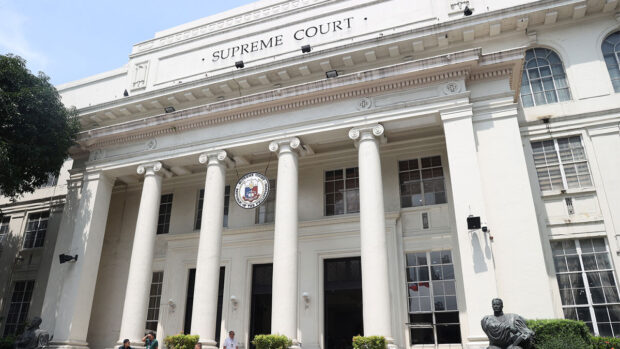
Supreme Court. INQUIRER FILE PHOTO
An employee’s consecutive absences alone are not grounds for outright dismissal, according to the Supreme Court.
A decision by the high court’s Third Division, dated Nov. 19 last year but released only recently, found agricultural company Green Era Biotech and its manpower service provider Great Value liable for the illegal dismissal of an employee who was absent for at least 18 days in 2018.
Article continues after this advertisement
The employee, a utility worker, was first hired by Green Era Biotech in 2015 and transferred to Great Value two years later.
FEATURED STORIES
NEWSINFO
NEWSINFO
NEWSINFO
After an initial eight days of absence at Great Value, he was issued a notice to explain and warned he would be recorded as AWOL (absent without leave). But he continued to be absent for another nine days.
AWOL notice
He was finally sent an AWOL notice, which also informed him that his absences were a serious misconduct and abandonment and, as such, were grounds for termination.
Despite that notice, the employee was still absent for one more day and showed up at work only two days after that warning.
This prompted Great Value to dismiss the worker, citing his gross and habitual neglect of duty and serious misconduct.
The company said his termination followed due process, adding that it followed a “twin notice requirement” for the employee’s benefit.
‘Severe penalty’
The Supreme Court, however, ruled in the employee’s favor, saying it granted his appeal (or petition for review on certiorari) and noting that his absences, although “clearly unauthorized, do not not merit the severe penalty of dismissal.”
The high court said the worker did not abandon his work, since there was no “deliberate and unjustified refusal” to resume employment.
Article continues after this advertisement
Abandonment of work entails not only a lack of valid reason for the absences but a clear intention to cut ties with the employer, the court said.
Great Value failed to prove these two elements, the Supreme Court said.
Article continues after this advertisement
“[T]he records are bereft of any allegation, much less proof, that [the employee] deliberately failed to report to work with the intent to discontinue his employment,” said the ruling written by Associate Justice Maria Filomena Singh.
“In fact, following his absences, [the employee] even attempted to report for work, but was no longer allowed to do so, and he thus filed a case for illegal dismissal protesting his removal from work,” the decision noted further.
Separation, nominal damages
The Supreme Court said it also found “too harsh” the company’s absenteeism policy, which penalizes with suspension “at least five days of unexplained absences” by an employee.
This policy “must be tempered,” the court said.
It ruled that the employee is entitled to reinstatement or, if that option is no longer possible, a full separation pay equivalent to his monthly pay for every year of service.
Green Era Biotech and Great Value were directed to pay nominal damages worth a total of P30,000.
The separation pay and total nominal damages will each incur an annual interest of 6 percent until these are fully paid to the employee.
The worker, however, is not entitled to back wages since his absences still violated company policy, the high court said.
Your subscription could not be saved. Please try again.
Your subscription has been successful.
The decision reversed earlier rulings by the Court of Appeals in 2022, the National Labor Relations Commission (NLRC) in 2020 and the NLRC’s Labor Arbiter in 2019—which all upheld the employee’s dismissal.
View original source — Philippine Daily Inquirer ↗
Related stories

TASS
TechnologyJun 28, 2026 · 1 min
CENTCOM says it struck ten military targets in Iran
TASS
South China Morning Post
TechnologyJun 28, 2026 · 1 min
Iranian drones target Bahrain after US offensive, straining ceasefire
South China Morning Post

Philippine Daily Inquirer
TechnologyJun 28, 2026 · 1 min
Antipolo bishop urges Senate to continue probe of flood control projects
Philippine Daily Inquirer

TASS
TechnologyJun 28, 2026 · 1 min
Series of explosions heard near Iran’s Sirik, Qeshm
TASS