Indian Express
What it takes to form a football team: An immigrant story
THE MAKESHIFT tent on the edge of the playing field at Flushing Meadows Corona Park, a sprawling public park in New York’s Queens borough, is blaring the Latino chartbuster DTMF by the Puerto Rican rapper Bad Bunny.
A few teenage players tap their feet to its tunes, their gaze fixed on a game of football in the middle. A volley from 20 yards clangs onto the crossbar, and coach Vincent Cordoba, a stern-looking elderly Colombian man with small, sharp eyes, throws a water bottle to the ground in anger. He shouts expletives in Spanish and instructs his players to tighten up their defence and fall back in numbers.
Here in the immigrant hub of Queens, where entire worlds coexist within a few stops of the subway, every Sunday, semi-professional and recreational footballers converge to relive their unfulfilled dreams of playing professional football, making new friends and being reassured of their identity.
Most of the players are from immigrant communities, largely Latin American, scattered across Queens. They are joined like a moving thread by New York City Subway’s famous Train 7 that stops at stations with some of the densest immigration populations, from Flushing Main Street through Jackson Heights and Corona, all the way to St Hudson Yards.
According to US government data, around 45 per cent of the 2.3 million residents of Queens are “foreign born”.
“We are a small club called La Bogota, and almost all of us are Colombian, living in Jackson Heights (in Queens). If there is a Sunday, we are here, wherever we are working,” Cordoba says a little later, once the irritation at the missed goal has subsided. “In America, the immigrants have been central to the game’s growth, like it is in most countries. Look at Spain, France, England…” he says.
England defender Marc Guéhi. (Photo credit: Reuters)
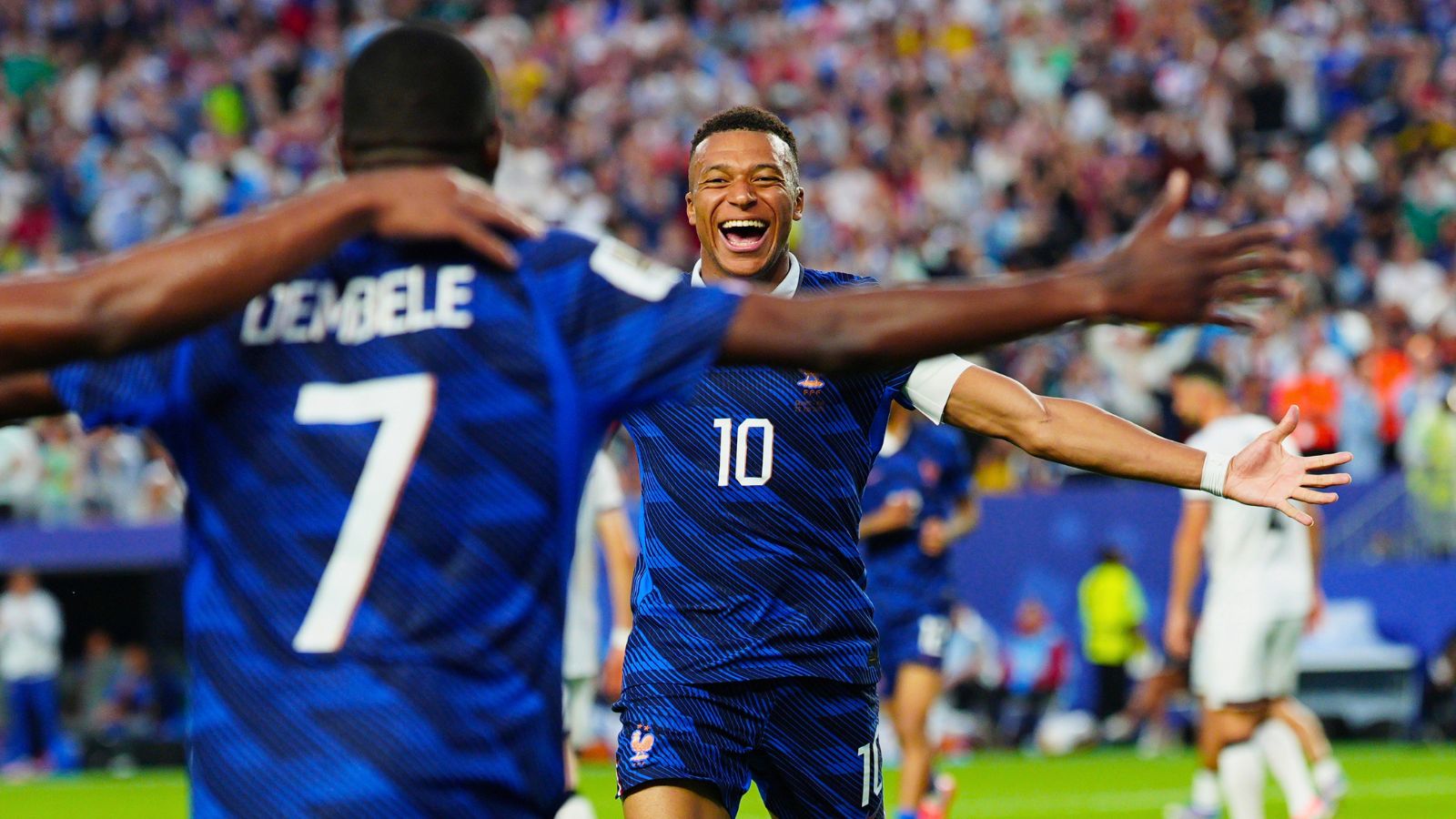
From France’s Kylian Mbappé who is of Cameroon-Algerian descent to UK’s Marc Guéhi who was born in the Ivory Coast, and US forward Folarin Balogun, who was born in New York when his Nigerian parents were on a vacation, immigrant players have been central to this World Cup, deified across the globe regardless of nationality, even among teams that have historically relied on their non-immigrant majority. It’s also the paradox of the tournament — that while the World Cup is being held in the backdrop of anti-immigrant policies across Europe and the US, it is being lit up by the children of those who left their countries for a better living, or just to live.
Story continues below this ad
A beautiful game, beyond borders
When politicians are busy drawing up stringent anti-immigration laws, football, as this World Cup has shown, is dismantling the boundaries drawn by men. The walls are crumbling at the outposts of the game.
France captain Kylian Mbappé. (Photo credit: Reuters)
Only two of France’s 26 players are of non-immigrant ancestry — 22 of them have African roots. Some, such as Mbappé, are deeply connected to their country of origin.
Of England’s 26 players, eight have Caribbean forebears, 10 African, and 20 who were eligible to represent at least one other country because of their family heritage or birthplace. Belgium has players who trace their lineage to its former colonies — Congo, Burundi and Mali. The Portugal team has those of Cape Verdean, Angolan, and Guinean lineage.
Those surplus to their requirements — players of African descent born and raised in Europe — in turn, populate most of the African teams. Ten of the 11 Senegalese players in the starting lineup against France in the opening game were born in France.
Story continues below this ad
Spain and Italy were latecomers to the multicultural transformation of European football. European heavyweights such as France, Portugal, England, Germany and Belgium had blended them long ago, so much so that most of their heroes and talismans this century have been of African descent, much to the irritation of the far-right parties that feel the France team is less French, or the England squad is less English.
Spain winger Lamine Yamal. (Photo credit: Reuters)
But Spain — and its teen sensation Lamine Yamal — are more than making up for the country’s slow start.
In the immigrant neighbourhood of Spain’s Rocafonda, roughly 40 km from Barcelona, nearly every wall wears the graffiti, “En El Barrio de Rocafonda/Mas Lamina Yamals/Ye Menos Desa Hucious (In the Rocafondaneighbourhood, more Lamine Yamals and fewer evictions)”.
The residents, largely from former Spanish colonies in North Africa, have long lived under the twin shadows of economic marginalisation and the stigma attached to immigrant communities. Then, along came Yamal, born in Spain to immigrant parents — his mother Sheila had illegally entered Spain from Equatorial Guinea as a teenager and his father Mounir Nasraoui, a painter from Morocco, had immigrated a few decades earlier.
Story continues below this ad
The Barcelona star’s rise in the 2024 European Championship offered a new voice and identity for millions of immigrants in Spain. Before Yamal, players with immigrant descent had played sporadically.
In a podcast for DAZN Espana, reputed pundit Alberto Edjogo Owono explained the social context: “The ethnic mix arrived much later in Spain than it did in England and France. So it took time for them to become visible in mainstream football.”
Yamal’s partner in-wing Nico Williams. (Photo credit: Reuters)
Unlike other Black players who played for Spain after gaining citizenship — Donato, Catanha and Marcos Senna — the new wave, including Yamal and his partner in-wing, Nico Williams, were born in Spain. “That’s very important for children of immigrants, the second generation,” Owono said.
Some 500 km away in Pamplona, in Spain’s Navarra province, children of immigrants from Africa have Nico’s face plastered on their bedroom walls. Nico’s parents had fled Ghana to escape the abject poverty there.
Story continues below this ad
In his early days, Nico and his brother, Inaki, were subjected to racial slurs from stands, especially during games in Spain’s capital, Madrid. But now, Nico is greeted as fervently as any other player.
Football and the American dream
United States striker Folarin Balogun. (Photo credit: Reuters)
At Flushing Meadows, coach Cordoba, 55, says he migrated from Colombia as a teenager. “All gangs and fights… My parents thought it was not the right atmosphere for us to grow, so we moved here. Those days, in the 80s, migrating to the States was not difficult,” he says, the musical tilt of Spanish still intact as he spoke.
Ever since he has been in New York, he remembers playing weekend football in Queens. “It becomes a slice of Latin America,” he says. His assistant Andreas chimes in: “We come here to play and share our experiences, problems. Almost a hundred games are played here every weekend.”
There are just 20 football grounds, though, at the Flushing Meadows park for these 100 games. A few are of regulation size, some are smaller and shapeless. A game between two Venezuelan clubs is unfolding on an oval-shaped pitch. One pitch has an enormous oak tree in the middle. “All we need is a little bit of space, and of course, different teams take different shifts,” says Cordoba.
Story continues below this ad
Most teams playing here are organised around the countries the players left behind — like Cordoba’s team with mostly Colombian immigrants, there are leagues with those from Mexico, Ecuador.
Andreas interjects: “It’s not like we only have Colombians in our league. There are a couple of boys from Guatemala, though primarily Colombians tend to play in Colombian clubs and Mexicans in Mexican clubs. And we make a lot of friends from other countries. We have a kind of immigrant bond, because our stories are similar.”
The stories he refers to feature gangs, shootouts, poverty and a guardian angel landing them on the promised land, the United States. “The only thing is, not all of us enter the country illegally,” says Cordoba, guffawing.
US team in Australia. Friday, June 19, 2026. (AP Photo)
Though their loyalties are unshakably tied to their country of origin, of late, the USA national team (USMNT) has become their second favourite.
Story continues below this ad
Says Manuel Fernandez of Salta FC, a Uruguayan-heavy team that plays at the park, “The US national team has become more relatable; it has mixed cultures and players proud of their identity. Many of them had a tough upbringing.” As an aside, he says, chuckling: “They have a Latin American coach too.”
Six of the players in the US national team are of Afro-Caribbean heritage, including Tim Weah, son of George Weah, the Liberian regarded as the greatest African player ever. There are those from Nigeria, Ghana, and Jamaica. Three are from Hispanic backgrounds — Christian Roldan (Guatemala), Ricardo Pepi (Mexican-American) and Jesús Ferreira (Colombian-American). As many are from Europe, and three others have dual nationalities. “Now, it’s a true reflection of the country we are. No matter how much some people want us out, we are integral to the country. We helped to make it,” says Fernandez. “Our communities now have icons to look forward to, and hope to produce players that could play for the country.”
Many of the country’s immigrant sportsmen were helped by the Deferred Action for Childhood Arrivals (DACA) programme, which allowed undocumented immigrants brought to the US as children to work legally and avoid deportation, giving them greater access to college sports, professional opportunities and the stability needed to pursue athletic careers. About 6,50,000 athletes, including tennis player Adrian Escarate and footballer Miguel Aguilar, have benefited from the programme. But the programme, established in 2012 during the Obama administration, is now facing legal challenges and scrutiny under the Trump administration.
Team Socceroos
Australia’s Awer Mabil. (AP Photo)
In a crisp two-minute video on Instagram, Australia’s variegated group of players reveal their descent. Awer Mabil, a winger who plays in the Australian men’s national team and for the Spanish club CD Castellón, sets the tone: “I was born in Kakuma refugee camp in Kenya. My parents are South Sudanese.” The full‑back, Aziz Behich, says, “My family migrated from Cyprus.” Jason Geria says: “My parents are from Uganda; I was born in Australia.”
Story continues below this ad
Professional Footballers Australia came up with the video to “highlight the profound impact of multiculturalism” on the country. “At a time when some seek to divide us and question who belongs, the Socceroos [the Australian national football team] stand as a powerful reminder of who we truly are as a nation and as Australians,” co‑president Jackson Irvine said.
Some of 2026 FIFA World Cup’s biggest sporting superstars hail from immigrant families.
A country, where football was derided as “wogball” and marginalised as part of the identity of working-class immigrants, where episodes of racism still rear their ugly heads, where the Right-wing political party One Nation is gaining traction with its stringent stance against immigration, Australia now is the cultural portmanteau of this World Cup.
Four players were born in refugee camps. The players represent 15 ethnic backgrounds and include a Malaysian with Sri Lankan roots. Eighteen other players have direct immigrant or refugee heritage. To contextualise, only one Black player (Sam Morris) and another of Caribbean descent (Andrew Symonds) have represented Australia in cricket. It was not until 2010 that the first Black player, Sanford Wheeler, got a contract with the Australian Football League.
Australia’s Nestory Irankunda (Photo Credit: AP)
In Mo Touré and Nestory Irankunda, Australia has its own version of Nico Williams and Yamal. Nestory, who scored Australia’s first goal in the World Cup, was born to Burundian parents in a refugee camp in Tanzania. Mo Touré’s parents were both children when they fled the war in Liberia in 1989, undertaking an 18-day journey on foot to the Guinean border. They met and married in their twenties. Shortly after Touré was born, the family received an Australian visa on humanitarian grounds.
The beats of the immigrant song are reaching far and wide this World Cup, from European nations to the Middle East to the Americas and Australia. It is not some kind of migrant opportunism, but a reflection of what the world has been and is.
View original source — Indian Express ↗
Related stories

The Punch
SportsJun 28, 2026 · 1 min
Meet Nigerian woman attempting 144-hour Bible reading Guinness world record
The Punch
The Punch
SportsJun 28, 2026 · 1 min
World Cup 2026 Round of 32: Full fixtures, dates, venues revealed
The Punch

Philippine Daily Inquirer
SportsJun 28, 2026 · 1 min
World Cup: Messi subs in, scores again as Argentina sweeps group
Philippine Daily Inquirer
CNA
SportsJun 28, 2026 · 1 min
Rangnick dismisses collusion talk after Austria, Algeria play out six-goal thriller
CNA