Indian Express
Knowledge Nugget | What is Netra, India’s indigenous ‘eye in the sky’?
Take a look at the essential concepts, terms, quotes, or phenomena every day and brush up your knowledge. Here’s your knowledge nugget for today.
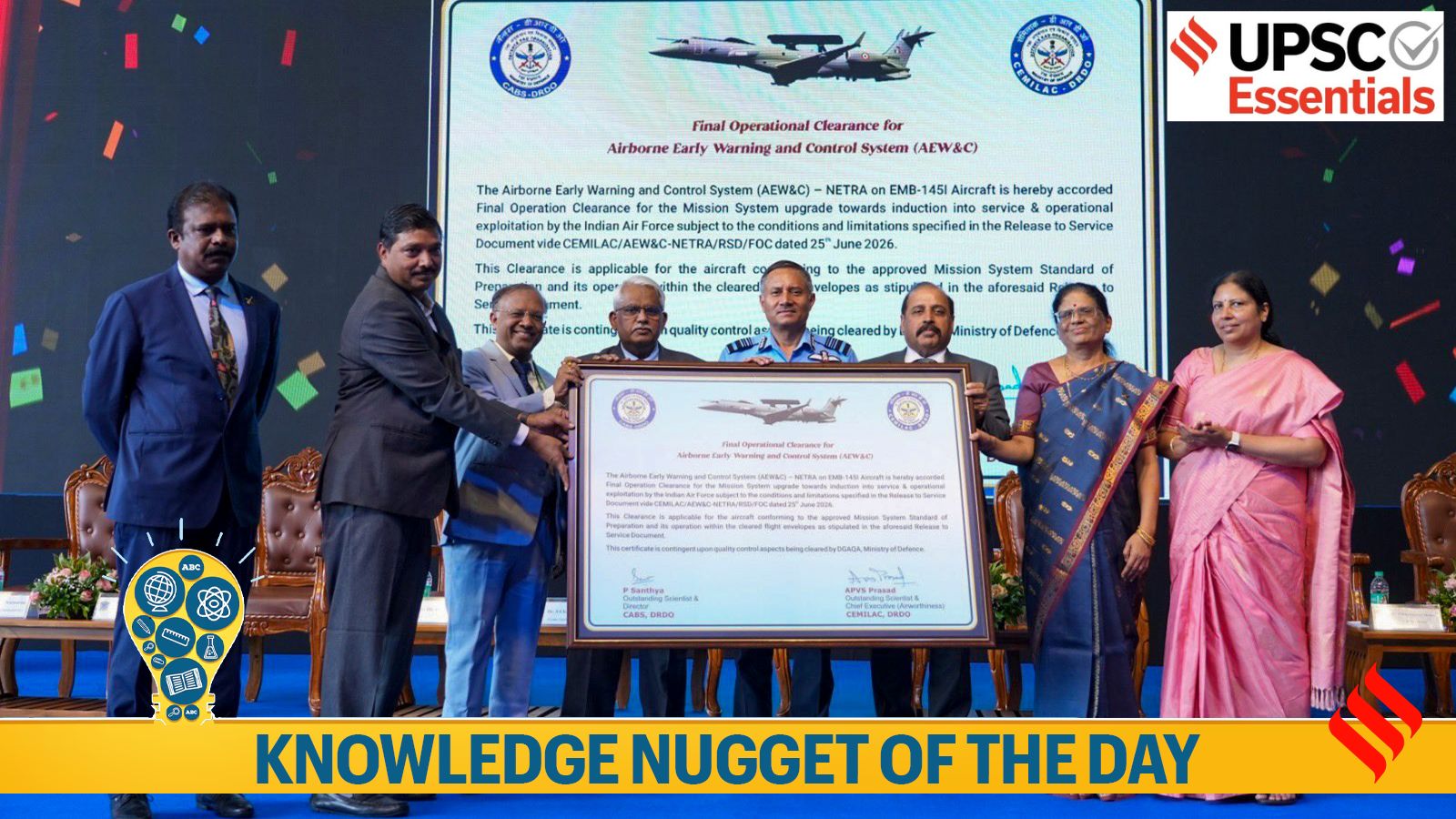
The indigenous ‘Netra’ Airborne Early Warning and Control (AEW&C) system achieved a significant milestone with the handing over of the Final Operational Clearance (FOC) to the Indian Air Force (IAF) by the Defence Research & Development Organisation (DRDO).
The clearance was awarded nearly eight years after Netra got Initial Operational Clearance (IOC) in October 2017, marking a notable step towards Aatmanirbhar Bharat in advanced aerospace and defence technologies.
1. The airborne radar and command centre will be an ‘eye in the sky’ for India — designed to detect incoming missiles, ships and planes from a long distance. It can provide real-time information for effective decision-making during crises.
2. According to DRDO, the AEW&C System consists of sensors mounted on an aircraft, for locating and providing early warning of airborne & sea surface targets and hostile emissions. The System also provides comprehensive information to the controllers on board the aircraft as well as to the ground stations.
3. The indigenous system has been in the works for nearly two decades, receiving its initial operation clearance in 2017.
4. Netra is equipped with an indigenously developed Active Electronically Scanned Array (AESA) radar in an Active Antenna Array Unit (AAAU) providing 240° radar coverage and detecting low-flying threats up to 375 km while mounted on two Embraer EMB-145 jets.
Story continues below this ad
5. The IAF also operates three Phalcon Airborne Early Warning and Control systems — integrating Israeli EL/W-2090 radar technology atop Russian Ilyushin Il-76 heavy-lift planes. These have a slightly higher range, providing 360-degree surveillance and tracking airborne targets up to 500 km.
6. The Deputy Chief of the Air Staff, during the ceremony, confirmed that Netra AEW&C was used during Operation Sindoor and Balakot strikes. The FOC is a step towards confirming that Netra has completed the required tests, changes, checks and approvals for its final accepted form.
How did the IAF strike the Jaish-e-Mohammad terror camp at Balakot?
1. In retaliation for the Pulwama terror attack of February 14, 2019, the IAF carried out a well-planned attack on the Jaish-e-Mohammad terror camp at Balakot on February 26, 2019 under the code-name Operation Bandar.
2. In the early morning of 26th February, IAF’s French origin Mirage-2000 fighter jets fired precision-guided munitions at the target location. These jets have a night vision-capable glass cockpit, upgraded navigation and IFF (identify friend or foe) systems, advanced multi-mode multi-layered radar, and a fully integrated electronic warfare suite.
Story continues below this ad
3. While a dozen Mirage-2000 were used, they were escorted by four Sukhoi Su-30 aircraft. The Russian origin aircraft, which forms the bulk of the IAF’s fleet, were deployed in an air defence role in case there was a need to respond to any action from Pakistan Air Force — but that never came.
4. The IAF, sources said, was able to beat Pak radars by employing the technique of “masking by hills” while flying, using two decoys to distract Pakistan Air Force and by flying low before pulling up to hit the target.
5. The Israeli Phalcon Airborne Warning and Control System (AWACS) and the indigenous Netra Airborne Early Warning and Control System Aircraft (AEW&C) aircraft, deployed to monitor the mission, showed that no aircraft was within 100 km while the operation was carried out.
6. The jets, which were also used successfully during the Kargil War, were armed with SPICE-2000 and Crystal Maze Mark2 also known as AGM 142 Popeye missile. Both these weapons gave the IAF the capability to hit the target with pinpoint accuracy.
Story continues below this ad
The Israeli-built Popeye is a medium-range conventional missile that can be fired from a stand-off distance of around 90 km, i.e., the aircraft doesn’t need to be vertically above the target to hit it.
SPICE (Smart Precise Impact and Cost Effective guidance kit)-2000 is a forward and tail kit evolved by Israel from the Popeye missile, mounted on a standard 2000-pound Mk 84 unguided bomb.
BEYOND THE NUGGET: Integrated Air Command and Control System (IACCS)
1. During Operation Sindoor, IACCS of the Indian Air Force brought all these elements together, providing the net-centric operational capability vital for modern warfare.
2. Developed by the public sector aerospace and defence electronics company Bharat Electronics Limited (BEL), IACCS is an automated command and control system that integrates data from all air defence assets, including ground-based radar, airborne sensors, civilian radar, communication nodes, and the various command and control centres of the IAF.
3. The availability of the consolidated dataset, along with real-time updates, provides military commanders at multiple levels with a comprehensive picture and overall situational awareness during air operations, so that they can respond to a wide range of aerial threats.
Story continues below this ad
4. The overlapping radar and radio data coverage of the IACCS helps in effective airspace management and reduces redundancy.
5. The Indian Army has a similar air defence control and reporting system called Akashteer, which connects the units of its air defence.
Post Read Question
Consider the following statements:
1. The air defence control system of the IAF is called Akashteer.
2. The Israeli-built Popeye is a medium-range conventional missile.
3. The indigenous ‘Netra’ Airborne Early Warning and Control (AEW&C) system is developed by ISRO.
4. The SPICE-2000 guided bomb is developed by Israel.
Which of the statements given above is/are correct?
(a) 1 and 3 only
(b) 2 and 4 only
(c) 2 and 3 only
(d) 1 and 4 only
Answer Key
(b)
Story continues below this ad
(Sources: Mirage, Awacs, Sukhoi, Popeye: How IAF took down Jaish training camp, drdo, Operation Sindoor | How India’s air defence shield works: Inside the IACCS command system)
Subscribe to our UPSC newsletter. Stay updated with the latest UPSC articles by joining our Telegram channel – IndianExpress UPSC Hub, and follow us on Instagram and X.
🚨 Click Here to read the UPSC Essentials magazine for June 2026. Share your views and suggestions in the comment box or at [email protected]🚨
View original source — Indian Express ↗
Related stories

The New York Times
TechnologyJun 27, 2026 · 1 min
Live Updates: Mideast Hostilities Flare, Testing Fragile U.S.-Iran Truce
The New York Times

Wired
TechnologyJun 27, 2026 · 1 min
Security News This Week: LastPass Users Had Their Data Stolen—Again
Wired

RFI
TechnologyJun 27, 2026 · 1 min
Marine biobanks: the science of 'stopping time' for an ecosystem under pressure
RFI

Indian Express
TechnologyJun 27, 2026 · 1 min
Midday meal row: As Bengal drops eggs, recalling Tamil Nadu’s century-long efforts to nourish schoolchildren
Indian Express