Mexico News Daily
Mexico City’s Morras on Sports collective is ready for its World Cup moment
When Elizabeth Santos and Natalia Bolaños first met during a sports photo shoot, they connected around being amateur athletes. But more importantly, they felt a kinship around the invisibility of women in sports in Mexico.
They began to strategize ways of bringing more attention to the issue and dreamed of creating spaces for women to enjoy sports in Mexico City in the way that their male counterparts have always seemed to be able to do. That was in 2021.
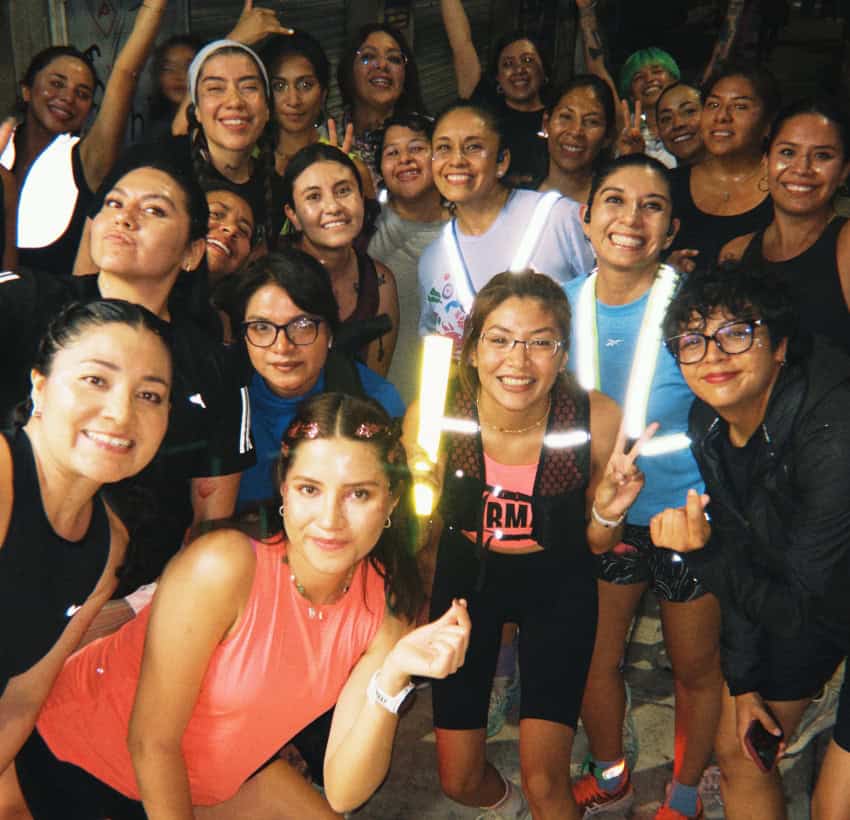
Five years later, they’ve manifested their shared vision with Morras On Sports — a sports and lifestyle collective for women (or, morras in Mexican slang) who regularly band together for night runs, soccer games, rock climbing and much more. Though they’re a year-round group, they’re particularly thrilled for the chance to showcase their brand during Mexico’s period as a World Cup host — which kicked off on June 11 and finishes on July 5.
How safety, inclusion and joy define Morras On Sports
Though loosely launched in 2021, Morras On Sports has been a gradual evolution for both Santos and Bolaños. Not until this year have they been able to make it a full-time gig, in which they split duties to continue growing their digital platform.
Santos handles design and brand identity, while Bolaños takes on editorial and public relations. Together, they’ve blossomed from hosting small gatherings with a few friends to drawing upwards of 50 participants for weekly events, which have expanded to include recreational activities outside of sports, such as dancing and dining together after finishing a competition.
The group’s mission is to develop an inclusive, informed and positive perspective on sports that encourages friendship for women who are seeking an outlet traditionally reserved for male participation and fandom. As the International Olympic Academy puts it, “Women are — to a greater or lesser degree — underrepresented among the populations active in sports.”
Addressing women’s underrepresentation
Even in 2026, though the perception around women in sports has seemingly shifted in the public eye, there is a significant lag between women and their male counterparts. A recent UNESCO report confirmed what many know firsthand: that “women and girls are still far from having equal access to sport at any level, professional or amateur.”
Enter Morras On Sport, who are particularly mindful of how women in Mexico have tragically endured higher-than-average rates of femicides, a crime that has steadily increased in number in the past decade. The crisis has been documented by the United Nations, which reported that the majority of perpetrators have gone unpunished, with exorbitant cases of impunity and injustice for murdered women in Mexico.
“We live in a country plagued by high levels of gender-based violence and femicides, and that inevitably affects how many women inhabit public spaces and experience activities as simple as going for a run,” Santos and Bolaños said.
The social dynamics of sports
“It’s important to understand that sporting itself isn’t negative; rather, sporting often reflects social dynamics that already exist outside of it. Therefore, it is important to take a critical look at how we experience sports and the violence that can arise around them,” the duo said. “In Mexico, for example, various studies have indicated that after defeats by certain popular [professional sports] teams, cases of domestic violence can increase. This demonstrates that the problem is not the sport itself, but rather the behaviors and social structures that some people reproduce both within and outside of these spaces.”
Together, Morras On Sports is working to deconstruct those norms, encouraging women to enjoy sports and exercise around the nation’s capital city despite the alarming trends and statistics that might otherwise deter them.
The World Cup as a communal experience for women in CDMX and beyond
Of course, with the World Cup in town, the chance to celebrate a collective love of sports, particularly through soccer, is opportune.
“We believe that the World Cup represents a very important opportunity for more women to approach football from a place of excitement, curiosity and belonging,” Santos and Bolaños said. “For us, it’s exciting to think about all the girls who will be able to get together to play, watch games, chat and experience the passion for this sport together.
“Historically, women have been excluded from many spaces related to football, both professionally and culturally. Many of us grew up thinking that football [soccer] wasn’t for us, or associating it solely with masculine or even aggressive environments.”
For the pair, who both grew up in Mexico participating in sports but have long felt a lack of support for women who play, what they’re offering is more than just kicking a ball around. They’re offering social representation, creative expression and friendship:
“We’re interested in talking about football not only from a sporting perspective, but also from the perspectives of fashion, history, culture, identities, inspiration and the experiences surrounding the game,” they said.
“Something we find very important is that more and more women can feel that football is for them, too. That they can enjoy it, understand it and analyze it from technical, tactical, cultural and historical perspectives without feeling they need validation,” they said.
World Cup jersey runs and collaborations
Aside from their regular programming of run clubs, pick-up games and hangouts, they’ve planned special touches, like a World Cup jersey run, in which women participants wear the kits of their favorite soccer teams, giving them the chance to discuss fandom, favorite players and favorite soccer moments. They are also gearing up to host jersey customization workshops and watch parties.
Outside of soccer, they’ve also organized interdisciplinary activities like a “Run and Embroidery,” event, dinner and DJ hangouts, group bike rides, ultimate frisbee gatherings and more.
The group isn’t solely for women who are top athletes either. It’s an invitation for women and girls of various ages, body types and skill levels who are merely interested in exploring an athletic connection — whether it’s for the first time or as the continuation of a lifelong passion.
Currently, they are collaborating with Soy Corredora, one of the largest women’s running clubs in Mexico City, with nearly 200,000 followers on Instagram. Their joint run is expected to have 100 or more women participants and will help to amplify their messaging around access, equality and connectivity through exercise.
“We know that a single run won’t change the reality of the streets, but we do believe in the value of creating collective efforts where we can feel more supported, visible and safe among each other,” the duo says. “Being able to run together at night, enjoy the city, move around without constant fear and feel that we don’t have to be constantly looking over our shoulders can be profoundly meaningful for many women.”
Women’s participation in sports is growing
Groups like Morras on Sports are having a greater impact, though. According to a recent report by Mexico’s national statistics agency INEGI, Mexican women’s physical activity and sporting participation has shown gradual growth.
“In 2025, between 37% and 40% of women reported engaging in some type of physical or sporting activity, depending on the methodology and age range used in the measurements. Although a significant difference compared to men still exists, the gap has begun to narrow gradually,” INEGI wrote.
Proof of this seems to be found in the story of the Mexican women’s soccer league, Liga MX Femenil — which is still relatively young, debuting in 2017. Nevertheless, attendance and viewership of the league’s games have been consistently growing. Last month, the league’s leadership reported that Liga MX Feminil had a viewership of 67.8 million throughout 2025 — the highest women’s soccer league viewership numbers worldwide. The league surpassed the viewership numbers of older women’s leagues such as the Barclays Women’s Super League and Germany’s Frauen Bundesliga.
Using everyday experiences to transform culture
Morras On Sports is clear, however, that their focus isn’t necessarily on women in professional sports, but more creating more everyday experiences with sports for average women — as both participants and fans. The World Cup, and the cultural activities that will spring up all around its peripheries, is one chance to solidify that focus.
“We believe it is important to understand that the growth of women’s sports is not only reflected in professional figures or television audiences,” said Santos and Bolaños. “From our experience, we see more and more women interested in getting involved in sports from amateur, collective and community spaces: women who start running, playing soccer, climbing, cycling or participating in sports activities because they are finally finding communities where they feel comfortable practicing it despite age, technique or physical condition. For us, this cultural transformation is a very important way to measure the growth of women’s sports in Mexico.”
Alan Chazaro is the author of “These Spaceships Weren’t Built For Us” (Tia Chucha Press, 2026), “Notes from the Eastern Span of the Bay Bridge” (Ghost City Press, 2021), “Piñata Theory” (Black Lawrence Press, 2020), and “This Is Not a Frank Ocean Cover Album” (Black Lawrence Press, 2019). He is a graduate of June Jordan’s Poetry for the People program at UC Berkeley and was selected as a Lawrence Ferlinghetti Poetry Fellow at the University of San Francisco. His work can be found in NPR, The Guardian, SLAM, GQ, L.A. Times, and more. He is currently based in Veracruz.
View original source — Mexico News Daily ↗
Related stories

ESPN
SportsJun 27, 2026 · 1 min
Grades for every team eliminated from the World Cu...
ESPN

TASS
SportsJun 27, 2026 · 1 min
RFU president says he is satisfied with how Russian team’s coach Karpin does his job
TASS

Al Jazeera
SportsJun 27, 2026 · 1 min
Cape Verde break record as smallest nation to reach World Cup knockouts
Al Jazeera
Euronews
SportsJun 27, 2026 · 1 min
2026 FIFA World Cup: Which third-place teams will reach the knockout stage?
Euronews