Indian Express
UPSC Key: Horticulture scheme, Indian diaspora in Seychelles and Genocidal intent
Preliminary Examination: Current events of national and international importance
Mains Examination: General Studies-II: Government policies and interventions for development in various sectors and issues arising out of their design and implementation.
What’s the ongoing story: Express Investigation: Bhagirath Choudhary is Minister of State in the Union Ministry of Agriculture and Farmers’ Welfare. An investigation by The Indian Express reveals that he received the subsidy three months ago through a scheme under his own ministry and approved by a board in which he is ex-officio Vice-President.
Key Points to Ponder:
— What is the Mission for Integrated Development of Horticulture (MIDH)?
— What is horticulture?
— What is commercial farming?
— What is the significance of horticulture?
— What are the schemes of the Union government for promoting horticulture?
— What is the National Horticulture Mission?
— What is the share of horticulture in India’s agriculture?
— What do you understand about conflict of interest?
— What is the process of dealing with corruption charges against the minister?
— What are the major schemes related to agriculture in India?
Key Takeaways:
— The scheme to promote “commercial farming” — on a large scale for profit — of select vegetables and flowers comes under Mission for Integrated Development of Horticulture (MIDH), which was launched in 2014-15 and is administered by the National Horticulture Board (NHB), an autonomous organisation under the administrative control of Choudhary’s Ministry.
— The initiative offers a maximum subsidy of 50 per cent, capped at Rs 1 crore per family, of the project cost for farming capsicum, cucumber and tomato, and eight varieties of flowers, including rose, anthurium and orchids.
— Choudhary’s project for cucumber cultivation across 16,592 sq m is one of 467 approved by NHB in 2025 under the scheme titled “Development of Commercial Horticulture through Production and Post-Harvest Management of Horticulture Crops”.
— According to NHB’s official website, its activities are managed by a Board of Directors headed by the Union Agriculture Minister as ex-officio President, with the Union MoS for Agriculture as ex-officio Vice-President.
— Agriculture Minister of State Bhagirath Choudhary received a Rs 99 lakh government subsidy for his Rajasthan cucumber farm — from a scheme run by a board he heads as ex-officio Vice-President.
— A signboard at his Peeh village farm proudly displays the NHB assistance, but omits that the beneficiary is the very minister overseeing the funding body.
— Choudhary financed his Rs 1.99 crore project with a Rs 1.49 crore HDFC Bank loan, into which the subsidy was directly credited just weeks after final NHB clearance in March 2026.
— In-principle approval arrived in just 14 days after application — though the scheme requires on-site joint inspections before any clearance is granted.
— His PMO asset declaration, filed a month before approval, lists his Peeh farmland but makes no mention of the pending NHB project; an aide says it “will be disclosed.”
— Choudhary did not respond to The Indian Express questionnaire on whether the subsidy constituted a conflict of interest.
Do You Know:
— ‘Development of Commercial Horticulture through Production and Post-Harvest Management of Horticulture Crops’ is a sub-scheme under National Horticulture Board’s Mission for Integrated Development of Horticulture (MIDH).
— Its purpose is to promote commercial farming (for profit) of horticultural crops on a large scale. The crops under the scheme are three types of vegetables: capsicum, cucumber and tomato; and eight varieties of flowers: anthurium, orchid, rose, lilium, chrysanthemum, carnation, gypsophila and gerbera.
— Upto 50 per cent of the project cost, capped at Rs 1 crore per family, is available as subsidy under the scheme.
— Beneficiaries: Individuals, self-help groups, associations or groups of growers, trusts, cooperative societies, companies, farmer producer organisations, cooperative marketing federations, agricultural produce marketing committees, marketing boards, municipal corporations, agro-industries corporations, state agriculture universities and R&D organisations.
Other Important Articles Covering the same topic:
📍Minister got subsidy, under own ministry’s scheme: How projects are cleared – Explained
📍Among beneficiaries of Centre’s scheme: wife, son, mother of IAS officer
Previous year UPSC Mains Question Covering similar theme:
Assess the role of the National Horticulture Mission (NHM) in boosting the production, productivity and income of horticulture farms. How far has it succeeded in increasing the income of farmers? (UPSC CSE 2018)
Rajasthan C-sec deaths: Centre seeks report after WHO asks for info
Syllabus:
Preliminary Examination: Current events of national and international importance.
Mains Examination: General Studies-II: Issues relating to development and management of Social Sector/Services relating to Health, Education, Human Resources.
What’s the ongoing story: The Union Health Ministry has asked the Rajasthan government for a detailed report on women developing complications following caesarean operations across several government hospitals in the state, with some resulting in casualties.
Key Points to Ponder:
— What is oxytocin?
— What is the role and function of the Central Drugs Standard Control Organisation (CDSCO)?
— What is the mechanism of drug regulation in India?
— How are licenses provided for drug production?
— What are the potential causes of inadequate safety standards of drugs?
— What are the impacts of ineffective regulations?
— What steps need to be taken to address it?
Key Takeaways:
— Sources said the ministry sent a note after the World Health Organization (WHO) sought information from the Indian government on the possible link of spurious oxytocin to the cases. The WHO sought information to ascertain whether the issue was localised, or more widespread, with potential risk at other locations, the source said.
— Several maternal deaths have been reported from Kota, Bikaner, and Jodhpur over the last couple of months. The women suffered fatal complications, including kidney failure and severe infections, following caesarean sections and routine deliveries.
— Investigation suggested that the Kota fatalities were linked to the use of fake or substandard oxytocin — a critical drug used to induce labour before a delivery and to contract the uterus for preventing blood loss after it.
— Many of the women who died or developed complications in Rajasthan saw excessive blood loss. Tests indicated the drug lacked active pharmaceutical ingredients. However, the deaths in Bikaner are being linked to unsanitary conditions, lack of fumigation in operation theatres, and poor infection control as major contributing factors.
— The Centre’s action followed after the Rajasthan government and the top drug regulator in the country cancelled licences of a Kota-based wholesale drug distributor of oxytocin and two factories manufacturing the drug in Punjab and Himachal, respectively.
— Sources said inspections had discovered widespread irregularities, including the absence of evidence of key tests regarding drug purity and proof of data fudging.
— In the latest case, eight women who underwent C-sections at the District Government Hospital in Paota, Jodhpur, on June 20 fell ill after surgery. Two of them who developed complications were moved to AIIMS, Jodhpur, and all are stable now.
— The WHO, as part of its global surveillance of medical products, usually reaches out to the national drug regulators for information on any spurious or harmful drug whenever there are such reports. It also raises alert when there is a likelihood of these products crossing national borders.
— In the first week of June, the Central Drugs Standard Control Organisation (CDSCO) held a joint inspection of the manufacturing units in Punjab and Himachal of Jackson Laboratories, the manufacturer of the oxytocin that is under a cloud in Rajasthan, along with the regulators of the two states.
— On Tuesday, the Rajasthan Drug Control Department cancelled the wholesale drug licence of Kota-based pharma distributor Rajasthan Medical Hall, over the alleged sale of thousands of spurious oxytocin injections and other irregularities.
Do You Know:
— Oxytocin, also known as the ‘love hormone’, is a hormone secreted by the pituitary glands of mammals during sex, childbirth, lactation or social bonding. However, it can also be chemically manufactured and is sold by pharma companies for use during childbirth. It is administered either as an injection or a nasal solution.
— “It is a practice to give oxytocin during a C-section as these contractions are essential to reduce bleeding after childbirth and prevent postpartum haemorrhage, one of the leading causes of maternal mortality worldwide. It also stimulates breast milk production,” said Dr Swati Ajit Gaikwad, consultant, obstetrician and gynecologist, Motherhood Hospital, Kharadi, Pune.
— During a normal vaginal birth, the body releases significant amounts of natural oxytocin in response to labour. However, during a C-section, especially under spinal or epidural anaesthesia, this natural hormonal response may not be sufficient.
Other Important Articles Covering the same topic:
📍Why oxytocin is vital in C-sections, and how fake doses can kill
📍Explained: What is Oxytocin and why does the govt want to ban its commercial use?
Previous year UPSC Prelims Question Covering similar theme:
(1) Which of the following are the reasons for the occurrence of multi-drug resistance in microbial pathogens in India? (UPSC CSE 2019)
1. Genetic predisposition of some people
2. Taking incorrect doses of antibiotics to cure diseases
3. Using antibiotics in livestock farming
4. Multiple chronic diseases in some people
Select the correct answer using the code given below.
(a) 1 and 2
(b) 2 and 3 only
(c) 1, 3 and 4
(d) 2, 3 and 4
EXPLAINED
From 5 Indians to 5% of population: Diaspora key to Seychelles ties
Syllabus:
Preliminary Examination: Current events of national and international importance
Mains Examination: General Studies-II: Bilateral, regional and global groupings and agreements involving India and/or affecting India’s interests
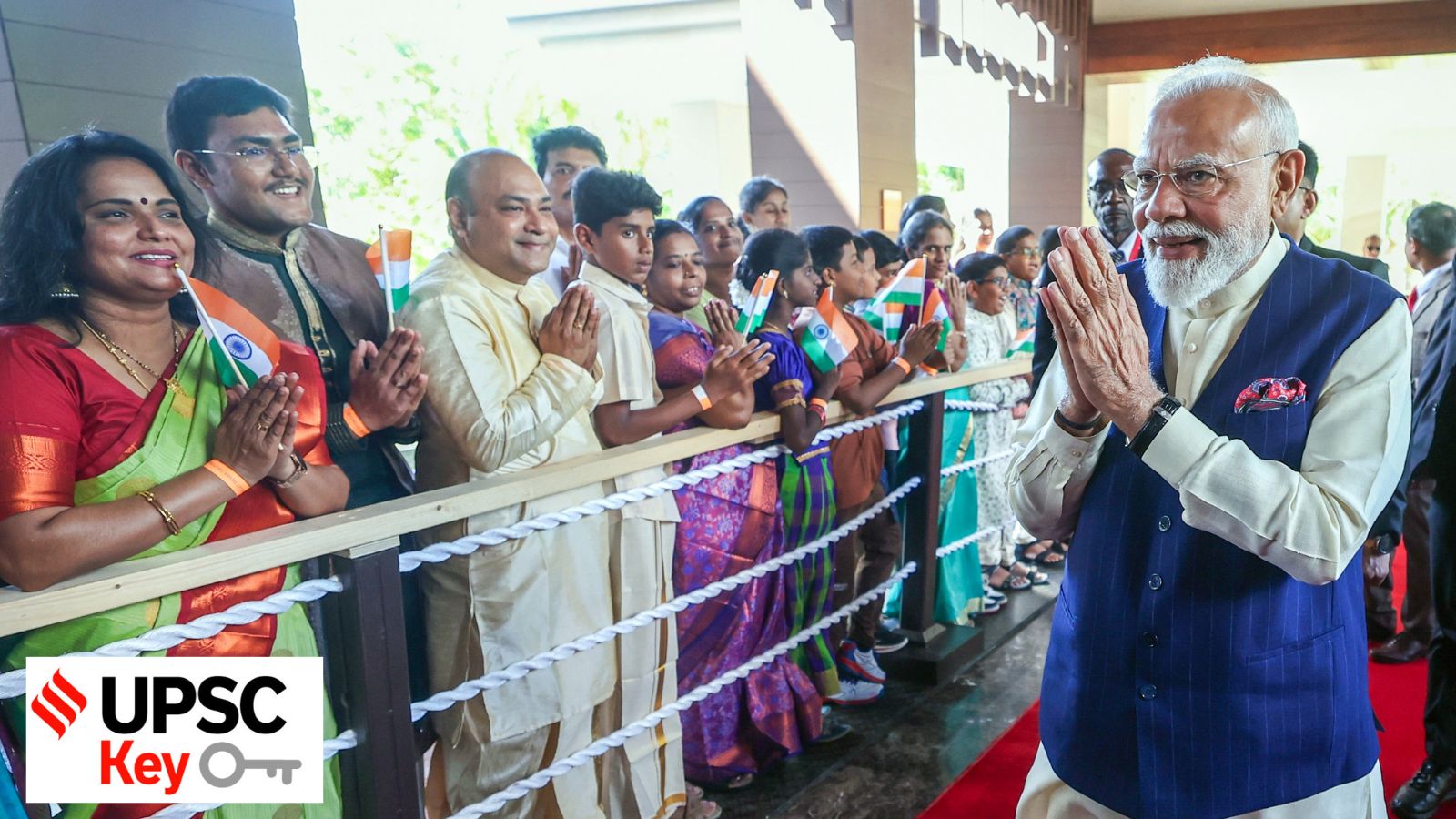
What’s the ongoing story: It was in 1770 that five Indians landed in Seychelles as plantation workers, along with seven African slaves and 15 French colonists, recorded as the first inhabitants of the Islands located in the Indian Ocean. Today, persons of Indian origin comprise 5% of the island nation’s population.
Key Points to Ponder:
— What is diaspora?
— What is the significance of diaspora for India?
— Know about the location of Seychelles
— What are the areas of cooperation between India and Seychelles?
— Know about SAGAR and MAHASAGAR
— What is Pravasi Bharatiya Samman?
— What are the steps taken by the Indian government to strengthen its ties with the diaspora?
— How has the diaspora acted as a soft power in the past?
Key Takeaways:
— As Prime Minister Narendra Modi heads to Seychelles on a three-day visit beginning Saturday, here is a look at the ties that bind the two countries located 4,000 km apart.
— It was from the 20th century that a constant flow of Indians, mostly from Tamil Nadu, Puducherry and later Gujarat, came to reside in Seychelles as traders, labourers, and construction workers.
— In fact, during the British colonial period, Seychelles was governed from the Bombay Presidency for some time, with regular shipping and flow of goods from India. These trade links facilitated the migration of an Indian trading community looking for greener pastures, having reached a saturation point in East Africa.
— The number of Persons of Indian Origin (PIOs) with Seychelles citizenship is estimated at around 6,000 presently, which is significant in a country with a population of about 120,000. A majority belong to the Gujarati and the Tamil communities.
— When Seychelles attained freedom on June 29, 1976, a contingent from the Indian Naval Ship, INS Nilgiri, took part in the Independence Day celebrations. This year, as PM Modi is attending the 50th Independence Day celebrations as the Guest of Honour, an Indian Armed Forces contingent and two Indian Navy ships are participating as well.
— Diplomatic ties were established with Seychelles in 1976. Earlier this year, Modi also described Seychelles as a key part of India’s maritime policy — Vision MAHASAGAR (Mutual and Holistic Advancement for Security and Growth Across Regions).
— In 2015, the Pravasi Bharatiya Samman Award was conferred on Justice D Karunakaran of the Supreme Court of Seychelles, becoming the second recipient from the country after V Ramadoss (2006), an entrepreneur and medical advisor to the Seychelles President.
— PM Modi had earlier visited Seychelles in 2015, while the first Indian PM to visit Seychelles was Indira Gandhi in 1981. During his three-day visit, Modi will address the National Assembly of Seychelles and interact with members of the Indian community.
— Beyond cultural relations, India has emerged as one of Seychelles’ most trusted development partners through grants, concessional credit and capacity-building initiatives. More than 1% of Seychelles’ population has received professional training in India.
Do You Know:
— The island republic of Seychelles is located in the western Indian Ocean. Seychelles is situated between 4° and 11° S latitude and 46° and 56° E longitude. The major islands are about 1,000 miles east of Kenya and roughly 700 miles northeast of Madagascar. Victoria, the capital, is on Mahé Island.
— Victoria is the capital city of the Republic of Seychelles. It is situated on the northeastern coast of Mahé Island, which is the largest in the Seychelles archipelago. It stands as the sole port and the only town of significant size within Seychelles, accommodating more than one-fourth of Mahé Island’s population .
Other Important Articles Covering the same topic:
📍PM Modi to be Guest of Honour at Seychelles 50th National Day
Previous year UPSC Mains Question Covering similar theme:
The Indian diaspora has a decisive role to play in the politics and economy of America and European Countries”. Comment with examples. (UPSC CSE 2020)
What a ‘right to walk’ can look like for India
Syllabus:
Preliminary Examination: Indian Polity and Governance
Mains Examination: General Studies II: Indian Constitution—historical underpinnings, evolution, features, amendments, significant provisions and basic structure.
What’s the ongoing story: Last week, the Supreme Court recognised walking on demarcated footpaths as a fundamental right and urged the government to introduce a law that declares this right. The two-judge bench’s ruling came in a case involving the death of a schoolboy in a road accident.
Key Points to Ponder:
— Know about important Supreme Court judgments that have expanded the scope of Fundamental Rights.
— What are the Fundamental Rights?
— What are the constitutional articles related to it?
— What are the reasons for the highest road accidents in India?
— What steps need to be taken to address it?
Key Takeaways:
— India has the dubious distinction of having the world’s highest road accident fatalities. The court identified this as the result of the exclusion of pedestrians in the way roads are built.
— The issue of road safety is a type of “elite capture”, in which the use of public infrastructure by wealthier people is privileged over the needs of others. Pedestrians and cyclists (along with two-wheeler and public transport users) are more likely to be road accident victims than private car users.
— These social divisions are exacerbated by the lack of safe roads. This absence worsens poorer peoples’ quality of life and prospects, constrains children’s access to school and playtime, and deprives adults of the health and well-being effects of walking in wealthier neighbourhoods.
— It is in this context that the right to walk needs to be considered — not just as something to be expected as a part of how roads are built, but rather as a fundamental right guaranteed through the right to “move freely through the territory of India” and the “right to life” under Articles 19(1)(d) and 21 of the Constitution.
— For the right to walk to be truly meaningful, people must be at its centre. This requires an enabling institutional framework rather than narrow infrastructure-driven solutions that may be slow to implement.
— The right to walk should not come at the cost of making people poorer, or by closing off avenues of everyday commerce, rest and refreshment. Social interactions and the exchange of news and views are all part of the life of pavements.
— The presence of vendors and shade-giving trees on the roadside might seem inconvenient from an engineering point of view, but they are necessary accompaniments of our street life. Ideally, they should coexist alongside the pedestrian right-of-way.
— The Supreme Court’s intervention on this issue nudges us in a different direction, to think about how walking as a fundamental right can be made mainstream and local. For this, it should be achievable within available budgets and resources. Perfect design-led solutions may have to be sacrificed for making conditions safer and more comfortable for pedestrians on every kind of street.
— There is a legal and institutional vacuum around the issue of walkability. The Motor Vehicles Act, 1988 imposes duties on motorists vis-à-vis pedestrians, but it is primarily a law for motor vehicles and cannot secure the public rights of pedestrians.
— In cities such as Bhubaneswar and Indore, one can see that walkability has improved in some areas because of recent efforts to improve pavements. These examples encourage us to think about how the right to walk can be integrated into the everyday work of municipalities, in the manner that the Supreme Court might have envisaged.
Do You Know:
— The Supreme Court on 19th June held that the right to walk on secured footpaths is a fundamental right and urged the government to bring a law that declares this right and recognises the duty of municipal authorities and local bodies to build, demarcate, and maintain necessary pedestrian infrastructure.
— The Bench held that the right to walk is integral to the right to movement guaranteed under Article 19(1)(d), read with Article 19(1)(a), Article 19(1) (b), Article 19(1) (c) and Article 21 of the Constitution of India. The fundamental right to walk will take within its sweep the right to demarcated footpaths.
— It further added that “the violation of the right to walk on demarcated footpaths will entitle the citizens to invoke constitutional and legal remedies against duty bearers for restitution and compensation. This remedy is independent of the remedies that are available under the Motor Vehicles (MV) Act, 1988.”
Other Important Articles Covering the same topic:
📍Supreme Court declares right to walk on safe footpaths a fundamental right, seeks law
UPSC Prelims Previous years Question Covering similar theme:
(2) ‘Right to Privacy’ is protected under which Article of the Constitution of India? (UPSC CSE 2021)
(a) Article 15
(b) Article 19
(c) Article 21
(d) Article 29
UPSC Mains Previous year Question Covering similar theme:
National Urban Transport Policy (NUTP) emphasises on ‘moving people’ instead of ‘moving vehicles’. Discuss critically the success of the various strategies of the Government in this regard. (UPSC CSE 2014)
‘Genocidal intent’: The implications of a UN panel report for cases against Israel
Syllabus:
Preliminary Examination: Current events of national and international importance
Mains Examination: General Studies-II: Important International institutions, agencies and fora- their structure, mandate
What’s the ongoing story: In a report released Tuesday (June 23), a United Nations Human Rights Council (UNHRC) commission of inquiry said that Israel has deliberately targeted Palestinian children in Gaza, documenting a pattern of acts to establish genocidal intent.
Key Points to Ponder:
— What is genocide?
— Know about the issue between Israel and Palestine
— What is the role and function of the UNHRC?
— What is the recent peace deal and how successful has it been?
— What is the International Criminal Court (ICC)?
— How is it different from the International Court of Justice (ICJ)?
— What is the UN Genocide Convention?
Key Takeaways:
— The commission called children “not just part of a population” but whose survival was “central to the existence and continuity of the Palestinian group”. It said: “The sheer number of cases investigated and documented by the commission showing a clear pattern that children were directly targeted by the Israeli security forces constitutes a key element in the Israeli authorities’ genocidal intent to destroy the Palestinian group in Gaza.”
— The report has been released by the UN Independent International Commission of Inquiry on the Occupied Palestinian Territory, including East Jerusalem, and Israel. The commission was established in May 2021 through a UNHRC resolution as an independent body to follow up on the conditions in the occupied Palestinian territory. It is mandated to submit annual reports.
— The commission is currently chaired by S Muralidhar of India, who retired in 2023 as the Chief Justice of the Odisha High Court. Apart from Muralidhar, the commission has Florence Mumba of Zambia and Chris Sidoti of Australia as members.
— The commission cited instances to describe what it called “the intentional killing of Palestinian children through airstrikes in populated areas”. As part of the inquiry process, it interviewed medical practitioners who reported a consistent pattern of children with single gunshot wounds inflicted by quadcopters or snipers, and reviewed photos, videos, CT scans and X-rays provided by them.
— The report highlighted that the October 2025 ceasefire between Israel and the Palestinian militant group Hamas did not stop the violence. There have been increasing killings of Palestinians, including children, near the “yellow line” — this refers to an Israel-declared security buffer zone that cuts north-to-south through the Gaza Strip.
— The report also discussed the torture of children during arrests and detention, including “rape, threats of rape, sexual assault, violence to the genitals, forcible stripping and humiliating acts”.
— The commission urged Israel to halt military operations in Gaza, return the bodies of deceased children, and adjudicate incidents involving children in special courts, among other things. Israel, however, dismissed the report, calling it “libellous sham” and “defamatory”.
— In September 2025, the commission, then chaired by Navi Pillay of South Africa and comprising Miloon Kothari of India and Chris Sidoti of Australia as members, had reached similar conclusions on genocidal intent.
— For the UN Security Council and the UN General Assembly, the commission has suggested that they prohibit all two-way military-related trade involving Israel and apply enforcement measures, if necessary. Jaswal said that these enforcement measures could be a resolution condemning Israel, economic sanctions, cutting the country off diplomatically, or a select few countries coming together to take action against Israel.
— For UN member states, the commission has recommended that they cease the transfer of arms that “have involved or could involve the commission of genocide”, arrest any Israeli officials against whom the ICC has issued arrest warrants, among other things.
From the Editorial Page: India remains silent on Gaza, the world continues to speak up
— Sonia Gandhi writes: Despite this clear genocidal intent, the support of President Donald Trump’s government in Washington DC has enabled the Israeli government to continue its brutal campaign against Palestinians. But the rest of the world has felt the pricking of its conscience.
— The UN has been unable to act with any resolve due to American obstruction, but through its agencies it has played a stellar role in the documentation of Israeli war crimes.
— Amidst the growing public backlash against Israel and the international community’s cognisance of the unjustifiable brutality unleashed on Gaza, India remains a lone voice of silence. Justice Muralidhar’s report, which has sparked renewed conversation and activism against the Gaza genocide, has been met with stony silence from the Narendra Modi government.
— The spirit of Indian nationhood demands that we speak up for our Palestinian brothers and sisters whose children have been so brutally targeted. The calculus of national interest demands that we respond to the global public opinion against the Israeli regime’s genocidal actions in Gaza and its brutal displacement and dispossession of lakhs of Palestinian families in the occupied West Bank.
Do You Know:
— The UN Genocide Convention, under Article II, defines genocide as “any of the following acts committed with intent to destroy, in whole or in part, a national, ethnical, racial or religious group, as such:
1. Killing members of the group;
2. Causing serious bodily or mental harm to members of the group;
3. Deliberately inflicting on the group conditions of life calculated to bring about its physical destruction in whole or in part;
4. Imposing measures intended to prevent births within the group;
5. Forcibly transferring children of the group to another group.”
— Genocide is defined in the same terms in the Rome Statute of the International Criminal Court (ICC) under Article 6, as well as in the statutes of other international and hybrid jurisdictions.
— While a UN commission does not have the power to impose legal penalties, its findings can be used by international courts as documentary evidence. Noah Weisbord, associate professor of law at McGill University in Montreal, Canada, told The Indian Express that the report adds to the growing body of evidence of “genocidal intent” in cases against Israel.
Other Important Articles Covering the same topic:
📍Why ICJ ruling on climate change is important for your UPSC exam
📍Conflicts in West Asia: A brief history of the Israel-Palestine conflict
THE IDEAS PAGE
A passport that doesn’t count, a narrowing idea of citizenship
Syllabus:
Preliminary Examination: Indian Polity and Governance-Constitution, Political System, Panchayati Raj, Public Policy, Rights Issues, etc.
Main Examination: General Studies II: Indian Constitution—historical underpinnings, evolution, features, amendments, significant provisions and basic structure.
What’s the ongoing story: Faizan Mustafa writes: Citizenship is a vertical relationship between the individual and the state. Originally, citizenship used to signify a belief in certain liberal and republican ideas and did not have much to do with territory and status. Today, it is all about territory, status, and exclusion rather than inclusion.
Key Points to Ponder:
— What are the constitutional provisions related to citizenship in India?
— Who is a citizen of a country?
— What are Foreigners’ Tribunals?
— Why is a passport not a proof of citizenship?
— What are the important Supreme Court judgements related to citizenship and passport?
— What is the Citizenship Amendment Act, 2019 (CAA)?
Key Takeaways:
— The Foreigners’ Tribunals in Assam reportedly denied citizenship to people despite some possessing as many as 15 documents. The judiciary, too, has become quite restrictive in this regard.
— B R Ambedkar said that the citizenship provisions of the Constitution had given the Constitution’s Drafting Committee “a headache” and he did not “know how many drafts were prepared and how many were destroyed”.
— After the Citizenship Amendment Act, 2019 (CAA), citizenship became the most important subject not only for law students but for the masses. Though the government enacted the CAA with great alacrity, it took five years to notify its rules, just prior to the 2024 general elections.
— The SC, in its Bihar SIR judgment, held that the passport is “conclusive proof” of citizenship. The latest clarification by the Ministry of External Affairs (MEA) has explicitly said that it is nothing more than a travel document. Strictly in terms of the law and judgments, the MEA is correct.
Who is an Indian citizen?
— Article 5, on the commencement of the Constitution, conferred citizenship on everyone born in India. Article 11 empowers Parliament to regulate citizenship by law, and thus the Citizenship Act was passed in 1955. The Act has so far been amended six times, but major amendments were made in 1986, 2003, and 2019.
— Parliament, over the decades, has narrowed the universal principles of citizenship incorporated in Article 5.
— Unlike the original Citizenship Act, which gave citizenship on the principle of jus soli or by birth, the 1986 amendment was less inclusive as it added the condition that, in addition to one’s own birth in India, one can get citizenship only if either parent was an Indian citizen at the time of birth.
— By 2003, an amendment under the Vajpayee government added that either both the parents should be Indian citizens or one parent must be an Indian citizen and the other should not be an illegal migrant.
— With these restrictive amendments, India has almost moved towards the narrow principle of jus sanguinis — blood relationships become more important than one’s birth on Indian soil.
— Since passports and voter ID cards can be issued only to citizens, why is there no presumption of citizenship? Is this not an official act? Many of us have experienced police verification and local intelligence officers’ enquiries prior to the issuance of passports. Passport, voter ID, etc., require governmental satisfaction about one’s citizenship.
— During the SIR, the Election Commission insisted on certain documents and arbitrarily excluded Aadhaar and its own voter ID card, which the Supreme Court did not find problematic. But none of the documents included was a proof of citizenship.
— The proof of citizenship should be demanded only from those who are caught while crossing over to India, or a foreigner found in India with a passport of another country, or those born abroad. For anyone born in India, there must be a presumption of citizenship, and voter ID and a passport must be taken as conclusive proof of citizenship.
Do You Know:
— Passport is a travel document, not a proof of citizenship, the Ministry of External Affairs has said. Even though it is issued only to Indian citizens, it is not a document that establishes citizenship, officials clarified.
— Given that a passport is issued only to Indian citizens and is accepted abroad, in practice, it is among the strongest pieces of evidence that a person is an Indian citizen.
— However, legally, its status as a citizenship document is complicated by the Passports Act itself. Section 20 of the Act empowers the Central government to issue a passport or travel document even to a person who is not an Indian citizen if it considers such issuance necessary in the public interest.
— Historically, Tibetan refugees and Sri Lankan Tamils in India have been issued special travel documents by Indian authorities when visiting foreign countries, sources said. In 2023, the madras High Court asked the government to grant a passport to a Sri Lankan Tamil Refugee under Section 20 of the Passport Act.
— The principle is common across democracies. In the UK and US, too, passports are issued because the state has already determined that a person is a citizen; they do not themselves create citizenship. The difference is that both countries have more robust civil registration systems and, for naturalised citizens, formal citizenship certificates that serve as primary legal proof.
Other Important Articles Covering the same topic:
📍Passport fees to increase from July 1: Why the government has raised charges now
📍How citizenship was decided by makers of Indian Constitution
📍Passport isn’t proof of citizenship. Was the NRC supposed to be?
Previous year UPSC Prelims Question Covering similar theme:
(3) With reference to India, consider the following statements: (UPSC CSE 2021)
1. There is only one citizenship and one domicile.
2. A citizen by birth only can become the Head of State.
3. A foreigner once granted the citizenship cannot be deprived of it under any circumstances.
Which of the statements given above is/are correct?
(a) 1 only
(b) 2 only
(c) 1 and 3 only
(d) 2 and 3 only
Previous year UPSC Mains Question Covering similar theme:
“Right of movement and residence throughout the territory of India are freely available to the Indian citizens, but these rights are not absolute.” Comment. (UPSC CSE 2022)
ALSO IN NEWS
Telegram key platform for drug ads, Myanmar route a concern: NCB
Encrypted messaging platforms such as Telegram, WhatsApp and Signal have become major channels for drug trafficking worldwide, including in India. Of these three, Telegram has emerged as a key platform for drug-related advertising, according to the Narcotics Control Bureau’s Annual Report 2025 released Friday.
According to the report, released by Union Home Minister Amit Shah, Telegram has become a prominent drug advertising platform, with public channels offering product listings, pricing and delivery details to large subscriber bases.
PRELIMS ANSWER KEY
1. (b) 2. (c) 3. (a)
Subscribe to our UPSC newsletter. Stay updated with the latest UPSC articles by joining our Telegram channel – IndianExpress UPSC Hub, and follow us on Instagram and X.
🚨 Click Here to read the UPSC Essentials magazine for June 2026. Share your views and suggestions in the comment box or at [email protected]🚨
View original source — Indian Express ↗
Related stories
Indian Express
TechnologyJun 27, 2026 · 1 min
Subsidy diverted for 3 years: Farmer after glitch leaves two with same Aadhaar number
Indian Express

Dawn
TechnologyJun 27, 2026 · 1 min
Australia to double fine on platforms for flouting teen social media ban
Dawn
Indian Express
TechnologyJun 27, 2026 · 1 min
Can poor sleep make you insulin resistant?
Indian Express

Philippine Daily Inquirer
TechnologyJun 27, 2026 · 1 min
Iranian drones hit Bahrain; ship struck in Hormuz after US airstrikes
Philippine Daily Inquirer