CNA
CNA··10 min read
He left the corporate world to be a busker. Nearly 30 years on, he's still chasing the next trick
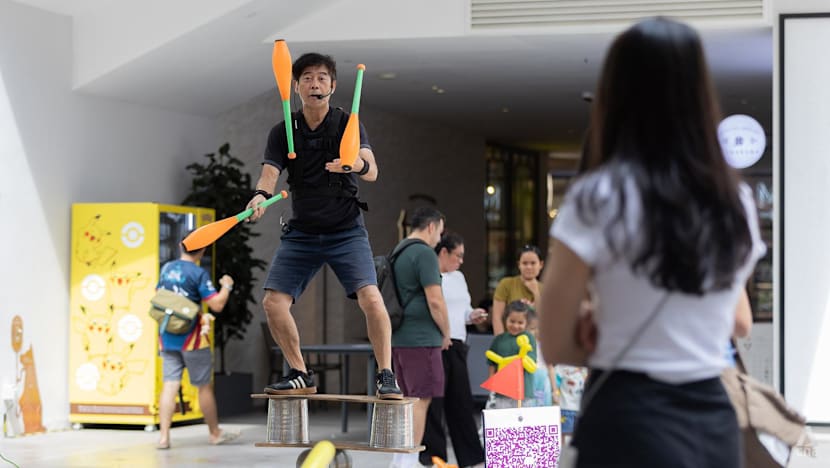
On a Saturday afternoon, a small crowd gathers at One Holland Village mall to watch a juggler toss balls and clubs into the air in impressive patterns. Families and curious passers-by delight and clap as he pulls off trick after trick with a dancer's grace.
Then, he brings out a balancing apparatus comprising a wooden board resting on a rolling cylinder, and adds a second tier with a second board and two buckets.
The atmosphere changes once he gets on top of this contraption.
Children who had been laughing and cheering moments before suddenly go quiet as the juggler climbs higher and higher. Parents and guardians look on, holding their breath as he finds his balance on the precarious apparatus.
A Cantonese martial arts theme blares through the speakers as the juggler shifts his weight carefully to the left, his calf muscles flexing visibly. He reaches for the neon-orange clubs attached to his harness behind him and sends them spinning around in an unbroken rhythm as he rocks on the board beneath him.
The crowd erupts in applause and cheers.
No other moment in the show better captures the highs and lows of Mr Wee Toon Hee's very unusual vocation than this climactic peak of a stunt. High risk indeed, but what a reward.
With his thick black hair, brisk gait and infectious energy, combined with the physically demanding stunts he's capable of, it came as a surprise to learn that Mr Wee is 65 years old.
When I arrived at the McDonald's outlet at East Coast Park on a separate day for our interview, he immediately set aside his phone to greet me with a broad smile and firm handshake. Affable and soft-spoken in a loose black T-shirt and trainers, he seemed far removed from someone who routinely attempts daring physical feats as Juggler H.
Yet, when he's performing his signature stunt of juggling atop the double-tier Rola Bola apparatus, his brows quickly perspiring from the physical effort of maintaining perfect balance, Mr Wee commands his audience's attention with practised ease.
There is no fear on his face, but even after nearly a decade of performing this particular trick, his heart still races each time.
"Some days, I'm very confident. Sometimes, I'm tired or a little weak," he said.
"I'll tell you frankly – even until today, I'm still very scared when I'm up there."
SEARCHING FOR A PASSION
Before he was Juggler H – H is short for Hee in his name – Mr Wee had already lived several different lives.
In the 1980s, after National Service, he was a deck cadet officer learning how to navigate ships. On voyages between Australia, Mauritius and China, he discovered that he was spectacularly unsuited to life on a ship.
"For two weeks, you don't see land. But you see dolphins, whales and gigantic waves. Then, you vomit like crazy until you have nothing left," Mr Wee said animatedly.
Starting over at 22, he enrolled in Singapore Polytechnic's mechanical engineering course. Three years later, he graduated into a difficult job market. On a whim, he applied for a cabin crew position with the Singapore Airlines – one that turned into a six-year career.
As much as he enjoyed himself seeing the world on the job, Mr Wee knew it was not the right fit for him either. He resigned and later secured a project management position at an engineering company through a close friend.
After three-and-a-half years, he took up a higher-paying marketing role in the shipping industry.
By now, it was the late 1990s. One day, while walking the streets of Shenton Way in the Central Business District, Mr Wee noticed a street performer juggling flaming clubs outside a British travel agency office.
As a boy, he had occasionally tossed oranges into the air for amusement and could manage a basic three-ball pattern. But he had never considered juggling to be anything more than a novelty – certainly not something one could make money out of, let alone a living.
He struck up a conversation with the performer, who invited him to join a juggling group that met every Friday at The Substation, then located near the Fort Canning area.
Mr Wee was excited at the prospect of stepping into a thriving community, but when he turned up, he was surprised to discover that the club had just three members.
Still, despite the club's size, he was awestruck by the members' skills.
"What impressed me wasn't their tricks. It was the fact that they could keep juggling without dropping (anything)."
Mr Wee, then 37 years old, began training intensively, both with the club and by himself.
While still working in the shipping sector, he started juggling every single day, managing to squeeze in two to three hours even on workdays, mostly during lunch breaks.
Around the same time, he became a "faithful attendee" of the Singapore River Buskers' Festival, an annual event launched in 1997 that brought some of the world's best street performers to Singapore – jugglers, acrobats, comedians, mime artists and more.
Up until its last run in 2005, the festival drew huge crowds along the Singapore River every November.
Mr Wee recalled attending every single edition, every single day of the festival's week-long programme. "I wanted to learn, to absorb, to immerse myself and see how to create a good show."
Spurred on by this inspiration, he began training even harder, juggling three hours in the morning and three hours at night.
"It's the same with any skill, not just juggling. The more you're into it, the better you become. Once you've reached a certain level, the skill stays with you."
These days, Mr Wee – who usually busks at One Holland Village – can juggle up to five balls now, a feat that very few jugglers can master.
But learning to juggle was only half the equation.
NERVES, CRITICS AND SCEPTICS
He spent countless hours watching buskers perform overseas on YouTube, estimating their earnings based on the size of the crowds they drew, to be sure the profession was financially viable before taking the leap.
The performers he admired most were able to turn a pavement into a stage not just with technical skill, but by deploying a mix of humour, suspense and carefully calibrated audience interaction.
"I was quite shy … Public speaking was a challenge for me," he said.
He joined the Toastmasters Club, but soon felt it was not providing him with the skills he needed.
He decided instead to train to be a tour guide, a job that required him to stand before groups of strangers and hold their attention.
During this time, he supplemented his income with jobs at children's parties and relief teaching at a primary school where he taught various subjects. He then slowly developed a repertoire of juggling and magic tricks.
However, he remained paralysed with fear when it came to performing on the streets and interacting with a fluid audience.
Even after obtaining his busking licence from the National Arts Council (NAC) in 2007, he did not hit the streets until 2009.
"I told myself, it's my dream that I must materialise. I cannot drag on anymore."
Mr Wee's earliest street performances took place largely on Orchard Road, in front of the Tong Building next to Paragon mall.
He spent hours at a stretch doing "walk-by busking" – juggling ceaselessly while passers-by stopped briefly to drop a coin or the occasional small note into his collection box before continuing on their way.
Once he got used to that, he turned his attention to his real goal: show busking, which required him to gather a crowd, keep them entertained and persuade them to stay until the finale.
His first attempts, in front of Wisma Atria mall, were "very bad", he recalled.
"I couldn't draw smiles, let alone laughter. Halfway through, people just stood up and walked away."
Redoubling his efforts, he focused on learning timing, humour and crowd work.
For the first several years of busking, he even refused to invite friends and family to watch his performances, embarrassed by the possibility of failure.
One of his harshest critics was his brother, who is his identical twin.
Mr Wee recalled his twin often making hurtful comments such as "You look so unnatural", or "Your comedic timing is very off".
The criticism stung, but it also helped Mr Wee shrug off his self-consciousness to become a more confident performer.
When Mr Wee first decided to make a serious living from performing, his wife, Mrs Josephine Wee, admitted that she was torn.
"(I felt) a mix of uncertainty and admiration," the 56-year-old said. "Of course, I worried about whether it would help pay the bills. But I admired his courage for wanting to pursue something he was genuinely passionate about."
In the years that followed, Mrs Wee, who has been a professional tour guide for decades, found herself defending a profession that few Singaporeans viewed as respectable.
"Back then, busking was sometimes viewed as being similar to begging. People would ask if we were doing okay or whether we needed help."
Despite the scepticism from those around him, Mr Wee pressed on with busking. Some years into this, he began thinking about a signature act to differentiate himself from other street performers.
In 2016, he came across an online video of a performer performing the Rola Bola stunt. Inspired, he bought himself a plank and a pipe and painstakingly taught himself to balance on it, starting on playgrounds with soft rubber flooring.
It was both mentally and physically challenging. He reckoned that it took him about three months just to get his balance.
"The hardest part is overcoming the fear."
He then conceptualised a trick that would have him balancing atop a double-tier Rola Bola mounted on a box, all while juggling clubs several feet above the ground.
"Every performer has one thing that puts them on the pedestal – a signature song, a signature act.
"For me, it wasn't just the Rola Bola. It was the double-tier Rola Bola."
THE SHOW MUST GO ON
For Mrs Wee, watching her husband perform over the years only continues to strengthen her conviction that he made the right choice.
"When I see people smiling, cheering and applauding, I feel a great sense of pride," she said.
"More than that, I feel a deep sense of gratitude that he's doing something he truly loves."
While Mr Wee has long settled into his stride with juggling and busking, things were not all smooth. The biggest blow so far has come not from injuries or physical dangers, but from surviving COVID-19.
From 2020 to 2022, the pandemic brought busking, tour guiding and children's parties to a total halt. Mr Wee saw nearly no income for two years, getting by on savings, loans from banks and family members, and temporary work such as polishing cars at an auto shop.
Worse than the financial strain, he recalled, was the uncertainty.
"At that time, I didn't know when it was going to end. I couldn't see light at the end of the tunnel."
When restrictions were finally lifted in March 2022, he returned to the streets "with a vengeance", busking for up to 12 hours a day on Orchard Road in an effort to rebuild his finances.
His two sons, aged 19 and 17 at the time, rarely saw him.
Now, years on from the pandemic, Mr Wee has a different challenge.
NAC's website shows that Singapore now has more than 500 endorsed buskers – half of them under 35 years old – and around 90 designated busking locations.
This is up from 300 registered buskers in 2019, and a far cry from the 20 or so Mr Wee recalled there being when he first obtained his licence in 2007.
Few of these are jugglers, but under the NAC's busking scheme, all performers must book approved locations and time slots in advance – meaning a growing number of buskers must compete for a limited number of popular spots with high foot traffic.
Mr Wee said: "Every busker is facing the same problem: too many performers and too few good locations."
And yet, for aspiring jugglers and performers out there, it's not all doom and gloom just yet.
For instance, Mr Wee noted the abundance of learning resources available to young people today through digital channels, compared with the books he studied when starting out.
He also pointed out the potential to reach a larger online audience these days – something his twin brother encourages him to pursue more aggressively, with the help of his younger son, now 21.
"The world has become so small through social media and the internet. If one dares to dream bigger, it's very feasible to go into that kind of unusual or unique occupation."
Even as Mr Wee enters his golden years, he's not quite ready to put down his clubs and balls just yet.
There are still tricks he is chasing: a five-ball pattern he has not fully mastered, a football-juggling routine he's now working out.
He's even entertaining thoughts of adding a third tier to his Rola Bola feat.
"I wish I had started juggling earlier," he said wistfully. "If I had started at 16 or 17, today, I'd be a superb juggler."
At the same time, he can see that his "runway is getting shorter" and he does want to enjoy life a little more, so he is starting to ease back on his packed training and performing schedule.
Some days, that is easier said than done.
"I'm still very energetic," he said. "My love for juggling is steadfast. There's always more to learn and I still have work to do."
Source: CNA/nl/ml/sf
Related stories

The Punch
PoliticsJun 27, 2026 · 1 min
Kano committed to Tinubu’s 2027 re-election, says Yusuf
The Punch
The Punch
NewsJun 27, 2026 · 1 min
Police deny arresting pastor over Oyo school abduction
The Punch

ESPN
SportsJun 27, 2026 · 1 min
Grades for every team eliminated from the World Cu...
ESPN
The Punch
PoliticsJun 27, 2026 · 1 min
Gombe LG poll: Yahaya commends voter turnout, peaceful conduct
The Punch