CNA
CNA··6 min read
I thought I was 'helping' my wife after childbirth. Truth is, I was missing out on being a father
Voices
The biggest lesson Dr Xander Ong learned after becoming a first-time father in 2023 was that caring for his children is not a task to complete, but a relationship to build.
New: You can now listen to articles.
This audio is generated by an AI tool.
27 Jun 2026 09:30PM
When my first child was born in 2023, I was over the moon. I was also completely lost.
As an expectant father, I prepared for childbirth by learning how to support my wife during her pregnancy and labour. I knew what to say and the small things that might bring her comfort – though how well I did is another matter.
Yet, nothing in the books I read or the prenatal classes I attended prepared me for my new identity as a father.
The reality of parenthood hit me when I held my son for the first time. I felt overwhelming love, but I did not know how to be a father.
My child was born at 37 weeks, three weeks before the estimated 40-week due date. At that point, we were still renovating our flat, so for his first night, I hurriedly bought a Moses basket – a woven basket without legs for newborns to sleep.
Then came a steep learning curve as I tried to figure out how to soothe a crying newborn while navigating conflicting advice from family, friends and parenting books.
Sleep deprivation clouded my mind. Before long, I was approaching caregiving like a checklist, focusing on helping my wife through early motherhood.
When I realised our son was more easily soothed by my wife, I instinctively stepped aside. What mattered to me was the outcome: that he was fed, comforted and healthy.
However, I soon realised I was missing something important.
I was not building a relationship with my child.
THE TRADITIONAL EXPECTATIONS OF A FATHER
Growing up, my father was present in the way that many fathers in his generation were. He was a provider and disciplinarian, somewhat distant but dependable.
Men were expected to be breadwinners, while women were caregivers. These expectations emerged in an era when most families had a single income and mothers often had support from extended family.
Today, families look different – with dual-income streams and little help beyond hiring a domestic worker or what the couple can arrange themselves.
In this environment, it is increasingly important for fathers to embrace caregiving as part of their role.
Research has consistently shown that children thrive with strong father-child bonds – one that differs from a mother-child bond.
A 2024 review of more than 180 studies, published in a leading psychology journal, found that paternal sensitivity – which is a father's ability to notice, interpret and respond to his child's needs – is linked to a more secure father-child attachment.
Children who feel securely attached to their parents tend to be better able to regulate their emotions, build trusting relationships and face the world with confidence.
Although many of us are influenced by how we were raised, we do not have to stick to being traditional father figures.
We simply need to set our own expectations of what kind of dads we want to be.
My father once admitted that he did not know how to carry a baby when my son was born, but he learnt how to be involved as a grandfather, and today, he enjoys carrying and playing with his grandchildren.
For me, I wanted to be a "present" father in my child's life. But being present means more than simply being in the room while my wife cares for him.
LEARNING TO BE A FATHER
What shaped me as an involved father were the conversations my wife and I have had through our parenting journey so far.
During her pregnancy, we talked about practical things such as how to achieve an unmedicated natural birth without an epidural.
After our son arrived, those conversations shifted.
We started talking about our roles and expectations, how we could support each other and the kind of parents we wanted to be.
Looking back, I wish we had had those conversations earlier, before the exhaustion and sleep deprivation of caring for an infant swept over us.
We learned to adjust and work together as parents, out of love for our baby. Those early conversations were not always graceful, but we pushed through and they helped us grow.
It was through those conversations that I realised I had been approaching fatherhood from the perspective of supporting my wife rather than building a relationship with my son.
Caring for my child should not be something I do only because my wife needs a break. I should do it because I want to spend time with him and nurture our bond.
When our second child was born in 2025, we were no longer first-time parents figuring things out from scratch.
We still found ourselves stretched thin, but I was stepping in more naturally instead of waiting to be asked or leaving my wife to manage on her own when she felt overwhelmed.
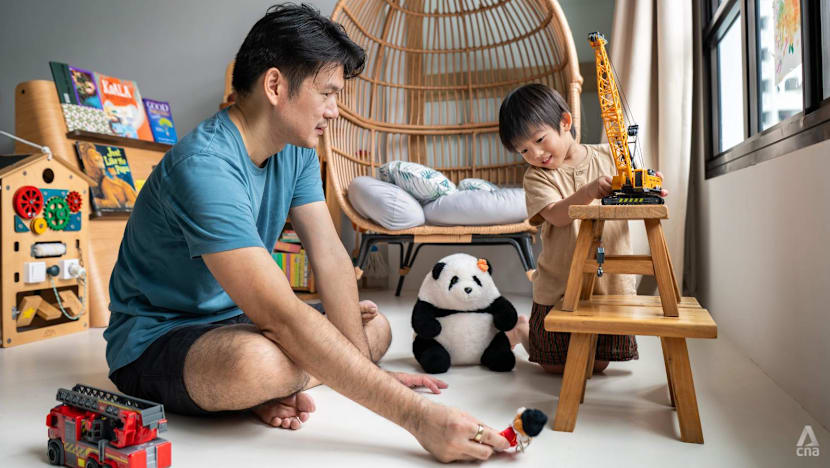
Rather than ticking off tasks, I treasured the time spent playing with my children and putting them to bed.
Those moments taught me that parenting is not simply about meeting needs.
Each moment I shared with my children was a privilege to love, care and bond with them.
THE EXPECTATIONS OF DADS TODAY
I have heard people saying too often that mothers need help and that men are good fathers for "helping" their wives.
There is no ill intent behind those comments, but their underlying assumptions need to be addressed.
When a father changes a diaper, soothes his baby or does the night feed, he is seen as doing something unexpected and, therefore, commendable.
Yet, when a mother does the same thing, she does not receive words of appreciation because it is expected.
This mindset persists in society and workplaces today, where fathers are still often viewed as secondary caregivers.
However, fatherhood should not be framed as "helping", because then, it implies doing something optional out of goodwill that is not your responsibility.
If we want involved fatherhood to become the norm, we need to support fathers accordingly – from the way we talk about their role in parenting to the larger changes in the system that give them the time and space to care for their kids.
When my first son was four months old, I attended the non-profit Centre for Fathering's I CAN Fathering Workshop.
I remember clearly how other fathers spoke candidly about the challenges and joys of fatherhood.
It helped me define the kind of father I want to be and I saw clearly how my relationship with my father would affect my own parenting journey.
Ultimately, a supportive "village" – consisting of extended family, workplaces, community groups and educational institutions – plays an important role in enabling fathers to be present in their children's lives.
It took me the past three years, through many challenges in marriage and parenthood, to fully appreciate this. I credit my wife, who continually notices and reminds me of the role I play.
Recently, at a parent-teacher meeting, I experienced a proud-dad moment when I learnt how my older child brings so much joy to his teachers through the way he relates to others, communicates and approaches learning.
At home, watching my children play with one another affectionately also warms my heart and makes me smile.
I may have been a father for only a few years, but one day, I hope my son grows up knowing what it means to be present to others – by learning to set aside the distractions of yesterday and tomorrow to fully cherish the people around him.
And if he becomes a father someday, I hope he carries that lesson with him.
More importantly, I hope he'll grow up in a generation where fathers are present not because they were told to be, but because they genuinely would not have it any other way.
Xander Ong is the chief executive officer of the Centre for Fathering and a father of two young children.
Source: CNA/lo/ay/sf
Related stories

The Punch
PoliticsJun 27, 2026 · 1 min
Kano committed to Tinubu’s 2027 re-election, says Yusuf
The Punch
The Punch
NewsJun 27, 2026 · 1 min
Police deny arresting pastor over Oyo school abduction
The Punch

ESPN
SportsJun 27, 2026 · 1 min
Grades for every team eliminated from the World Cu...
ESPN
The Punch
PoliticsJun 27, 2026 · 1 min
Gombe LG poll: Yahaya commends voter turnout, peaceful conduct
The Punch