Indian Express
Indian Express··5 min read
Unsung Heroes: How ‘Naada’ Maninalkur uses music to break social barriers in Karnataka
In an age where art is weighed by viral reel viewership and commercial hits, 45-year-old Bhaskar, once a Yakshagana lead singer, is on a silent mission to break social shackles, bonding music with human connection and social change. The motivation for his journey? His life experiences.
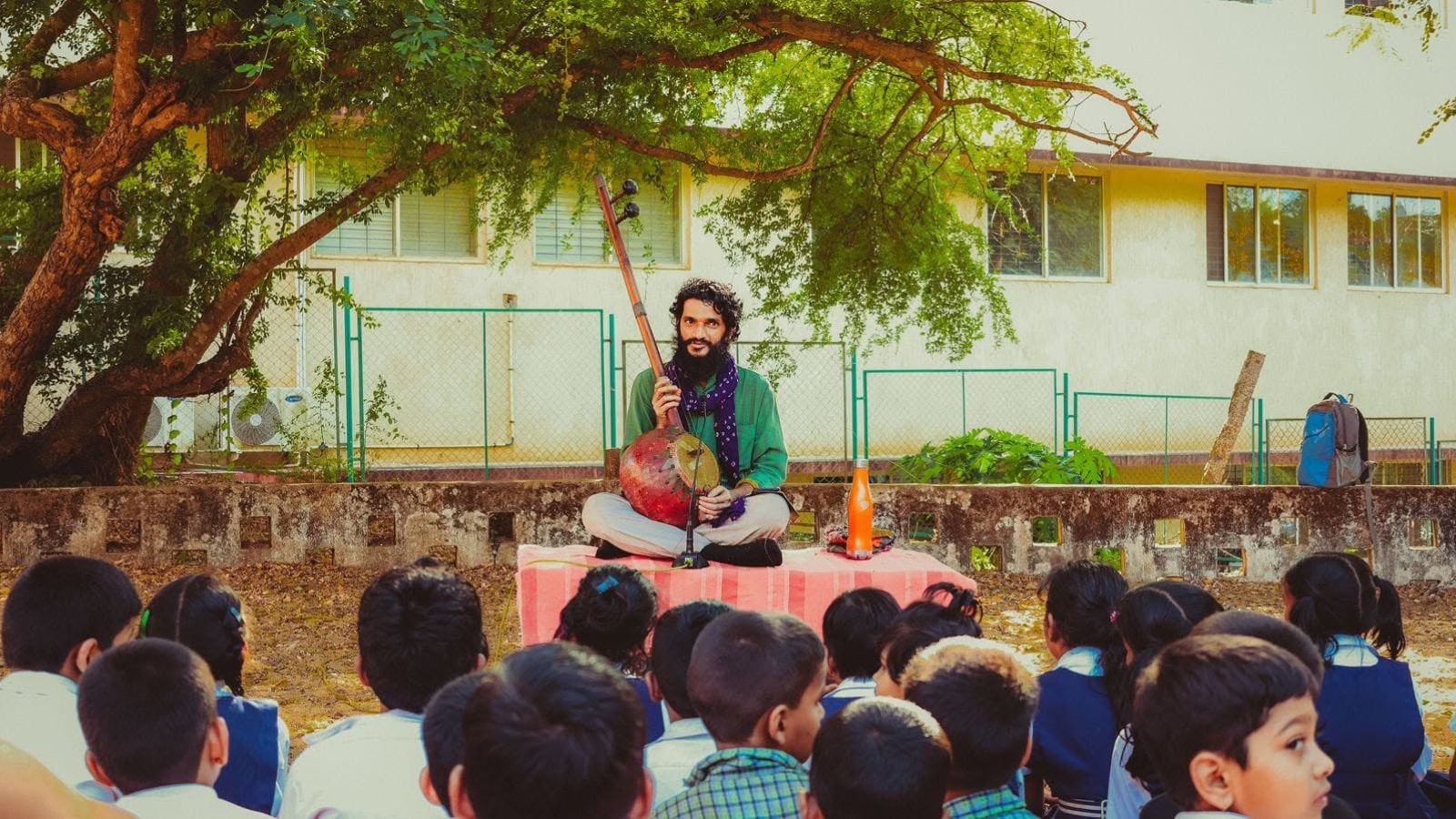
Known across Karnataka through his stage name ‘Naada’ Maninalkur, the artist from Dakshina Kannada district is on a quiet and determined crusade. Armed with a rich repertoire of Sufi music, Vachanas, Tatvapadas, and Kannada folk traditions, Maninalkur travels across the state sowing seeds of harmony, humanism, and equality in the minds of children. He also educates the elders in the need to fight against social discrimination and superstitions. For Maninalkur, this was born not just out of passion, but a culmination of life shaped by hardships, social stigma, and resilience.
A life shaped by hardships, social stigma
Born in Maninalkur village in Bantwal taluk, his parents named him Bhaskar. With his father a drunkard, Bhaskar was raised by his mother with his two sisters. “It has always been my mother who shaped my thoughts and provided education,” he says.
Like any village child, Bhaskar, who completed his Class 10, got into a hostel. It was during this time in the 1990s that he sought to learn Yakshagana — the traditional, vibrant theater art form deeply rooted in coastal Karnataka. But he was met with a closed door because of his caste status.
“I was never exposed to caste discrimination till then, but it was a shocker to me. At a young age, I had Papillon-Lefèvre syndrome (PLS), a rare genetic skin disorder which made friends and relatives keep me away, especially during functions like marriage and other events. This was my second experience of stigmatisation, to be specific,” he shares.
The boy who was deemed “unfit” due to his social status later grew into a master of Yakshagana singing tradition by making the best use of a rare opportunity that came his way.
“It was after I had appeared for the 2nd Pre-University examinations. A letter that was meant for someone else was delivered at my doorstep. It was an application that needed to be submitted for Yakshagana classes in Dharmasthala. Due to my ardent interest in the traditional art form since childhood, I applied for it,” he recalls.
Story continues below this ad
Bhaskar noticed that Yakshagana, being a folk art, was caught in social dynamics in the name of rituals and superstition, and it was increasingly male-dominated, and women were restricted.
Ektara transforms his musical journey
It was a challenge when Bhaskar chose to become a Yakshagana Bhagavatha, the lead singer of the traditional dance-drama, where the singers are largely drawn from the upper caste. Under the tutelage of Leelavathi Baipadithaya, the first female Bhagavatha, and armed with an ektara (tanpura) gifted by writer Janardhan Kesargadde around 2011-12, he carved a niche for himself in his musical journey. From then on, Bhaskar came to be called ‘Naada’ Maninalkur or “musical” Maninalkur.
“Since then, I have been engaged in using my art form for the betterment of society. But I needed to understand society better. So I decided to travel across the country to propagate peace and harmony through folk songs. But I failed miserably when I went to places like Bihar. I returned and decided to travel within Karnataka,” he says.
At one point, he decided to come out of Yakshagana, the very art form that once barred him, and instead expanded his musical canvas to include the philosophies of Sufism and the radical equality of 12th-century Vachanas.
The Rs 2,000 pilgrimage
Story continues below this ad
In 2018, Naada embarked on an extraordinary solo tour, moving across one district after another with his ektara and a repertoire of more than 50 songs. He had just ₹2,000 in his pocket.
“When I decided to travel across Karnataka, I had 30,000 savings. I gave all the money to my mother and took Rs 2,000 with me. It was really challenging. But the people I met motivated me to go forward,” he says.
Relying on a loose network of acquaintances to get started, Maninalkur’s grassroots tour quickly gained its own momentum. “They helped me to reach farmers, schools, prison inmates, corporate employees and many more. Throughout the journey, those who organised events provided shelter, food and money for my survival,” he says.
His audiences were remarkably diverse — students, farmers, prison inmates, corporate employees, senior citizens and villagers. He rejected the traditional elite grand stages, but preferred schools, community halls, temples, Dhargas, public spaces and village gatherings.
Lesson learnt: Society isn’t that toxic
Story continues below this ad
The true testament to Maninalkur’s art is its universality. Maninalkur’s 251-day journey across Karnataka showed him that there was compassion, empathy and harmony despite several social and economic hurdles. “We often blame society as being toxic and complain about people. It is not fully true. Some people silently help society with no expectations in return. I calculated the money spent by the people during my journey, and it was around Rs 6 lakh. The biggest remuneration I received was Rs 10,000,” he says.
Finding harmony in darkness
Among Maninalkur’s most innovative contributions to the folk art form is ‘Katthale Haadu’ (Songs in Darkness). During these unique performances, the venue is kept almost completely dark, illuminated only by the faint, flickering glow of traditional lamps.
Naada Maninalkur’s ‘Katthale Haadu’ performance, where the venue is kept almost completely dark, illuminated only by the faint, flickering glow of traditional lamps. (Express photo)
Without visual distractions, the audience is forced to strip away their external judgments. Listeners focus entirely on the lyrics, melody, and raw emotion of the Kannada songs. The experience encourages deep introspection, transforming music from something passive that is merely heard into an immersive emotional experience.
Maninalkur’s purpose of the tour was simple – to encourage people to pause, reflect, and reconnect with themselves and society through music. He let Kannada songs spark conversations on compassion, equality, peace and self-awareness.
Story continues below this ad
“I have visited places where women and men felt shy when I sang songs about menstruation,” he notes. “As a society, we are yet to accept the fact that it is a natural process. But everything makes an impact on the fabric of society,” he says.
‘All thanks to music’
Through folk traditions, Sufi philosophy and Vachana literature, he advocates compassion, dignity and respect for every individual. “During my journey, I have witnessed people pondering thoughts, self-reflecting on the society they live in and their actions. All thanks to the music,” he says.
Maninalkur’s mission has only evolved. Today, he partners with various organisations and self-help groups to institutionalize social reform from within the community.
“I invest my time in summer camps for children and also parents, bridging generational gaps. I do visit jails and other places, spreading the word of peace and harmony. Even if it transforms just one person, I feel the purpose is served,” he says with a serene smile.
View original source — Indian Express ↗
Related stories

The Punch
NewsJun 27, 2026 · 1 min
Police recover electric cables, nab vandals in Delta
The Punch
The Punch
SportsJun 27, 2026 · 1 min
VIDEO: Messi won’t start against Jordan, says Scaloni
The Punch

ESPN
SportsJun 27, 2026 · 1 min
Russell takes pole in chaotic qualifying session
ESPN
The Punch
NewsJun 27, 2026 · 1 min
Police probe shooting of Osun APC member
The Punch