Indian Express
Indian Express··3 min read
How a young farmer turned surplus milk into a pioneering artisanal cheese businesses
In the 1970s, a young dairy farmer, Sohrab Chinoy, made his rounds delivering milk in a jeep. Among his customers were Ruby Hall Hospital and Amir Hotel on Connaught Road, now the site of Lemon Tree Hotel.
The canteens of several industrial units were his biggest clients. But when factories shut on Thursdays, Chinoy was left with a problem: nearly 1,000 litres of unsold milk.
A third-generation dairy entrepreneur, Chinoy came from a family whose business, ABC Farms, traces its origins to the Byculla Dairy Farm in Mumbai in the late 1800s. At its peak, the Byculla Dairy Farm milked 1,500 buffaloes housed behind Victoria Gardens in sheds built by the British. In 1976, the year Chinoy returned from higher education and hands-on dairy training in Germany, the family established ABC Farms in Pune with 14 cows on a 27-acre property.
To make use of the surplus milk, Chinoy decided to produce cheese. He strongly believed cheese was a nutritious, protein-rich food.
“It’s vegetarian because we make the cheese using plant rennet. I decided to start the business and carry on. I was convinced it had to take off in our country,” he says.
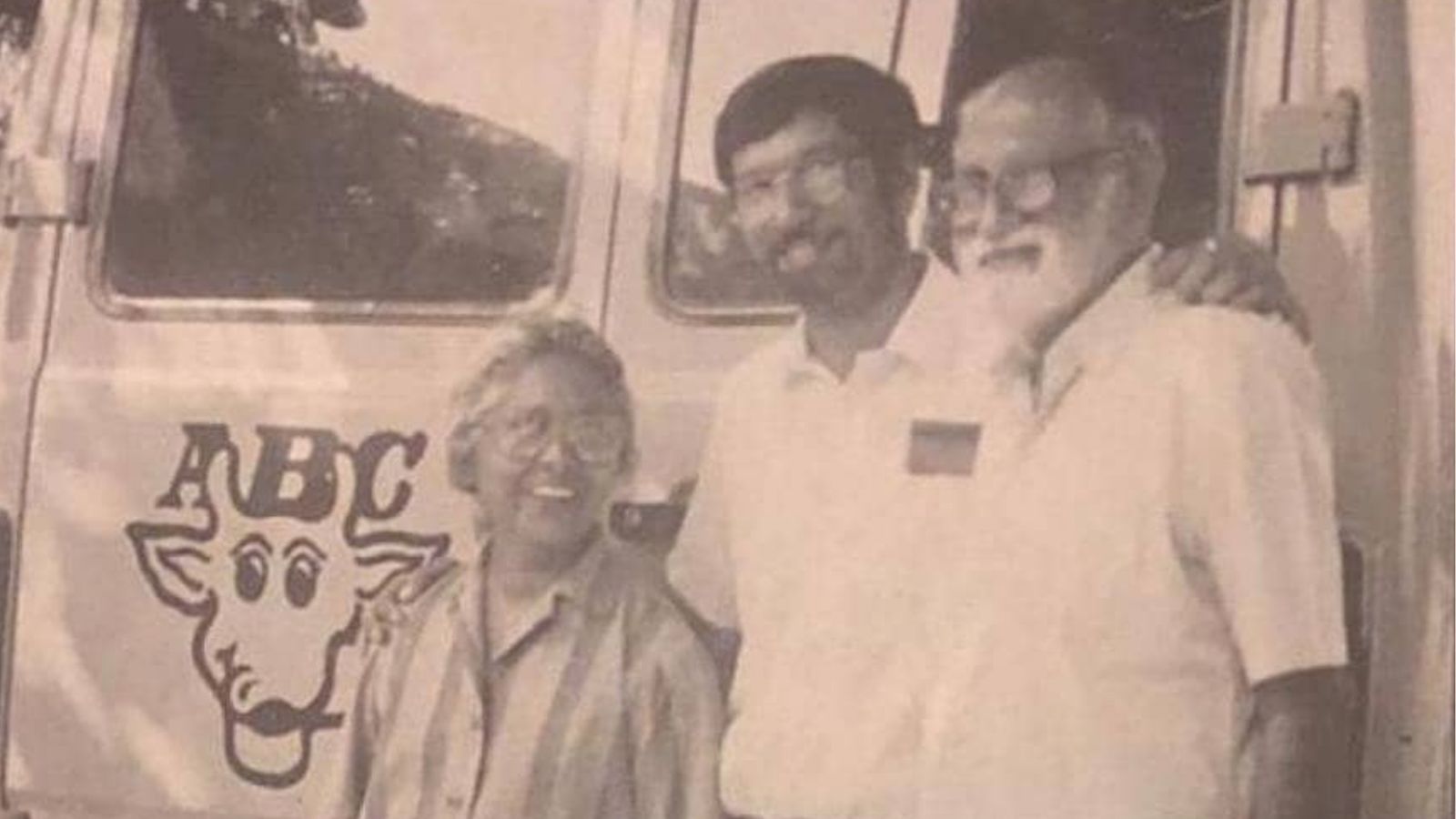
To make use of the surplus milk, Sohrab Chinoy decided to produce cheese. (Specially arranged)
Now 77, Chinoy vividly recalls setting up his cheese factory with just Rs 25,000.
“If you told somebody you wanted a tank to make cheese, they would immediately quote Rs 80,000 to Rs 1 lakh for the equipment,” he says.
Story continues below this ad
Instead, he headed to Juna Bazar in search of discarded industrial equipment. Initially, he found nothing useful. Then he spotted two 200-litre drums, which he bought for a fraction of the cost. Next came a trader selling old refrigerators. With the help of a refrigeration mechanic, Chinoy got them working again. Each unit could hold seven to eight blocks of cheese.
Even that proved too much.
“One could not sell the cheese. People were not used to cheese in the city,” he says.
ABC Farms began offering free tastings at its stores. Many customers looked at the cheese blocks and wondered if they were some unfamiliar variety of butter.
“Some people made faces, but a few would say, ‘Bahut achcha hai. I like it. Give me 200 grams,'” Chinoy recalls.
Story continues below this ad
The turning point came as a generation of young Indian chefs, trained abroad in the 1960s and early 1970s, returned home and began opening restaurants in the 1980s. Having been exposed to European, Continental, Greek and Turkish cuisines, they wanted authentic cheeses.
“They would phone me and say, ‘Can you make a Gouda for me, a Cheddar, a Bel Paese, a blue cheese?’ I would happily make them,” says Chinoy.
An unexpected opportunity gave the business another boost.
One day, a man walked into Chinoy’s MG Road shop and asked if he could supply 20-25 kg of cheese every week.
“He invited me to meet him at Blue Diamond. I assumed he was a restaurateur staying there, so I didn’t ask any questions. When I reached, I discovered he was the chief purchase manager for Indian Airlines. He put our cheese spread on the menu as a cheese sandwich. I was thrilled to get the order,” Chinoy says.
Story continues below this ad
Soon, ABC Farms’ cheeses were also being served as part of cheese boards for first-class passengers on international Indian Airlines flights.
Despite the business’s success, Chinoy regrets that artisanal cheese has never truly become a staple in Pune’s home kitchens, partly because of its cost.
“We’ve had lakhs of students visit the farm for cheese tours. Almost all of them had eaten cheese before, but for a long time, hardly anyone bought cheese to take home,” he says.
That, however, is slowly changing. Today, more people, especially mothers, understand the health benefits of artisanal cheese.
Story continues below this ad
“Cheese can be eaten for breakfast, and then continued through lunch and dinner. I would like to see that happen in Pune,” Chinoy says.
View original source — Indian Express ↗
Related stories

The Punch
NewsJun 27, 2026 · 1 min
Newborn baby rescued from Venezuela twin earthquake rubbles
The Punch
The Punch
NewsJun 27, 2026 · 1 min
E’Guinea man returns home after being forced to serve in Russian army
The Punch
The Punch
NewsJun 27, 2026 · 1 min
BUA donates N108m farm inputs to 211 resettled Sokoto farmers
The Punch
The Punch
NewsJun 27, 2026 · 1 min
Police recover electric cables, nab vandals in Delta
The Punch