Indian Express
Indian Express··5 min read
Express Special | From Ganga to global pet markets: Police in Madhya Pradesh map rail route of protected turtles
Police in Madhya Pradesh are preparing their first coordinated crackdown on wildlife trafficking through the state’s railway network after an analysis of six years of seizure data uncovered organised interstate networks smuggling protected freshwater turtles from northern India’s river systems to markets in Southeast Asia and the Middle East, The Indian Express has learnt.
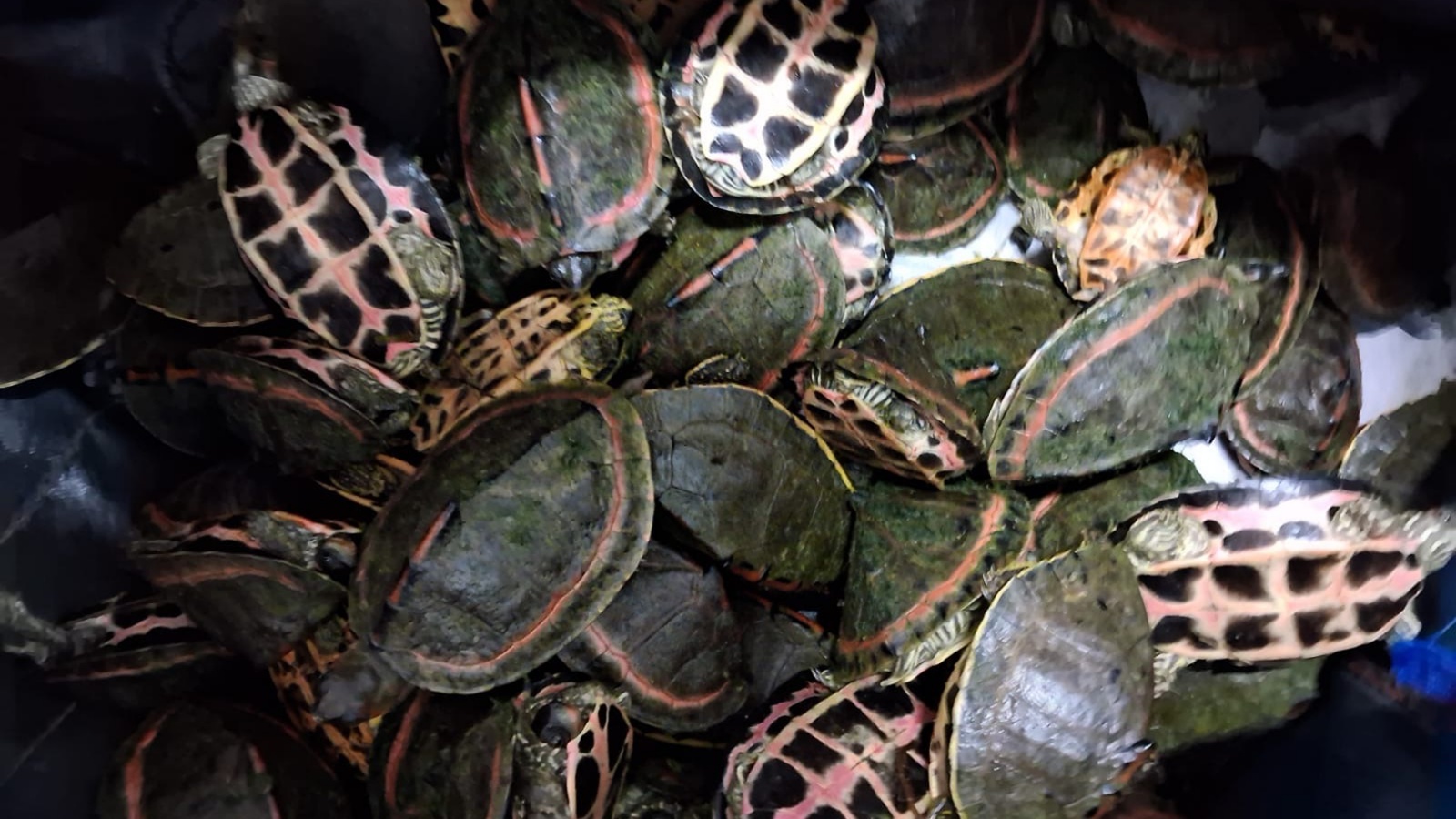
Between 2020 and 2026, the State Tiger Strike Force (STSF) and Government Railway Police recovered 654 protected animals from passenger trains crossing the state — 647 turtles and seven vultures — across what enforcement records describe as four organised interstate networks.
Senior police officials said the analysis has convinced them that the animals seized over six years represent only a fraction of the wildlife being trafficked through Madhya Pradesh’s rail network. They said repeat offenders appearing across multiple cases indicate established rackets may have been operating along the same corridors for years.
Based on that analysis, Madhya Pradesh is now preparing its first coordinated crackdown on wildlife trafficking through the railway network, moving beyond isolated interceptions towards a structured enforcement response.
“We are coordinating with all sister agencies like the state wildlife task force and railway officials to enhance the vigilance and checking of these trains and routes,” ADG (Railways) Raja Babu Singh told The Indian Express. “We are taking this very seriously and are formulating a strategy and working on curbing wildlife trafficking.”
Additional Principal Chief Conservator of Forests (Wildlife) L Krishnamurthy confirmed to The Indian Express that turtles seized in Madhya Pradesh “are trafficked primarily as exotic pets”, while Singh described the data on wildlife trafficking through the railways as “alarming”.
The seizures suggest traffickers overwhelmingly rely on passenger trains rather than railway cargo systems. All 654 animals recovered during the six-year period were found concealed in passengers’ luggage.
Story continues below this ad
The route
The turtles begin their journey far from Madhya Pradesh.
The Indian softshell and Indian flapshell turtle — both listed under Schedule I of the Wildlife Protection Act, 1972, in the same protection category as tigers and elephants — inhabit the river systems of the Gangetic basin. STSF officers said poachers and fishermen capture them from stretches of the Ganga and its tributaries in Uttar Pradesh before selling them to collectors, who aggregate consignments until they are large enough to move by train. Madhya Pradesh is where they next appear in official records, usually after being detected during random checks.
Wildlife officials said the seizures in the state reflect a much larger interstate trade.
“Freshwater turtles are the species we encounter most frequently in trafficking cases,” a senior wildlife official said. “The animals are sourced from river systems in northern and eastern India and transported through the rail network. Madhya Pradesh is largely a transit corridor in these cases, with consignments moving towards markets in western India.”
Different species feed different markets.
Story continues below this ad
“Indian roofed turtles and star tortoises are primarily sought for the illegal pet trade,” officials familiar with the investigations said. “We have seen networks linked to cities such as Indore, Dewas and Ujjain, with further movement towards Gujarat.”
Softshell and flapshell turtles follow a different route. “There is demand in parts of eastern India, particularly Odisha and West Bengal. Investigators have also found evidence of turtles moving through Bangladesh, where they are valued for traditional medicinal uses before being trafficked further.”
The rarest species face the most organised extraction.
“Species such as the Batagur turtle, which is critically endangered and survives in very limited stretches, including the Chambal river system, are particularly vulnerable as they are trafficked to exotic pet markets in Southeast Asia,” a senior forest officer said.
The seizures also show the scale of operations growing sharply.
Story continues below this ad
In March 2020, just one man was arrested at Sagar station carrying seven turtles in a fertiliser bag. In September 2023, four people were arrested at Itarsi with 282 turtles aboard the Lucknow-Yashwantpur Express. In February 2026, eight people were found carrying 311 turtles on the Patna-Indore Express at Sant Hirdaram Nagar station on the outskirts of Bhopal — the largest wildlife seizure ever recorded on the state’s railway network.
“The alarming part is these animals were detected after a foul smell emanated from them,” a senior wildlife official said. “We have intelligence that these animals are largely trafficked now in small batches through the rail network and are largely undetected.”
The challenges
The 2020 Sagar case illustrates another challenge. Charges were filed in May 2020, but the matter remains pending before a magistrate’s court, with six of the eleven witnesses yet to be examined. The next hearing is scheduled for August 11, 2026.
Madhya Pradesh’s central location makes it a key transit corridor. Enforcement records identify three principal trafficking routes through the state: Patna-Lucknow-Indore, Kanpur-Bhopal-Mumbai and Lucknow-Itarsi-Bengaluru. Any consignment moving from Uttar Pradesh towards Mumbai, Indore or Bengaluru must cross Madhya Pradesh.
Story continues below this ad
Eight stations are identified as particularly vulnerable: Sant Hirdaram Nagar, Bhopal, Itarsi, Jabalpur, Khandwa, Katni, Indore and Ujjain.
Officials said traffickers deliberately prefer passenger trains.
“The rail network allows traffickers to move live animals over long distances while blending in with regular passengers,” a wildlife enforcement official said. “Many seizures have involved animals concealed in personal luggage or sacks inside passenger coaches, including air-conditioned coaches.”
Of the 24 people arrested in the cases analysed, 15 are categorised as sellers, seven as passengers and two as coach attendants.
The same railway network has also been used to transport birds.
Story continues below this ad
On January 19, 2022, officers intercepted seven live Egyptian vultures at Khandwa station aboard the Sultanpur-Lokmanya Tilak Terminus Express. Five people were arrested. Egyptian vultures are classified as endangered and protected under Schedule I of the Wildlife Protection Act.
Officials said the vulture trade operates through different networks. “We do not encounter vultures in the same volumes. It is a niche, high-value trade,” a senior forest officer said. “Investigations suggest some birds are trafficked towards Maharashtra and Hyderabad, while others may be destined for international markets. The networks are smaller but more specialised.”
Enforcement records show baggage scanners are installed at 10 stations along the network, including several on routes where wildlife has repeatedly been seized.
Officials, however, said infrastructure alone is insufficient.
“Routine deployment of sniffer dog squads, wider use of baggage scanners, stronger CCTV monitoring and facial recognition tools could significantly improve detection,” an enforcement official said, adding that intelligence-led policing – identifying repeat offenders through better data sharing between agencies — would be more effective than random checks.
Story continues below this ad
Stations on known trafficking corridors, particularly around the Chambal region, Unnao, Etawah and Kanpur, require enhanced surveillance, the official said. The six-year analysis has, for the first time, enabled enforcement agencies to identify recurring routes, vulnerable stations, and repeat offenders — the basis for the coordinated crackdown now being planned.
View original source — Indian Express ↗
Related stories

ESPN
SportsJun 28, 2026 · 1 min
Colombia take top spot after Portugal stalemate
ESPN

ESPN
SportsJun 28, 2026 · 1 min
'Earned 100%': Jake Paul delivers Ellie Scotney pr...
ESPN

Indian Express
EntertainmentJun 28, 2026 · 1 min
Welcome to the Jungle Box Office Collection Day 2 Live Update: Akshay Kumar’s film crosses Rs 50 cr mark worldwide
Indian Express

Philippine Daily Inquirer
NewsJun 28, 2026 · 1 min
ILIGAN CITY — The local government unit (LGU) of Iligan City has tapped the Quezon City-based recycling firm Mark…
Philippine Daily Inquirer