Indian Express
Indian Express··4 min read
Punjab engineer gives up ‘Australian dream’, earns Rs 80L annually from buffalo farming and start-up consultancy
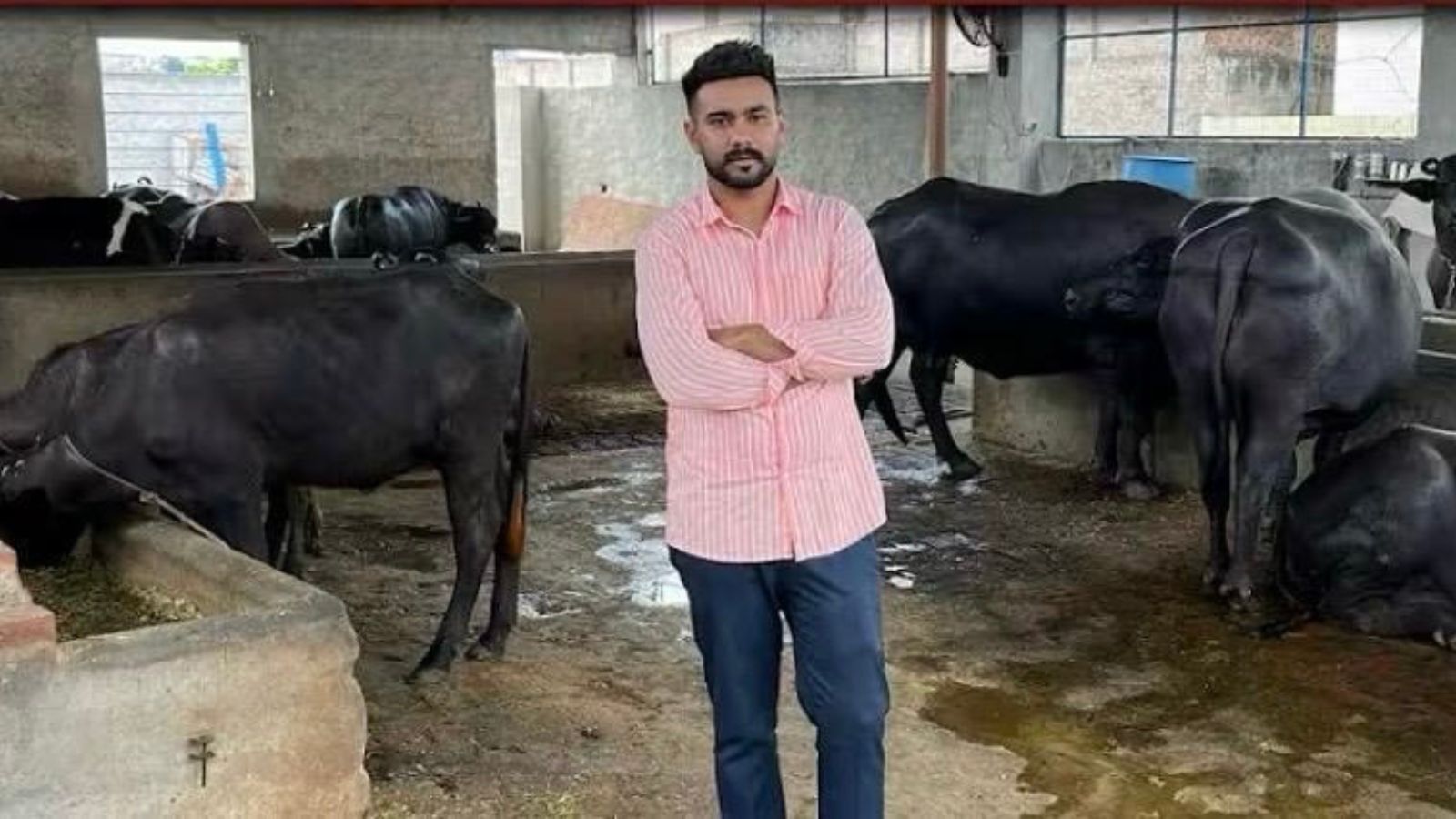
Despite obtaining an Australian visa in 2020 and having his wife already there, Amrit Singh Buttar (32), a Chandigarh University engineering graduate from Dhurkot village in Ludhiana district, decided otherwise: he returned to his roots and invested in dairy farming. Six years down the line, he turned his decision, once ridiculed by relatives and questioned by his family, into a success story with ‘Buttar Dairy Farm and Dhurkot Feed Industry’ built around buffalo rearing, breeding, cattle feed production, goat farming, agriculture, and running a start-up consultancy.
With an investment around Rs 5 crore, mostly earned from his dairy, Buttar now manages a herd of 130 buffaloes, produces around 500 litres of milk daily, operates his own cattle feed unit, cultivates 25 acres, and earns a monthly profit of Rs 6-7 lakh. Buttar has a plan afoot to expand his operation to nearly 1,000 buffaloes over the next decade.
“My parents wanted me to become an IAS officer, but I decided to start my own business and chose to enter dairy farming. Many people thought I was wasting my education by doing a job that even an uneducated person could do,” Buttar recalled.
Some family members, including his mother, who was working with the Punjab Health Department, and his grandparents, both school principals, stopped talking to him for months. Relatives openly questioned his decision. “I had a vision, but I knew it would take time to actualise. At that time, nobody could see what I was trying to build. Today, the same people are proud, seeking consultation and appreciate the decision,” he said.
In 2021, Buttar asked his wife, Ramandeep Kaur, who had by then completed her master’s degree in Environmental Science from an Australian university, to return to Punjab and join him in building the business. “We often talk about brain drain and migration, but somebody has to stay back and build opportunities here. Money can be earned anywhere, but who will take care of our land, our culture and our villages?” he said.
Now, Ramandeep manages a goat farming unit and breeding activities on the farm.
Buttar treated dairy farming as a serious business project, and for nearly seven to eight months, he travelled extensively across Haryana and other states, meeting breeders, veterinarians, and successful dairy farmers. His objective was to identify the best buffalo breeds and understand scientific dairy management. “I didn’t want to enter dairy farming blindly. I studied everything — from breeding and nutrition to disease management and milk economics.”
Story continues below this ad
He also underwent formal dairy training at Guru Angad Dev Veterinary and Animal Sciences University (GADVASU), Ludhiana.
The farm supplies 500-600 litres of milk daily, of which 50 per cent is sold to Verka, while the rest is sold to private customers at premium rates, ranging between Rs 70 and Rs 79 per kg, depending on the fat content.
In 2020, Buttar purchased two premium Murrah buffaloes for Rs 4.40 lakh from Haryana, and has now grown into a herd of around 130 buffaloes, including nearly 100 adult buffaloes. Around 80 buffaloes are currently lactating and producing milk. “Tell me, which other business puts money in your pocket twice a day — once when you wake up in the morning and again before you go to bed at night?”
The farm supplies 500-600 litres of milk daily, of which 50 per cent is sold to Verka, while the rest is sold to private customers at premium rates, ranging between Rs 70 and Rs 79 per kg, depending on the fat content. The farm sells milk worth nearly Rs 11–Rs 12 lakh per month (Rs 1.32 to 1.44 crore) with an estimated profit margin of around 50 per cent.
Buttar estimates that consultancy alone generates an income of around Rs 1 lakh per month.
Story continues below this ad
Buttar’s success has attracted aspiring entrepreneurs from across Punjab and overseas. He now conducts professional consultancy sessions for individuals interested in dairy farming and charges Rs 5,000 per consultancy session. The demand is so high that appointments are often booked nearly two to two-and-a-half months in advance.
Moreover, Buttar helped establish 10 to 12 dairy farms, several by people returning from overseas. He is currently constructing a large cattle shed spread over two acres, in addition to his existing infrastructure, as part of his long-term goal of building a herd of 1,000 buffaloes.
Buttar owns around 14 acres and additionally cultivates leased land, taking his total farming area to approximately 25 acres, and most of his agricultural produce is used to support his dairy business.
The farm grows maize, paddy, and wheat, while maize is extensively used for silage preparation and cattle feed production.
Story continues below this ad
“We don’t look at farming and dairy separately. Farming supports dairy. If we depend entirely on commercial feed, our costs increase significantly. Producing feed in-house gives us better quality control and profitability,” he said, adding: “The feed manufacturing unit formulates specialised feed for calves, growing animals, and mature buffaloes using maize, wheat, barley, mustard cake, and other ingredients.”
The feed unit helps ensure nutritional consistency.
Alongside buffalo farming, the family also maintains around 30 Beetal goats. Ramandeep oversees the breeding and management of the goat unit, which is gradually being expanded.
He takes care of brucellosis-related issues and adopts quarantine methods whenever purchasing any new animals. Through veterinary supervision, scientific treatment, and strict management protocols, the farm successfully controlled disease outbreaks.
The enterprise currently provides employment to around 10 people, including three women.
Story continues below this ad
“Dairy farming is not just about milk anymore. It is about genetics, nutrition, feed manufacturing, technology, fetching disease-free milk and value addition. If done professionally, it can become a highly profitable enterprise. My engineering degree and UPSC preparation have greatly helped me establish a successful business,” he says.
View original source — Indian Express ↗
Related stories

The Punch
NewsJun 28, 2026 · 1 min
LASTMA unveils free hotline for traffic complaints, emergencies
The Punch
The Punch
NewsJun 28, 2026 · 1 min
Abia North group endorses Otti for second term
The Punch
The Punch
NewsJun 28, 2026 · 1 min
France records around 1,000 excess deaths in heatwave — Health agency
The Punch
The Punch
NewsJun 28, 2026 · 1 min
My mother trained me selling akara, bananas, Tinubu’s aide backs First Lady’s remarks
The Punch