The Guardian
Germany trapped between past and future with team lost in identity malaise | Jonathan Liew
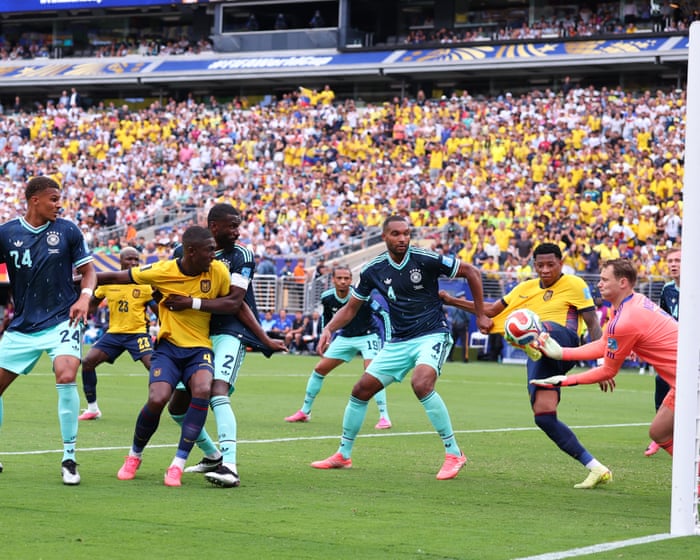
“No, please, stop with this nonsense,” snapped Julian Nagelsmann. Germany had just lost 2-1 to Ecuador in their final group game and the television interviewer was suggesting that with Germany already qualified, perhaps the Ecuadoreans had simply wanted it more. “They didn’t want it more,” Nagelsmann bristled. “I cannot tell any of my players that they didn’t give it their all. That’s far too simplistic.”
If that was the line, then fair enough. Albeit, a line Nagelsmann may have wanted to run past his players before they did their post-match media duties. “The difference today was that the opponent wanted to win more than us,” said Joshua Kimmich. “I had the feeling they wanted it more than us,” said the substitute Deniz Undav.
A minor disagreement, on the face of things. And yet also quietly emblematic of this Germany team at the moment, on and off the pitch: a team operating on multiple planes, a little lost in translation, a little lacking in message discipline. If they can get their constituent parts working in harmony, they can be a genuine threat. Until then, it remains hard to take them seriously.
After two wins in their first two games, Germany have emerged from a World Cup group phase for the first time since 2014, when they went on to lift the trophy. Their 7-1 win over Curaçao was the biggest win of the tournament so far. Why do things still feel so unsettled, so unsatisfactory? In large part, it is a malaise encapsulated by two men: one inside the camp, one very much not.
The second is Jürgen Klopp, who has been extremely visible as a pundit on German television, a face in the stands, a brand ambassador for his various beverage partners. At the start of the World Cup he had to apologise to Nagelsmann for a slip of the tongue when he claimed that the coach was in charge “for now”. It is the worst-kept secret in German football that Nagelsmann’s job is one of the very few that could tempt the 59-year-old back into coaching.
So you have Klopp on manoeuvres, messing about on the edge of things, flogging hotel packages and fizzy beer in the ad breaks. But this goes deeper than one beloved coach and his effortless animal magnetism. As well as Klopp, you have Thomas Müller and Mats Hummels analysing games on Magenta, Per Mertesacker and Christoph Kramer on ZDF, Bastian Schweinsteiger on ARD, Toni Kroos throwing hand grenades on TikTok, Philipp Lahm writing acerbic columns in Die Zeit.
That’s half the 2014 World Cup-winning side engaged in critically analysing the current setup in some form: a kind of rolling, roiling noise that creates headlines, stokes conflict and controversy, sets the weather around Nagelsmann’s team.
To an English audience, a fitting parallel may be the way Manchester United’s class of 1992 took an iron grip on the media after retirement, not simply a destabilising force, but a kind of institutional nostalgia, a reminder of how good things used to be. The nostalgia here is not simply for the 2014 side, but the era it represented: a period when Bayern Munich and Borussia Dortmund were the best two teams in the world, when the world fell in love with Klopp and his Gegenpressing football, when the fan culture of the Bundesliga first went global, when Germany had a fair claim to be the centre of the footballing universe.
Understandably, German football has tried but struggled to move on from its imperial era. Müller and Hummels were unceremoniously dropped in 2019 by Joachim Löw, only to be recalled (Hummels twice) after results took a downward turn. Löw was retained for far too long, surviving a humiliating exit at the 2018 World Cup to lead Germany into an uninspiring Euros in 2021.
Kroos was persuaded out of retirement for one last dance at Euro 2024. For a decade, the 2014 generation remained a kind of break-glass option, the magic potion that might – just might – turn everything back to the way it was.
Which brings us to the first man. Like Klopp, Manuel Neuer represents the Germany that Germany wishes still existed: immaculate, confident, innovative, best in class. But at the age of 40, and the last survivor of that 2014 team, Neuer is no longer best in class by any stretch of the imagination. While he remains capable of transcendent moments, he looks more fallible, more injury-prone, more inconsistent than ever.
While his calamitous error against Real Madrid in the first minute of Bayern Munich’s Champions League quarter-final second leg was largely in character, his inertia for Ecuador’s winning goal on Thursday felt more tectonic: a goalkeeper who once commanded an entire half now no longer able to control his own six-yard box. Neuer and Nagelsmann took a sizeable gamble in ending two years of international retirement and displacing Hoffenheim’s Oliver Baumann, the steady 36-year-old who may now never play at a World Cup. Nobody, as yet, can describe that gamble as a success.
Nagelsmann played down any suggestion of dropping Neuer after the Ecuador game. Nor has he warmed to the idea of shifting Kimmich out of right-back into the central midfield role he plays for Bayern. Nor replacing the willing but declining Leroy Sané. Nor breaking up the Jamal Musiala-Florian Wirtz partnership that lit up the group stages of Euro 2024 but has not worked in Germany’s past two games.
For years, through successive tournament humiliations, German football has been engaged in a kind of existential-level angst about what its identity should be. For all the evolution and fresh talent, the wins and the optimism, the suspicion remains that this is a team unwilling to articulate a coherent vision, a team with plenty of talent but precious little rhythm, precious little understanding, neither trusted at home nor feared abroad.
The ghosts of 2014 are still chatting away, shaping the terms of debate; Klopp is still out there, reminding everyone – including Nagelsmann – of how much fun things once were. Among a divided public there remains a sensation of loss and decline, a golden inheritance stabbed in the back, a basic confusion over what it is reasonable to expect of this team.
In the short term, Paraguay await in Boston on Monday. France, the Netherlands and Spain lurk over the next horizon. Nagelsmann has a ferocious noise to shout down and big calls to make. Will this be the team that finally lays to rest its baggage? Or will it ultimately be remembered like those who tried and failed: a team trapped between its past and its future, a museum to itself?
View original source — The Guardian ↗
Related stories

The Punch
SportsJun 28, 2026 · 1 min
World Cup: Meet nine African teams in the knockout stage
The Punch

Philippine Daily Inquirer
SportsJun 28, 2026 · 1 min
What's offside? And all your other World Cup questions, answered
Philippine Daily Inquirer

Philippine Daily Inquirer
SportsJun 28, 2026 · 1 min
Gilas Pilipinas bucks travel woes, routs Kiwi club in tune-up
Philippine Daily Inquirer

Philippine Daily Inquirer
SportsJun 28, 2026 · 1 min
Top seeds dominate AEBA Corporate Cup semifinals cast
Philippine Daily Inquirer