Times of Israel
High Court assails state comptroller election, signaling it will likely intervene
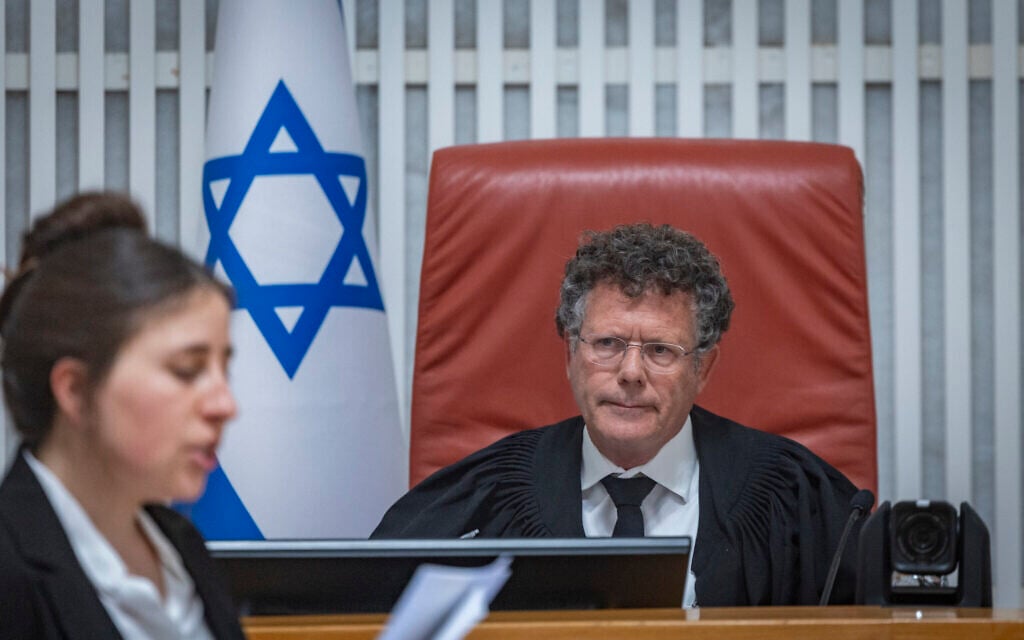
The High Court of Justice appears set to intervene in the contested Knesset election of Michael Rabello as state comptroller earlier this month, after all five judges expressed concern in a hearing on Sunday that the requirement for a secret ballot had been violated.
Deputy Supreme Court President Noam Sohlberg was especially strident in his criticism, saying that if the court does not intervene over the election then the requirement for a secret ballot would turn into a “dead letter.”
“Should we erase the word ‘secret’ from Basic Law: State Comptroller?” Sohlberg asked rhetorically.
The numerous issues raised by the justices over the election were a strong indication that the court will intervene in some manner, most likely by ordering the Knesset to redo the election — a step it already urged two weeks ago.
Rabello, Prime Minister Benjamin Netanyahu’s longtime lawyer and negotiator, was elected in the Knesset in a controversial election in which several Likud MKs either made their ballot slip visible outside the voting booth, or photographed or videoed themselves voting for Rabello inside the booth, reportedly on the instructions of senior Likud officials.
Get The Times of Israel's Daily Edition
by email and never miss our top stories
By signing up, you agree to the terms
Rabello lost the first round of the June 3 voting to retired Supreme Court justice Yosef Elron 60-57. A second round of voting then began, since a candidate needs 61 votes to be elected, but was aborted after opposition MKs alleged that coalition MKs had been ordered to record their vote.
When the second vote started over, at least seven coalition MKs recorded themselves voting for Rabello, who won 61-57, with some coalition MKs having apparently switched their votes from the first round.
Petitioners alleged that the process was contaminated, violating the requirement in Basic Law: State Comptroller that the vote by members of Knesset be conducted by secret ballot, and argued that this component of the law was designed to bolster the political independence of the office.
Responding to the petitions, Knesset Legal Adviser Sagit Afik argued that there was no hard evidence of instructions from Likud officials to MKs to record themselves voting, although she acknowledged it would be illegitimate if that had happened.
Coalition MK Sharren Haskel of the New Hope party has stated on several occasions that coalition MKs were “required” to record themselves voting to prove that they had voted for Rabello, comments repeated in court on Sunday by the petitioners.
The High Court earlier this month strongly recommended that the Knesset redo the election “cleanly and properly” because of the irregularities, but Knesset Speaker Amir Ohana refused, leading the court to order the Knesset to explain in Sunday’s second hearing why the court should not annul the election.
At the hearing were Supreme Court President Isaac Amit, Deputy President Sohlberg, and justices Daphne Barak Erez, Gila Canfy Steinitz, and Ruth Ronen.
Rabello is supposed to take up the post of state comptroller on July 4, so the court will have to issue a decision before that date if it wishes to intervene.
Isaac Bart, an attorney representing the Knesset, argued during the hearing that although Basic Law: State Comptroller and the Law for the State Comptroller require an election by secret ballot, there is no specific instruction in the law saying that recording one’s ballot is forbidden.
He also argued, like Netanyahu’s legal representatives, that there is no evidence that instructions were given to coalition MKs to record their vote, insisting that the court could not issue a decision on the basis of “rumors” surrounding the vote.
Bart also claimed that whether or not filming or photographing one’s vote inside the ballot box is a violation of the requirement for a secret ballot was “a complicated question” since there were no explicit instructions over the issue.
Barak Erez argued in response that there are various actions that would explicitly violate the requirement for a secret ballot but that are not all detailed in the law.
“Common sense says the vote is meant to be secret… You don’t need explicit instructions, it’s understood,” added Sohlberg.
Netanyahu’s lawyer, Ilan Bombach, argued that the requirement for a secret ballot merely meant that the Knesset must provide a mechanism for a secret ballot, but Knesset members who wanted to publicize their vote were permitted to do so.
Sohlberg attacked that notion too, saying that if some MKs publicized their vote it impacted the ability of others to insist on keeping the ballot secret.
“If some MKs say how they voted, then it makes other MKs worried that they will be blamed for whatever the result might be, so they are forced to also give up on the right that was given to them, and violate secrecy,” he said.
The fight over Rabello’s election comes against the backdrop of the government’s ongoing efforts to erode checks on its power and avoid scrutiny of its actions, such as its refusal to establish a state commission of inquiry into the October 7, 2023, Hamas-led massacre. The state comptroller is not a law enforcement official, but is considered an important institution in impartially reviewing and auditing government functioning.
View original source — Times of Israel ↗
Related stories

The Punch
PoliticsJun 28, 2026 · 1 min
Deregistration: Ondo NDC rejects Kogi court judgment
The Punch

TASS
PoliticsJun 28, 2026 · 1 min
Putin orders to minimize impact from Kiev’s terrorist attacks on civilian infrastructure
TASS
Dawn
PoliticsJun 28, 2026 · 1 min
‘What a loser:’ Former US president Biden slams Trump
Dawn
Rio Times
PoliticsJun 28, 2026 · 1 min
Latin America Defense Monitor — June 23–28, 2026
Rio Times