Times of Israel
Netanyahu’s vow to build ‘broad national government’ marks familiar attempt at pre-election rebrand
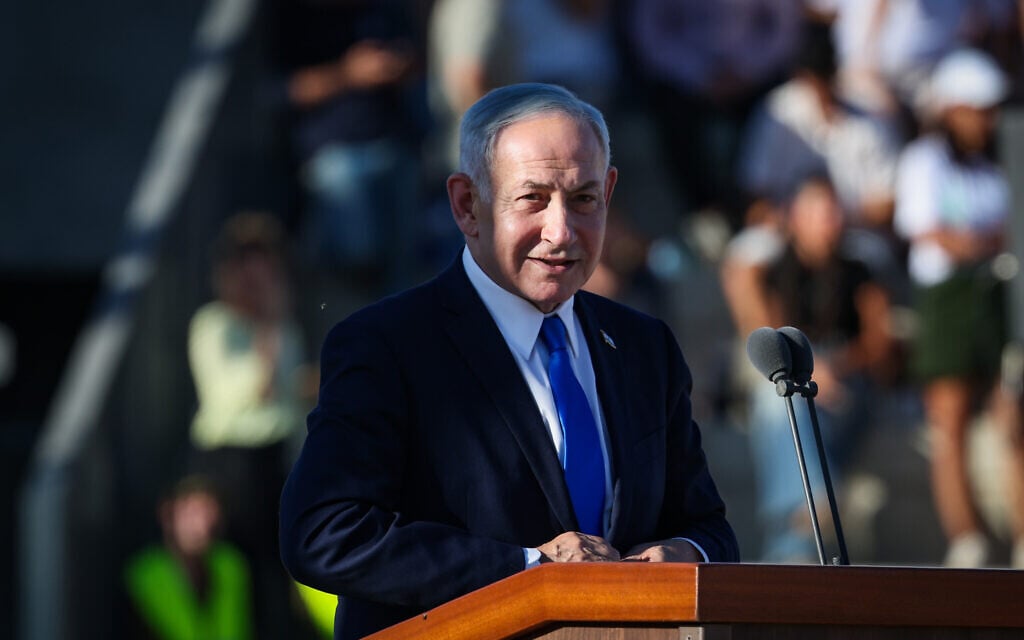
Prime Minister Benjamin Netanyahu on Saturday night promised to establish a “broad national government” after elections in October, using a press conference largely devoted to defending his handling of the wars in Gaza, Lebanon and Iran to attempt to rebrand himself.
His talk of seeking consensus and unity appeared at first glance to presage a potential departure from his current and longtime reliance on a coalition of right-wing and ultra-Orthodox parties, and echoed language increasingly used by several centrist rivals.
But political analysts say Netanyahu’s appeal was aimed less at seeking post-election partnerships with opposition party leaders than at persuading moderate Likud and center-right voters that he — rather than rising rivals including Yashar chief Gadi Eisenkot — is best positioned to lead a broad Zionist governing coalition after the election.
The goal, said one analyst, was to raise his current coalition’s poor polling — it is currently headed for some 52 seats in the 120-member Knesset. But he would likely stick with the same far-right and ultra-Orthodox allies if the gambit proved successful and he was reelected.
“There are forces among us that want to bring about a rupture within our society, that want to exacerbate and deepen misunderstandings, disagreements and divisions among us. And I think that is a terrible mistake,” Netanyahu said Saturday.
Get The Times of Israel's Daily Edition
by email and never miss our top stories
By signing up, you agree to the terms
“I intend to establish a broad national government. Not a narrow government, not a left-wing government that would be dependent on Arab parties, but a broad national government. Because only in that way, I believe, can we reach agreements among ourselves,” he continued.
Netanyahu said the coalition he aimed to build would require “ending boycotts” between political camps and would be constructed around what he described as broad public agreement on several key issues, including preventing a “civil war” over divisive domestic issues such as ultra-Orthodox enlistment and opposition to the establishment of a Palestinian state.
He said his prospective government would be open to anyone who shares core principles, including that Israel is the nation-state of the Jewish people, respect for individual rights, a free and technologically advanced economy, and Israel’s ability to defend itself independently.
“In my view, there is far more unity among the people than what you see in the Knesset. Much more. I believe there is broad agreement on many issues,” the prime minister said during the press conference, in response to a question on his promise of a broad national coalition.
He argued that Israelis widely agree on the need to avoid internal conflict. “People do not want to see a civil war. I am certain of that. There are those who are trying to inflame it and deepen the divisions within the public. I want to do everything possible to calm things down,” he said. A divisive figure who has demonized political opponents as “dangerous leftists,” and is pushing a raft of divisive legislation, Netanyahu acknowledged no personal responsibility for national disunity.
Referring to reported incidents of threats of violence against Haredi demonstrators during recent mass protests against ultra-Orthodox conscription, Netanyahu said, “Someone pulled out a gun, and I believe a woman was injured. We do not want to get there.”
He did not mention violence by Haredi protesters, including recent attacks on the home of Deputy Supreme Court Chief Justice Noam Sohlberg and other top officials involved in enforcing the law against draft evaders.
He also issued a curious critique of those who would ostensbly send police into “Haredi hesder” yeshivas to arrest students for not drafting, saying this would simply prevent Haredi men from ever wanting to serve: “We have seen an enormous response from the Haredi public. Young Haredi men want to enlist. But when arrests are carried out in places of Torah study, it produces the opposite result,” he declared. In fact, however, there have been no such reported arrest operations, and the claim appeared to be an attempt to foment dissent even as he asserted a desire for unity.
“If I told you that in some country in Europe, police were entering yeshivas, taking young men studying Torah, and putting them in prison, you would be shocked,” he said.
The premier also argued that there was now a broad public consensus against the establishment of a Palestinian state.
“There is no room for two states,” he said, arguing that while the Israeli public had been divided on the issue before Hamas’s October 7, 2023, attack, the massacre had fundamentally shifted public opinion against Palestinian statehood. Netanyahu has ducked personal responsibility for the failings surrounding the Hamas invasion, steadfastly refused to resign, and blocked a state commission of inquiry into the catastrophe.
A play for the political center
Netanyahu’s remarks came as he seeks to stem an erosion of support among moderate Likud and center-right voters. A Channel 12 poll published in May found that 42 percent of Israelis who voted for Likud in the previous election had either decided on, or were considering, backing another party in the upcoming election.
Some of those voters may have gravitated toward Eisenkot, the former IDF chief of staff whose security credentials, reputation as a straight shooter, and personal sacrifice after losing his son in the Gaza war, have made him one of the opposition’s strongest draws among center-right voters.
“Prime Minister Netanyahu is trying to move his party to the center in order to capture the center,” said Prof. Gideon Rahat, a senior fellow in the Israel Democracy Institute’s Political Reform Program. But Rahat argued that the effort was disingenuous. “If this works, I expect after elections, he would ultimately rebuild the same government that he has now — with [far-right leaders Itamar] Ben Gvir, [Bezalel] Smotrich and the ultra-Orthodox.”
Netanyahu has repeatedly in previous elections reached out to rivals and opponents including Naftali Bennett, Benny Gantz, Gideon Sa’ar, Avigdor Liberman, urging them to put previous disputes behind them and join forces with him.
But rather than signaling a genuine willingness to govern with opposition leaders such as Eisenkot, Liberman, Yair Lapid or Bennett, all of whom have said they will not partner with him, Rahat argued that Netanyahu’s message this time was primarily aimed at persuading disaffected center-right voters that Likud remains their natural political home.
That strategy, Rahat elaborated, also helps explain why, despite repeatedly invoking unity, Netanyahu defined his proposed coalition as one excluding Arab parties and the political left, while devoting much of the press conference to attacking Eisenkot, whose party overtook Likud for the first time in a Zman Yisrael poll published last week.
Unity message clashes with coalition agenda
Netanyahu’s call to embrace consensus on two of Israel’s most divisive issues –ultra-Orthodox conscription and the role of the judiciary — contrasts sharply with his current government’s legislative agenda. Even as he said he hoped to reach “broad agreement,” his coalition is racing to push through contentious legislation on those very issues before the Knesset is expected to recess on July 16 ahead of the October 27 election.
This week, the Knesset House Committee is holding marathon sessions to advance a proposed Basic Law declaring Torah study a foundational value of the State of Israel, legislation promoted by the ultra-Orthodox parties to shield yeshiva students evading the draft from sanctions and prosecution.
The bill is being advanced amid reports of a deal between Netanyahu and the two ultra-Orthodox parties to promote some of their legislative agenda in exchange for supporting coalition priorities. Although both Shas and United Torah Judaism have denied such an agreement exists, the coalition’s legislative agenda was effectively frozen for two weeks due to a boycott by the Haredi parties, initially sparked by the coalition’s refusal to advance the so-called Daycare Law restoring subsidies for the children of draft evaders before expanding to other conscription-related demands.
At the same time, the coalition is racing to pass a controversial pair of bills as part of its ongoing attempted judicial overhaul, curtailing the powers of the attorney general and making it more difficult to indict senior public officials, including the prime minister, who is currently on trial for corruption. Critics argue that the legislation is intended to weaken one of the government’s core institutional checks ahead of the election.
The prime minister is also defying what polls have repeatedly indicated is the overwhelming national consensus in favor of a state commission of inquiry into the failings surrounding the October 7, 2023, Hamas-led massacre, and pushing legislation for an inquiry overseen by his own coalition.
The disconnect between Netanyahu’s rhetoric on Saturday night and his own and his government’s words and deeds prompted widespread skepticism, with opposition leaders accusing him of hypocritically and cynically seeking to depict himself as a champion of national unity after years of deepening political divisions. Even members of his own coalition rejected the prospect of the broad government he described.
“A prime minister who blindly led Israel to a historic low, who works day and night to sow division and incitement, and who devotes all his energy to encouraging draft evasion is unworthy of this nation, and certainly has no standing to preach about unity,” said Eisenkot.
He insisted that Netanyahu would be replaced with a “Zionist and nationalist majority that serves Israel’s interests.”
“Even tonight you continued to lie about Gaza and Lebanon,” the Yashar chief added. He said Netanyahu would instead be replaced by a government with a “Zionist and nationalist majority” that serves Israel’s interests.
Democrats party chair Yair Golan likewise dismissed the prime minister’s promise, declaring that “the man responsible for the greatest disaster in Israel’s history will not establish a unity government — or any government.”
Mocking Netanyahu’s appeal for consensus, he said the prime minister was “more than welcome to unite with Ben Gvir, Smotrich and the ultra-Orthodox parties in the opposition” and urged all parties in the opposition bloc to clearly state that they would not join a government with Netanyahu.
From within the coalition, National Security Minister Ben Gvir also criticized the proposal, calling it “very troubling” and arguing that Netanyahu’s previous unity governments with figures such as Tzipi Livni and Gantz had “paralyzed the government’s ability to advance a determined right-wing agenda.” Instead, Ben Gvir said, Netanyahu should seek to establish “a full-fledged right-wing government.”
An opening for Gantz?
Netanyahu’s appeal for a “broad national government” echoed language increasingly used by Blue and White chairman Gantz and his prospective political partners, former Fire and Rescue commissioner and bereaved father Dedi Simhi and Yoaz Hendel’s Reservists party, all of whom have argued that Israel needs a broad Zionist government that is not dependent on Arab parties.
The overlap in rhetoric raised questions about whether Netanyahu was attempting to position Gantz and his allies as potential coalition partners, despite longstanding criticism of the prime minister and policy differences, particularly over the role of the ultra-Orthodox parties in the next government.
Gantz nevertheless rejected Netanyahu’s overture outright.
“Prime Minister, we don’t believe you,” Gantz said. “If it were up to you, you would once again establish a government with the ultra-Orthodox parties and extremist elements that would continue to keep Israel stuck.”
Despite his public criticism, Gantz remains the only opposition leader who has not explicitly ruled out joining a future Netanyahu-led coalition. Simhi, who has confirmed his alliance with Gantz, has repeatedly said he would join any Zionist government that is not dependent on Arab parties, including one led by Netanyahu.
At the same time, negotiations between Gantz, Simhi and Hendel’s Reservists party have reportedly stalled over precisely that issue: Hendel has categorically ruled out serving in a government with the ultra-Orthodox parties, while Simhi, and apparently Gantz, are prepared to do so.
Running alone, none of the three would likely clear the electoral threshold, but together they could win as many as seven seats, according to recent polls. Such a result could leave the Gantz-led alliance holding the balance of power and provide Netanyahu with a potential coalition partner beyond his traditional ultra-Orthodox and far-right allies.
View original source — Times of Israel ↗
Related stories

The Punch
PoliticsJun 28, 2026 · 1 min
Deregistration: Ondo NDC rejects Kogi court judgment
The Punch

TASS
PoliticsJun 28, 2026 · 1 min
Putin orders to minimize impact from Kiev’s terrorist attacks on civilian infrastructure
TASS
Rio Times
PoliticsJun 28, 2026 · 1 min
Latin America Defense Monitor — June 23–28, 2026
Rio Times
The Punch
PoliticsJun 28, 2026 · 1 min
Kebbi declares war on’Yan vocal’ cybercrime syndicate
The Punch