The Guardian
Ukraine’s targets in Russia are fully justified | Letters
Prof Christian Enemark’s letter (‘Morale’ bombing Moscow is not justified, 25 June) articulates a position of admirable moral consistency, but one that risks being fatally disconnected from the strategic and moral realities that Ukraine faces.
The professor rests his argument on a bright-line distinction between combatants and civilians – a distinction that has genuine force in international humanitarian law, but which becomes considerably more complicated when Russian civilians fund, staff and politically sustain a war machine that has systematically targeted Ukrainian hospitals, schools, apartment blocks and energy infrastructure.
The notion that Russian civilians are entirely without moral agency in relation to a war prosecuted in their name, with their taxes, and – polls suggest – with their substantial approval, is one that deserves more scrutiny than it receives here.
Furthermore, Prof Enemark conflates two distinct categories of infrastructure targeting. Strikes on oil refineries and energy facilities are not “morale bombing” in the sense associated with the discredited area bombing campaigns of the second world war. They are attacks on dual-use industrial infrastructure that directly enables the Russian war effort – precisely the kind of target that international humanitarian law has long recognised as potentially legitimate, provided proportionality is observed. That civilians are inconvenienced, or even harmed incidentally, does not automatically render such strikes indiscriminate.
The professor’s closing maxim – that “two wrongs do not make a right” – is philosophically tidy but strategically hollow. Ukraine is not retaliating for its own satisfaction; it is attempting to shorten a war in which its own civilian population continues to suffer grievously. If bringing the costs of that war home to Russian society accelerates its end, the calculus of harm may well favour such a strategy, not undermine it.
The legitimate concern is proportionality and intent – not whether Ukraine must forever absorb punishment without responding in kind.
Tim Dee-McCullough
Windsor, Berkshire
In his letter, Prof Christian Enemark uses language that hides the clear moral reasoning and justification for Ukraine’s defence strategy, which is clearly targeting Russia’s ability to fuel its continued attacks on Ukraine.
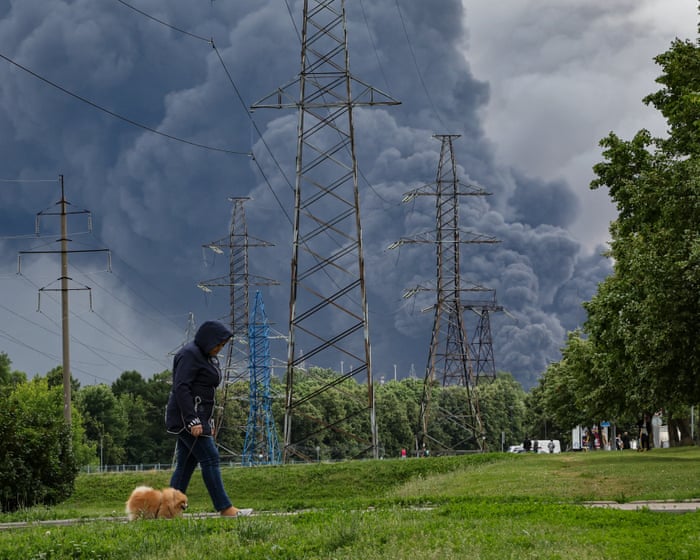
Videos on social media show that the injuries and private property damage caused in Ukraine’s strike on the Moscow oil refinery on 18 June probably arose due to air defences missing targets, or drone debris. In many past attacks, Russia maintained that the injuries arose due to the debris of drones intercepted by Moscow’s air defences. If Russia wants to protect its civilians, it should let Ukraine hit targets or, even better, the most moral act would be to withdraw from Ukraine’s territory entirely.
Further, it is not reasonable to suspect Ukraine of deliberately targeting civilians when the Ukrainian president speaks of bringing the war closer to ordinary Russians. In this context, “ordinary Russians” does not include activists speaking out against the war, and probably refers to middle-class Russian urbanites. In the past few months, “ordinary Russians” have been vocal on social media about internet restrictions and now fuel shortages. Prior to this, “ordinary Russians” rarely spoke about the consequences of the war, and some even cheered the killings of Ukrainian civilians.
Further, Russia’s mobilisation deliberately targets prisoners and ethnic minorities from remote regions, and exploits the global south. The Moscow regime shields “ordinary Russians” as a political strategy against any uprisings.
Prof Enemark ignores not only the political strategy but the battlefield and defensive strategy of these attacks. Moving air defence systems to Moscow will leave gaps that Ukraine can now exploit to liberate occupied territories. Moreover, hitting strategic military and fuel installations in Russia prevents their use in Ukraine. These attacks save thousands of lives for every “ordinary Russian’s” shoulder injury.
Bombing Moscow influences morale, but morale does not serve as the primary motivation for the attacks.
Nonetheless, allies could have helped to defend Ukraine in a more ethical manner. Political will to end our global addiction to fossil fuels would have stopped the west from continuing to economically support Russia’s war machine after the 2014 invasion. Instead, Europe continues to import Russian energy. The west could have “closed the skies” over Ukraine at any point since February 2022. This moral act would have prevented the deliberate killing of children in Mariupol in March 2022.
Ukraine already pays deeply for the moral failings of Russia; do not make it pay for the moral failings of allies.
Dr Natalie Kopytko
Lecturer, Sustainability Research Institute, University of Leeds
The main target of Ukraine’s largest-ever drone attack on Moscow was very clearly the Moscow oil refinery located in the Kapotnya district of the capital. One drone did not reach its target, hitting a nearby residential area, but there are no indications this was intentional, and the strike’s proximity to the Moscow refinery indicates that the drone probably missed its target or was driven off course due to Russian electronic warfare.
Despite this, Prof Christian Enemark argues that “a strategy of ‘morale bombing’ a city’s residents is one that suffers from being inherently unjust”, writing that “Ukraine does not gain any moral permission to retaliate against Russia by launching indiscriminate attacks”. Yet Ukraine’s attack was highly discriminate, with nearly all drones that made it through Russia’s dense missile defence network – comprised of multiple rings of defensive systems – hitting the Moscow oil refinery.
Enemark further argues that the “desired effect of such action is to increase [Russian] civilians’ sense of insecurity”, thus anchoring his objections to the attack. But if Ukraine’s aim was simply to increase a sense of insecurity in Moscow, many other less well-defended targets could have been hit. Or targets with more civilians in the immediate vicinity. The fact is that Ukraine chose to strike – with great precision – a key source of fuel and revenue for Russia’s ongoing illegal war against Ukraine.
Enemark’s arguments also rely on a false moral equivalency between Russia and Ukraine, treating the two states as potentially acting on a par with one another – he remarks that “two wrongs do not make a right” – despite the widespread documentation of Russian soldiers targeting civilians, torturing civilians and prisoners of war, kidnapping children, and using rape as a method of war. The simple fact is that the Russian military has carried out a dizzying array of war crimes throughout its illegal and immoral war, and Ukraine precisely striking core pillars of the Russian economy that directly feed into ongoing wartime efforts is exactly what Volodymyr Zelenskyy says they are, “long-range sanctions” on the Russian war machine.
Nathan Gabriel Wood
Executive director, International Society for Military Ethics in Europe
View original source — The Guardian ↗
Related stories

TechCrunch
TechnologyJun 28, 2026 · 1 min
Ford rehires ‘gray beard’ engineers after AI falls short
TechCrunch

TechRadar
TechnologyJun 28, 2026 · 1 min
The Ninja AutoBarista Pro accommodates two totally different coffee-drinkers
TechRadar
Ars Technica
TechnologyJun 28, 2026 · 1 min
Why did this journal retract two 1940s papers by Max Planck?
Ars Technica

Engadget
TechnologyJun 28, 2026 · 1 min
5 easy ways to get more range out of your EV
Engadget