Indian Express
Indian Express··7 min read
The next 25 years: Delhi’s new firefighting plan
Smart buildings that alert the Fire Control Room even before someone can dial the fire helpline number 101.
Artificial intelligence systems that identify and dispatch the nearest available fire truck to the location within seconds.
Drones that stream live visuals to firefighters as they race to the scene.
These are among the proposals in a 25-year roadmap drawn up by the Delhi Fire Services (DFS), a blueprint for the future of firefighting in the Capital that calls for a significant expansion in the number of fire stations, and the recruitment of more than 25,000 additional personnel over the next quarter century.
The plan has been drawn up in response to the rapid and continuous expansion of the city, its changing lifestyles, the use of modern construction material that often overlooks fire safety considerations, and increasingly complex building designs which have stretched the DFS’s ability to respond to emergencies – even as the numbers of fire incidents and emergency calls continue to rise every year.
According to the DFS, the changing nature of fires has exposed critical gaps in infrastructure, manpower, communication systems and emergency response — shortcomings that the department says call for a unified, technology-driven, fire safety framework for the Capital.
“The changing nature of fire emergencies necessitates a paradigm shift in the functioning of the fire service,” the document states. The roadmap, it says, seeks to move the DFS from a largely reactive firefighting system to one that is centred on prevention and early detection of fires.
Story continues below this ad
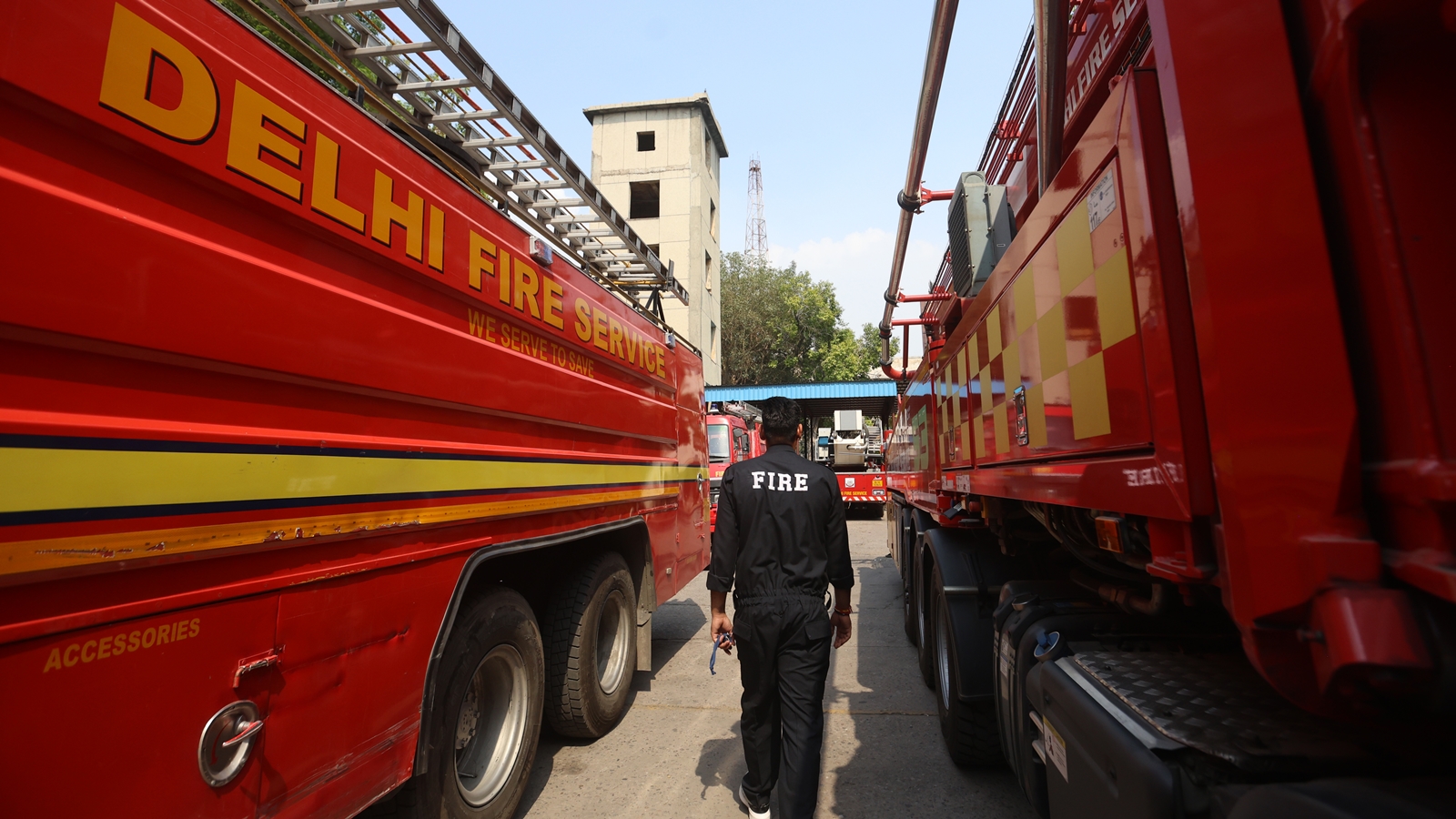
Fire Station in connaught place in Delhi. (Express Photo by Gajendra Yadav)
Three tragedies, one reckoning
The plan was prepared in the aftermath of the Palam, Vivek Vihar, and Malviya Nagar fires, which together claimed more than four dozen lives in March, May, and June this year, and laid bare serious gaps in Delhi’s emergency response system, officials said. The 23-page blueprint, accessed by The Indian Express, was drawn up after Chief Minister Rekha Gupta directed relevant government departments to formulate a long-term firefighting master plan to tackle similar incidents in the future.
The document has proposed a series of measures aimed at cutting casualties and building a faster, technology-driven emergency response system — they include mandatory smoke detectors and sprinkler systems, drones for fire assessment, Internet of Things (IoT)-enabled fire alerts, an expanded network of fire stations, specialised response units, a massive modernisation of equipment, and large-scale recruitment of Fire personnel. DFS officials said the plan has been submitted with timelines of five, 10, 15, and 25 years, aimed at bringing Delhi’s fire and emergency response up to “an advanced, global standard”.
A city outgrowing its fire cover
At the heart of the plan is a stark reckoning: For its size, the capital of India simply does not have enough fire stations.Delhi is currently served by 71 fire stations, a third short of the requirement of 107 identified by the global tech solutions company RMSI in a 2011 risk analysis commissioned by the Union Ministry of Home Affairs. The firefighting master plan has proposed that the number of fire stations be raised to 100 by 2030, 120 by 2032, and to 196 by 2051, with 49 new stations coming up in the first six years alone, followed by four a year over the rest of the 25-year horizon.
Story continues below this ad
The document envisages a response time of five minutes, even though it concedes that given the pace of the city’s growth, “achieving [that] …continues to remain a distant goal”. The more immediate aim, officials said, is to bring the average response time down from the current 12-15 minutes to under seven minutes in congested areas.
Fire Station in connaught place in Delhi. (Express Photo by Gajendra Yadav)
The numbers behind the crisis
DFS data show the scale of the challenge. Emergency calls have jumped 135 per cent over the past two decades, from 15,718 in 2007-08 to 36,877 in 2025-26. Annual casualties have climbed even faster — up 4.2 times, from 351 to about 1,480 over the same period.
Most fire deaths, the document notes, occur from smoke inhalation within the first three to five minutes of an incident — a survival window that has shrunk in recent years because of changing building designs, the spread of modern construction materials and interior finishes, and contemporary living styles. Reducing fire incidents in the capital by 2030 is listed as a key objective of the plan.
An undermanned, overstretched force
Story continues below this ad
The manpower numbers are perhaps the most alarming presented in the plan. The DFS has projected a need for 9,223 additional personnel over the next three years simply to roll out the long-pending “1+1” duty system — 24 hours on duty, 24 hours off — across its 71 existing stations.
Under the present arrangement, operational staff work 24-hour shifts followed by 24 hours off, while officers do 72 hours on duty for every 24 off, the document notes.
According to the department’s own assessment, its current sanctioned strength of 3,051 personnel is barely a quarter of the 12,274 required to run the proposed duty pattern without interruption — a roughly three-fold shortfall that would make this one of the largest recruitment drives ever proposed for the city’s fire services. The gap is the widest among fire operators, the personnel who drive and operate fire engines, ladder trucks, and specialized rescue equipment — the DFS needs 9,553 of them but has only 2,367, leaving a shortfall of 7,186.
Wiring buildings to the Fire Brigade
A central plank of the long-term plan is to connect buildings directly to the Fire Control Room. Under a proposed IoT-based smart building integration system, to be rolled out over the next five to 10 years, buildings fitted with smoke detectors, sprinklers and hydrant systems would be linked to the Control Room through web-based technology — enabling real-time monitoring, faster alerts, and continuous health-checks on a building’s fire safety systems to catch faults early.
Story continues below this ad
The DFS has also proposed to make smoke detectors and automatic sprinkler systems mandatory in all upcoming buildings by 2026, and in all existing buildings by 2030.
“Valuable response time is often lost between the occurrence of a fire and its detection by occupants or observers, resulting in delayed reporting…and slower mobilisation,” the plan notes, arguing that a shift to automated detection and communication can sharply cut this delay.
Closer to the present, the DFS is upgrading its main Fire Control Room and equipping fire engines with Mobile Data Terminals for faster, real-time transmission of incident details — a modernisation drive officials say is already under way and expected to be completed within the current financial year. Looking further out, the plan envisages each of the DFS’s operational divisions getting its own fully automated Fire Control Room within 15 years, working in tandem with the main control room to create a decentralised but integrated communication network across the city.
Drones, dead zones and a broken radio network
The 15-year plan also proposes inducting drones into the firefighting fleet, with live aerial feeds beamed directly to the Fire Control Room — giving senior officers a real-time view of how a fire is spreading, where the vulnerable zones are, and how best to deploy resources on the ground.
Story continues below this ad
That vision contrasts starkly with the DFS’s account of its present-day communication network, which the document describes in unflattering terms. Fire stations in the outer parts of the city have become “virtual dead zones”, it says, with little or no wireless coverage, severely hampering coordination during emergencies.
The department currently relies on a patchwork of mobile and static wireless sets, hand-held walkie-talkies, towers and repeaters — of which, the DFS says, only one repeater is fully functional.
“The present arrangement suffers from signal obstruction, inadequate coverage in high-rise and basement structures, dependency on outdated analog systems, and the absence of resilient disaster communication capability,” the document states.
The fleet, the phases, and a new address
The plan also envisages a stronger first-response fleet. Quick Response Vehicles (QRVs), built for rapid initial response, especially in dense, congested neighbourhoods, are to be doubled from 100 to 200 by 2032, growing by 10 vehicles a year thereafter as a dedicated QRV wing.
Story continues below this ad
The 25-year roadmap itself is broken into four phases: rapid expansion in the first five years; consolidation and upgradation over the next five; optimisation and specialisation between years 11 and 15; and, in the final phase, the development of modern, GIS-enabled emergency hubs.To find space for the new stations, the DFS has approached the DDA, the PWD and the Revenue Department for land, and has separately proposed a new headquarters at Connaught Place, to be built through NBCC — a proposal that will go before the Cabinet on its own.
Delhi Home Minister Ashish Sood, who attended a high-level meeting chaired by the Chief Minister after the Palam and Vivek Vihar fires, said the government planned to strengthen the DFS over the next 25 years “with modern machinery and advanced firefighting equipment”. Asked about the plan, Sood said: “We have received the draft firefighting master plan from the DFS and are examining it.
A senior DFS official said the department had been specifically asked to draw up a fire master plan for the next 25 years. “DFS has prepared a roadmap for strengthening the Delhi Fire Service to meet the immediate demands of fire emergency response and long-term plans for 10, 15 and 25 years. The report has been submitted to the Home department and the government,” the official said.
View original source — Indian Express ↗
Related stories

Euronews
NewsJun 29, 2026 · 1 min
Critical 72-hour rescue window closes in Venezuela as earthquake death toll nears 1,500
Euronews

SBS News
TechnologyJun 29, 2026 · 1 min
'I'm a rare breed': The Aussie firefighter inside Venezuela's desperate quake rescue
SBS News

Stuff
NewsJun 29, 2026 · 1 min
Do you recognise this man? Police seek help identifying prolific burglar
Stuff

Sky Sports
SportsJun 29, 2026 · 1 min
Scheffler's clutch putt sets up Monday play-off vs Hovland at Travelers Championship
Sky Sports