Times of Israel
Short of funds for drugs or doctors, West Bank health system falters under Israeli sanctions
Dr. Aid Qudami has worked as a family physician at a clinic in the West Bank city of Qalqilya for the past 11 years. In recent weeks, however, he has stopped reporting to work, along with the clinic’s other doctors, leaving the facility shuttered.
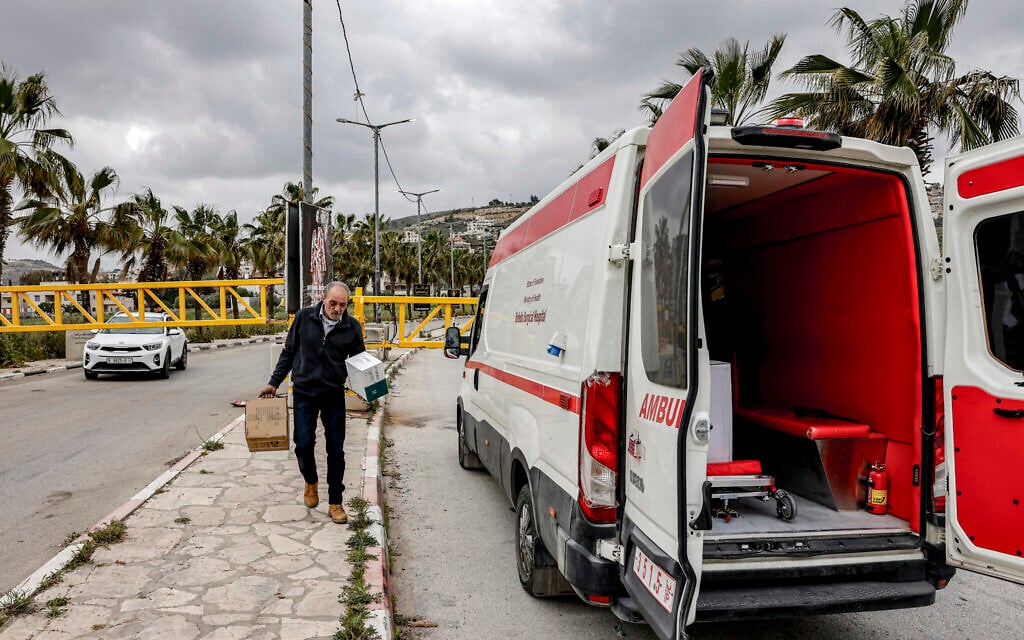
His clinic is one of hundreds of Palestinian Authority-run medical facilities across the West Bank that have closed over the past month as part of a strike declared by the Palestinian Medical Association on May 9.
The association has not published an exact figure for the number of clinics affected. However, according to Physicians for Human Rights Israel, an organization that monitors healthcare conditions in the West Bank and Gaza and provides assistance to Palestinians, most of the government-run clinics operating in the West Bank have closed, while a minority are open only once or twice a week.
Behind the strike lies a deep financial crisis facing the Palestinian Health Ministry, which operates the clinics.
The ministry is currently roughly NIS 3.5 billion ($1.2 billion) in debt, according to PHRI, affecting nearly every aspect of the healthcare system — from cuts to doctors’ salaries, to shortages of essential medicines, to a lack of basic equipment needed to conduct examinations in the PA’s 15 government hospitals and 447 public clinics, which normally provide free health care throughout the West Bank,
Get The Times of Israel's Daily Edition
by email and never miss our top stories
By signing up, you agree to the terms
According to Qudami, the Palestinian Medical Association didn’t strike over doctors’ salaries but rather because clinics and hospitals can barely function under the weight of mounting debts, prompting health workers to demand that the PA find a solution to the financial crisis.
“The strike is happening because I sit in the clinic and cannot help patients,” he told The Times of Israel.
Withheld tax revenues
The crisis is the culmination of years of financial deterioration in the PA, stemming largely from tax revenues withheld by Israel, which collects levies at border crossings and ports on behalf of Ramallah, compounded by longstanding allegations of corruption and financial mismanagement within the authority.
The withheld tax revenues amount to hundreds of millions of shekels each month and account for roughly 60 percent of the PA’s income.
In 2019, Israel began deducting sums to offset stipends given by the PA to convicted terrorists and their families, and following the October 7, 2023, massacre, also began withholding funds earmarked for Gaza, including pensions for Gazans employed by the PA before the Strip was seized by Hamas in 2007.
Over the past year, Israel has stopped transferring the funds altogether, acting on instructions from Finance Minister Bezalel Smotrich. The decision was made because of what Smotrich described in an April statement as the PA’s “activity against the State of Israel in the international arena and its support for the encouragement of terrorism.”
The move has significantly deepened the financial crisis for the perennially cash-strapped PA, which has cut public sector salaries and slashed services in recent months, including for healthcare.
In an interview with the Le Monde on June 10, Palestinian Authority Finance Minister Estephan Salameh said that the total amount currently being withheld by Israel stands at $5.7 billion.
Though on paper, the PA Health Ministry operates in both Gaza and the West Bank, there are in fact two separate Health Ministry entities, with the Gaza ministry under the control of the Hamas terror group. In 2007, when Hamas violently seized power in the Strip, the PA stopped paying Gaza employees’ salaries and ceased being responsible for its hospitals, remaining involved only in cases involving the referral of patients for treatment outside the enclave.
Drug shortage
Dr. Salah Haj Yahya, an Israeli citizen from Taibe, has headed PHRI’s mobile clinic for nearly 40 years, providing free medical treatment to Palestinian patients.
According to Haj Yahya, who maintains close ties with Palestinian health workers, there has been an unprecedented deterioration in recent months in the availability of medicines and medical supplies in the West Bank.
Under normal circumstances, he told The Times of Israel, the Palestinian Health Ministry maintains stocks of roughly 1,200 types of medication. These days, however, between 800 and 900 of those medicines are in short supply. Painkillers of all kinds, as well as medications used to treat chronic conditions such as hypertension and diabetes, have largely disappeared from government clinics and hospitals.
“The shortage of medicines is a disaster,” he said, adding that the crisis affects not only patients who rely on medication but also the ability of hospitals to carry out more complex procedures.
“The Palestinian Health Ministry cannot purchase prostheses for joint replacement surgeries, for example. It cannot buy the disposable medical supplies needed in operating rooms to perform surgeries, so everything is being postponed.”
On May 23, the Palestinian Health Ministry warned of a “critical depletion” of life-saving medications in the West Bank, including cancer drugs.
The shortages stem from the massive debt accumulated by the Palestinian Health Ministry, much of which is owed to around 30 major Palestinian suppliers that import medicines and medical equipment into the West Bank from abroad, according to PHRI.
Virtually all medical supplies and pharmaceuticals used in the West Bank are imported due to the lack of local manufacturing capacity. According to Haj Yahya, the ministry’s mounting debts have led many suppliers in recent months to halt imports until they are paid for equipment and medications already delivered.
Another major portion of the debt is owed to private hospitals in the West Bank that treat patients on behalf of the Palestinian Health Ministry, which is supposed to foot the bill.
According to the Palestinian Central Bureau of Statistics, there are 15 government hospitals in the West Bank, alongside 38 non-governmental hospitals, including both private, for-profit institutions and nonprofit hospitals operated by charities and other organizations.
While no official announcement has been made suspending cooperation between public and private hospitals, media reports suggest it is increasingly strained by the ministry’s debts.
In February, a hospital in Bethlehem announced that it would stop accepting patients referred by the ministry due to an outstanding debt of NIS 80 million.
The result has been a growing demand for assistance reaching organizations such as Physicians for Human Rights Israel. Haj Yahya said he has been inundated with requests for medication.
“I receive dozens, if not hundreds, of requests every day from Palestinian patients seeking even the most basic medications,” he said. “That includes all types of insulin, as well as medicines for cancer patients and kidney patients. They simply are not available in the West Bank.”
‘What am I supposed to do’
For West Bank Palestinians with no access to medical care due to the shortages and strike, Physicians for Human Rights Israel is among the only organizations helping fill the gap. Palestinians registered as refugees also have access to clinics operated by UNRWA, though the UN agency has faced its own funding issues.
On June 9, doctors and health workers volunteering with PHRI set up a mobile clinic in the village of Nasariya, near Nablus. Over roughly seven hours of activity, Palestinian doctors treated 371 people, examining patients, conducting tests and distributing medication free of charge.
Haj Yahya said demand for the organization’s services has risen sharply as the crisis has deepened.
“In the past, we would see 200 or 250 patients in a day. When 300 showed up, we would say it had been a crazy, exhausting day,” he said. “But in early June, more than 750 people came to a treatment day in a village near Jenin. The doctors worked from the morning until almost six in the evening.”
Qudami took part in the Nasariya mobile clinic, the first time in several weeks that he had practiced medicine. He described deep frustration over salaries continuing to be slashed and his inability to provide adequate care to patients.
“A patient comes to the clinic, and I have no medication to give him. I don’t have the ability to run tests. What am I supposed to do?” Qudami said. “If the patient doesn’t receive treatment, his condition will continue to worsen until he dies.”
At the same time, doctors and other health care workers are struggling to get by on only a fraction of their normal wages.
Since 2021, the PA has failed to pay its employees — including doctors working in government hospitals and clinics — their full salaries and only disburses money after significant delays.
In April, the PA began paying out January salaries, but capped them at NIS 2,000 ($650) per employee, regardless of position, a new low. In the past, senior employees who were supposed to earn salaries of up to NIS 10,000 ($3,300) per month would only have had half that amount garnished at most.
In late May, as the major holiday of Eid al-Adha approached, the Palestinian Finance Ministry pledged to make more payments.
The Times of Israel learned through conversations with Palestinian Authority clerks that partial salaries amounting to roughly 50% of wages were paid during the week of Eid al-Adha.
That week, Qudami received approximately NIS 3,000 ($1,000) for his February wages.
On June 25, employees were paid 50 percent of their March salaries, or at least NIS 2,000, according to a statement by the Palestinian Finance Ministry.
An emergency room physician at the government-run Thabet Thabet Hospital in Tulkarem, who spoke to The Times of Israel on condition of anonymity, said medical residents who are still undergoing specialty training were working without any pay at all.
She said that three residents in her department were currently completing their training on a voluntary basis, receiving no salary.
“It’s bad, but they have to do it [to complete their training],” the doctor said.
Like Qudami, the Tulkarem physician said the salary cuts were just a small part of the crisis.
“The difficult part is not only that we’re receiving half salaries,” she said. “It’s that we’re unable to provide services to patients.”
Rock and a hard place
On June 9, the Palestinian Medical Association announced a partial restoration of some services suspended during the strike, intended to “provide an opportunity to reach an agreement with the Palestinian government.”
According to Physicians for Human Rights Israel, however, the change has been minimal: Some of the clinics that had been operating only one day a week increased activity to two days a week, while most others remained closed.
Government hospitals, meanwhile, continue to operate on an emergency-only basis. According to the Tulkarem physician, that means only those few who can afford treatment at private hospitals are receiving non-emergency care.
“A person who comes to a government hospital today has to suffice with half of the medications they need because of the shortages, and only the most urgent cases are being treated,” she said. “The economic situation in the West Bank is very difficult. On one hand, people cannot rely on government hospitals because services are limited. On the other hand, they do not have the money to be hospitalized in private hospitals. They are caught between a rock and a hard place.”
In Israel, the main union representing doctors and other health care workers has warned that the PA’s financial crisis is putting both Palestinian healthcare and regional public health at risk.
On June 7, Israel Medical Association head Prof. Zion Hagay sent a letter to Prime Minister Benjamin Netanyahu warning that that the closure of clinics, shortages of medication and delays in surgeries were creating “a severe humanitarian crisis with direct implications for public health and regional stability.”
In a rare instance of the IMA attempting to steer foreign policy, Hagay urged Netanyahu to reconsider the withholding Palestinian tax revenues and to find a mechanism that would allow the money to be transferred, particularly for healthcare.
The collapse of the Palestinian healthcare system could lead to “the spread of disease, worsening civilian hardship and deeper security instability,” he warned.
The prime minister has not publicly responded to the letter.
Asked whether he fears the collapse of the West Bank’s healthcare sector, Qudami responded with a bitter laugh.
“Doctors have stopped showing up to primary healthcare centers. They’re closed,” he said. “The collapse has already happened.”
View original source — Times of Israel ↗
Related stories

South China Morning Post
TechnologyJun 29, 2026 · 1 min
Nasa turns to robotic spacecraft to save telescope from falling back to Earth
South China Morning Post

TechSathi
TechnologyJun 29, 2026 · 1 min
5 Best Temporary Email (Temp Mail) Services in 2026
TechSathi
Dawn
TechnologyJun 29, 2026 · 1 min
Iran and US agree to halt attacks and renew talks, US official says
Dawn

AllAfrica
TechnologyJun 29, 2026 · 1 min
Kenya: Missing Activist Davis Lichuma Found Alive At KNH After Alleged Abduction and Torture
AllAfrica