BBC Sport
When five Wimbledon titles in one weekend changed British tennis
Murray reckons his memory of some of his tennis matches and tournaments is getting a little hazy.
Not this one, though. He's watched championship point "a few times" since.
In an era where many of his Grand Slam title attempts had been thwarted by Roger Federer, Novak Djokovic and Rafael Nadal, he had found himself in the less familiar position of being favourite in a major final.
Federer had been stunned by Milos Raonic in the semi-finals, while Djokovic had suffered a shock third-round defeat and Nadal was absent through injury. But on top of this or even regardless of this, Murray was in phenomenal form.
He had dropped only two sets on his way to the final and had been runner-up at the two other Grand Slams so far that year, as well as winning Queen's and the Italian Open.
He had also won Wimbledon three years earlier to finally take off the annual pressure to end a more-than-seven-decade-long wait for a British men's champion.
In the face of all that, his opponent had no chance.
By the time Murray got his first break in the opening set, Lewis Hamilton had just won the British Grand Prix at Silverstone and there was never any question a fantastic weekend for the nation was not going to get even better.
Murray duly delivered, winning 6-4 7-6 (7-3) 7-6 (7-2).
Asked what his memories of the moment were, in typically understated fashion he remembers "hitting an approach shot with my forehand into Raonic's backhand and him missing the passing shot into the net".
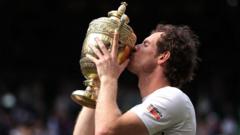
He doesn't mention the tears of joy he cried into his towel repeatedly, or the famous trophy he hugged so hard that he looked like he never wanted to let go – even in the ice bath later.
And he didn't know then yet why he really, really needed to savour those moments.
Even Murray's usually impassive coach Ivan Lendl had cracked and had tears in his eyes along with the rest of Centre Court and the country at the magnitude of the achievement.
"Feel good?" Sue Barker opened her on-court interview with the new champion. "Er, yeah" replied Murray in possibly the understatement of his life.
He thanked his team and family before blundering into acknowledging the prime minister in the Royal Box. Cue boos for David Cameron, who had a couple of weeks earlier announced his plans to stand down in the aftermath of the Brexit vote.
Murray defused the situation adeptly, declaring: "Playing at a Wimbledon final is tough and I certainly wouldn't want to be Prime Minister, it's a tough job."
Cheers resumed before Murray headed on to the balcony of the Wimbledon pavilion to show off his trophy to the thousands of fans below, stopping to sign autographs and pose for selfies.
Within hours, the then 29-year-old Murray was already looking to the future, saying he felt his best tennis was ahead of him.
He was not entirely wrong. A few weeks later he became the first double Olympic singles champion and by the end of the year was world number one.
But then in 2017 came the hip injury that required major surgery and ultimately denied him the chance of adding to those major titles despite the valiant efforts over the next seven years.
Asked what he would now tell his 2016 self at Wimbledon, he replied: "Appreciate that moment for a long time because they're gone very quickly."
Thankfully, having said that his 2013 triumph was more a relief than anything else, this victory was one he was determined to enjoy – and he stayed up all night to do just that.
But more on that later, there was still one more British trophy to win…
"It's sort of a whirlwind," Watson says of the moments after lifting the final trophy of the weekend.
"You go straight into the locker room, shower, you've done your press, and there's a rack of ball gowns, shoes, bags, accessories, and you just pick your outfit… hair and make-up.
"You then go straight to the ball … and that is an experience all in itself."
Murray had said beforehand that there was no way he would be doing the traditional dance with the women's champion "unless I've had a few glasses of champagne".
The evidence points to exactly this happening. Watson is certain she remembers him dancing with Serena Williams, and Murray himself revealed a few years later that he had been sick in a taxi on the way back from his night out.
Hewett, who was 18 at the time and took his grandad with him to the ball, remembers being excited by the "fancy red carpet", while Reid says he shared a "cool moment" where Murray sought out his fellow Scot to congratulate him and invite him to the after-party.
"Unfortunately our paths got lost when we were getting in the cars. Maybe [that was] better for the head the next day though," he laughed.
Watson, though, carried on celebrating through the night with Murray.
"I think we partied till 7am that night. And then we actually had to leave at 7am. I didn't even realise the time because I was having that much of a good time," she said.
"Henri said to me, 'Heather, I've got to go. My flight's in an hour.' I was like, oh my God."
The hangovers from the party have long been slept off but the after-effects of that golden weekend for British tennis are still being felt today.
Murray went on to win another five tour titles that year, including the ATP Finals that secured the world number one spot and set a new standard for the next generation.
While no-one has come close to emulating that since, there have been other successes over the past decade, including Emma Raducanu ending Britain's 44-year wait for a female Grand Slam singles champion with her 2021 US Open victory and a strengthening in depth within British tennis particularly in the men's game.
In 2016 there were three men in the top 200 of the singles world rankings, which has grown to eight now.
There has also been a huge upturn in doubles – in the 10 years before 2016 there had been only two Grand Slam doubles trophies won by Britons, while in the decade since there have been 20. Watson's title was one of three won by Britons that year, with Murray's brother Jamie winning the other two and also ending the year as doubles world number one.
"Even though it's an individual sport, there's no doubt that having someone who does set the bar high helps and even just shows you what's possible," said former British number one Kyle Edmund.
The influence of that great weekend of British success at Wimbledon is also being felt in wheelchair tennis, where a Court 17 final in front of a couple of hundred fans has grown to a Court One showpiece in front of thousands.
The 'Murray effect' has been widely viewed as contributing to increases in participation at grassroots level, with the LTA last year reporting the highest ever figures for adult annual participation of 5.8 million and four million children playing tennis each year.
British tennis' governing body has also stepped up its investment, including a £250m injection over the past decade into refurbishing public courts, raising the number of covered and floodlit courts and making it easier to book online.
And, even though Murray has been retired for two years, his influence is still been felt on court, whether through his formal coaching of Jack Draper or his informal mentoring of up-and-coming players.
"I feel like I can reach out to him. I played nine holes of golf with him in December and got to chat and ask him questions," British number eight Jack Pinnington Jones said.
There are 21 British players in the main singles draws at Wimbledon this year, including for the first time since 1999 three who have progressed from qualifying, and it remains to be seen what that will bring.
But 2016? Well, in the words of Hewett: "Wow, what a year."
Additional reporting by Kate McKenna and Jonathan Jurejko
View original source — BBC Sport ↗
Related stories
BBC Sport
SportsJun 29, 2026 · 1 min
Lewandowski close to Chicago Fire switch
BBC Sport

TASS
SportsJun 29, 2026 · 1 min
Israeli army strikes three Hezbollah command centers in response to ceasefire violations
TASS

ESPN
SportsJun 29, 2026 · 1 min
Transfer rumors, news: Barcelona eye Kane, plus tw...
ESPN

BBC Sport
SportsJun 29, 2026 · 1 min
Norway fans cheer Hovland into Monday play-off with Scheffler
BBC Sport