South China Morning Post
South China Morning Post··4 min read
From invention to impact: Hong Kong Science Fair gives young innovators a wider stage
[The content of this article has been produced by our advertising partner.]
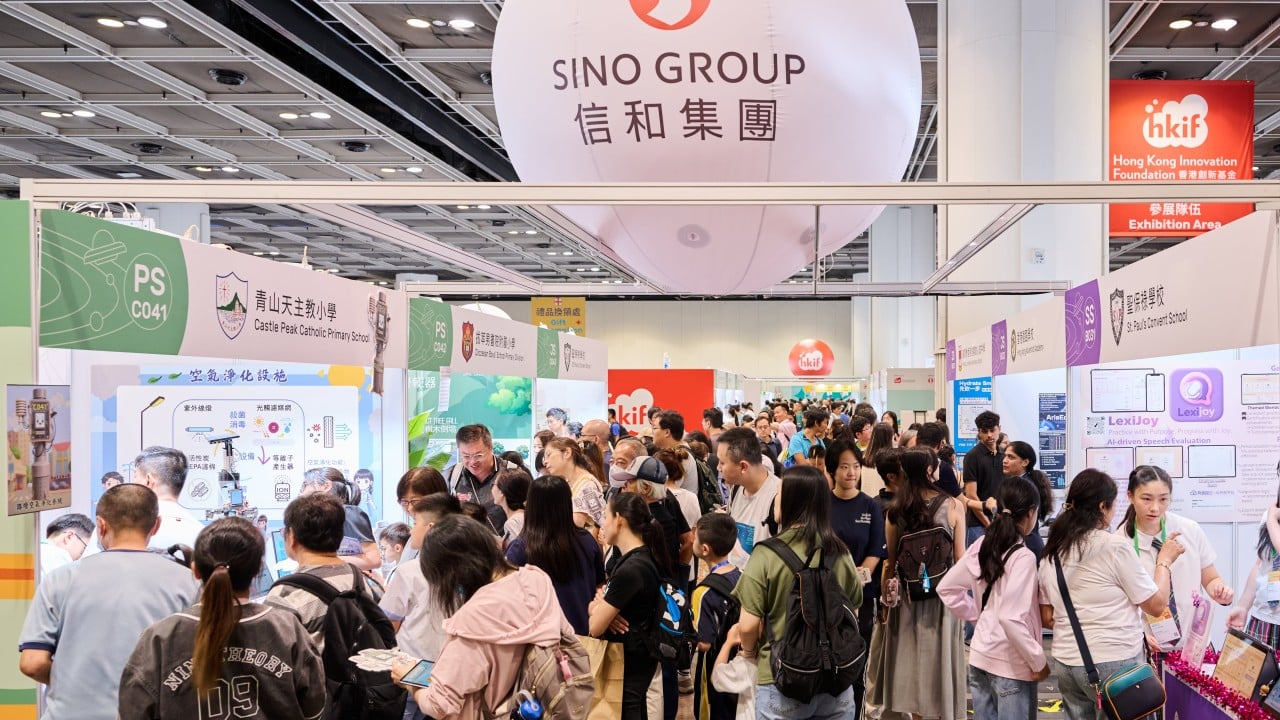
This year’s event drew more than 60,000 visits over two days at the Hong Kong Convention and Exhibition Centre. Around 120 shortlisted teams from primary and secondary schools presented inventions that combine AI with other technologies to tackle everyday challenges.
Secretary for Innovation, Technology and Industry Professor Sun Dong described the Hong Kong Science Fair as an annual flagship innovation and technology education event, noting that it gives students valuable opportunities to unleash their potential and embody the spirit of “Think Big Be Innovative”.
The HKSAR Government is actively promoting “AI for All” to enhance public understanding and application of AI, while fostering a stronger culture of science popularisation across society, he added.
Daryl Ng, Chairman of the Hong Kong Innovation Foundation and Chairman of Sino Group, said he was inspired by the creativity and innovation of the participating students, who turned everyday problems into practical solutions through imagination, hard work and persistence.
He also expressed his deep gratitude to the Central Government, the HKSAR Government, and the Innovation, Technology and Industry Bureau for their strong and continuous support in helping the Science Fair grow into a major platform for young innovators since its launch.
Organisers announced that teams from overseas will join the event for the first time next year. This aligns with the 30th anniversary of the HKSAR’s establishment and will open fresh opportunities for young innovators to share ideas with peers from around the world.
Turning ideas into solutions
That broader sense of momentum could be seen in the projects on displays, many of which began with students observing challenges in their immediate surroundings, then moved through research, testing and refinement to turn those observations into working solutions.
For some winners, further opportunities will come quickly.
Award-winning teams from the Junior Secondary Division, Senior Secondary Division and the Testing and Certification Special Award will also be invited to attend Asian Science Camp 2026, hosted by The University of Hong Kong.
There, outstanding students from across Asia will take part in academic exchange and engage with leading scientists, including Nobel Laureates.
One project that stood out came from Chinese International School, where students developed the “Automated Rail Sanitiser (ARS)”.
The team noticed that MTR handrails carried high levels of bacteria during peak hours. “We go to school every day by MTR, so we had to know that there was going to be actually some germs inside,” team member Lucas Mao explained.
They developed an automated rail sanitiser that uses a photovoltaic-powered robot with a hexagonal gripping system and UV-C light to climb and disinfect poles automatically at terminal stations. The project won the Gold Award in the Senior Secondary Division.
Among younger students, the same interest in how city systems work took another form. In the Primary Division, the Tin Shui Wai Methodist Primary School team developed “Park & Easy Toll”, a smart parking meter system that integrates AI camera technology with the HKeToll electronic payment system.
The system automatically detects licence plates, records parking time and calculates progressive charges. It won the Gold Award in its category.
Other shortlisted teams focused on health, safety and environmental concerns closer to home. For example, students from West Island School were concerned about harmful chemicals in conventional whiteboard markers and developed a non-toxic alternative using ethyl lactate and other natural materials.
Building connections and confidence
This year the Foundation for the Development of Science and Technology in China joined as an Advisory Organisation for the first time. Zhu Jin, Deputy Secretary-General of the Foundation, said the projects showed both technical skill and awareness of societal needs.
That idea was echoed in the way organisers encouraged students to think not only about invention, but also about reliability and public confidence. Participants were encouraged to consider product quality from the early stages of their work.
The Hong Kong Council for Testing and Certification supported the fair through the Testing and Certification Special Award. Professor Wong Wing-tak, Chairman of the Council, said that integrating testing and certification early helps young innovators turn scientific ideas into trustworthy solutions.
Looking ahead
Since its launch in 2021, the Hong Kong Science Fair has drawn more than 400 local schools and involved nearly 9,000 students and teachers from Primary 4 to Secondary 6. More than 2,200 invention projects have been submitted in total. This year alone saw over 500 entries before around 120 finalists were selected.
The exhibition also offered aerospace-themed activities inspired by Hong Kong’s first astronaut, Dr Lai Ka-ying, as well as opportunities to interact with humanoid robots from UBTECH Robotics. Families could explore science through hands-on activities in the interactive zones.
As this year’s fair drew to a close, the strongest impression came from the confidence shown by students as they set their sights beyond the competition itself.
Next year’s edition will welcome overseas teams for the first time and open another chapter for a platform that continues to create opportunities for young innovators to share ideas and move their projects forward.
View original source — South China Morning Post ↗
Related stories

The Punch
NewsJun 29, 2026 · 1 min
Soludo awards scholarship to Anambra UTME top scorer
The Punch
The Punch
PoliticsJun 29, 2026 · 1 min
Protest peacefully, lawfully, Ramaphosa tells South Africans ahead of Tuesday rally
The Punch
The Punch
NewsJun 29, 2026 · 1 min
FG to unveil digital system to track every Nigerian school, learner
The Punch
The Punch
BusinessJun 29, 2026 · 1 min
UK cigarette giant BAT to cut 5,500 jobs globally
The Punch