Indian Express
Indian Express··5 min read
Akal Takht sets one-month deadline for Punjab to amend anti-sacrilege law
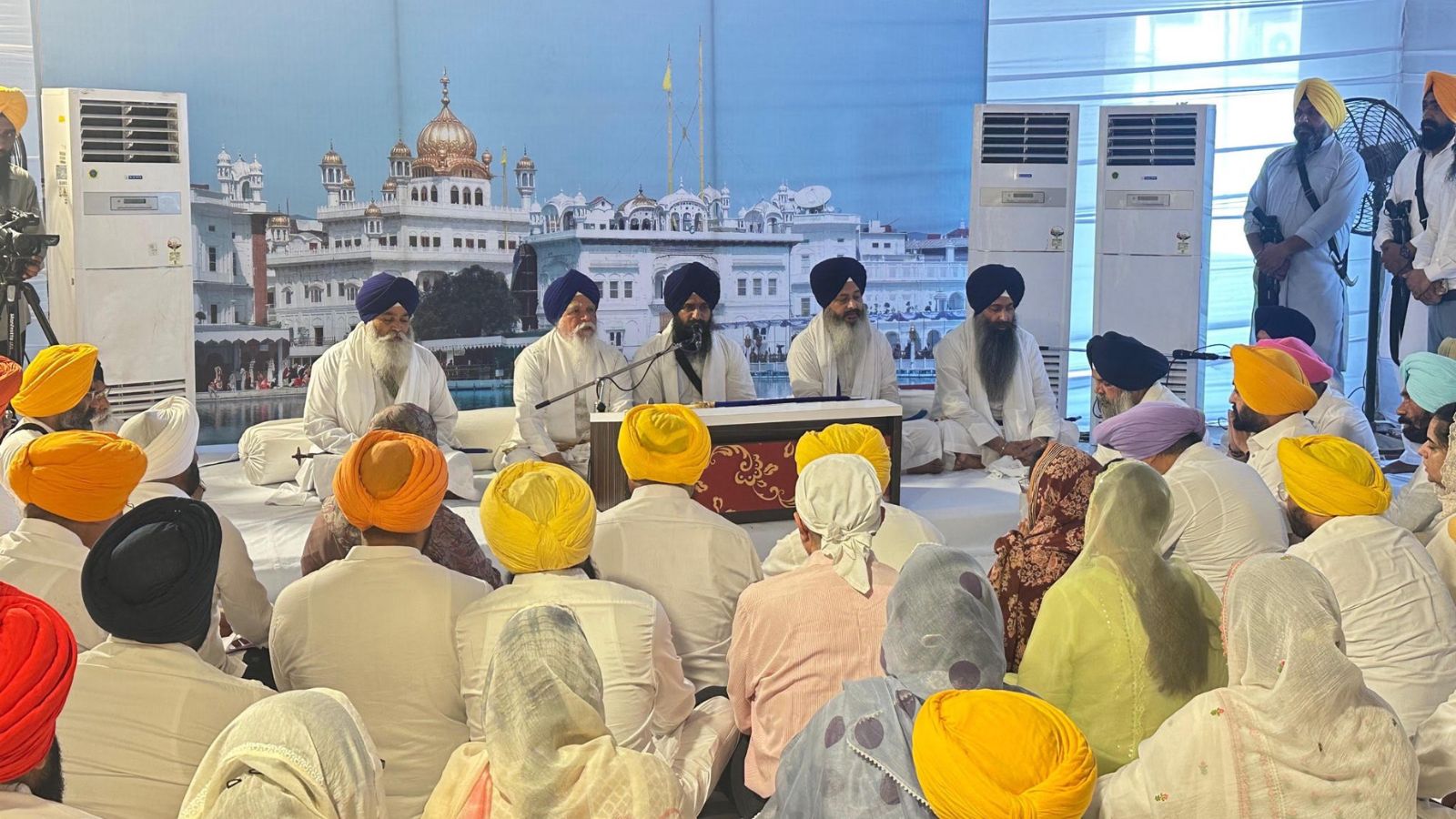
The Akal Takht Monday gave the Punjab Government a month to amend the anti-sacrilege law, after ministers and legislators across party lines agreed to revise provisions the Sikh temporal authority said encroached on matters of religious doctrine and governance.
Last week, the Akal Takht had summoned all 78 Sikh MLAs and nine Sikh ministers, asking them to appear before it in connection with The Jagat Jyot Sri Guru Granth Sahib Satkar (Amendment) Act, 2026, which it said had been notified by the Punjab Government “without consultation or consent from Sri Akal Takht Sahib, the SGPC and the Guru Khalsa Panth”.
“We will give you our objections in writing; call your House and remove those objections,” Akal Takht Jathedar Kuldip Singh Gargajj told the legislators during the proceedings.
Gurgajj, Takht Damdma Sahib Jathedar Tek Singh, head priest of the Golden Temple, Baljeet Singh, and Keval Singh and Mangal Singh, priests on the five-member Akal Takht panel, presided over the meeting.
The Aam Aadmi Party (AAP)’s Amritsar South MLA Inderbir Singh Nijjar said the government is ready to make any amendment if needed.
‘Don’t have the right to decide Sikh vocabulary’
After an hour and a half, Gargajj and the ministers and MLAs agreed that while deliberate desecration must be punished, the legislature had gone too far in defining religious vocabulary, custodial roles and registry mechanisms — matters, the Takht argued, that belong to Sikh institutions such as SGPC and the Takhts.
“We have no objection to punishment — if someone is guilty, give punishment. But you do not have the right to decide on Sikh vocabulary. Sikh vocabulary will be decided by the Akal Takht and the Panth,” Gargajj said.
Story continues below this ad
He warned that historical terms such as bir cannot be unilaterally replaced by words like saroop without Panthic consent, and demanded that the Assembly not “substitute its judgment” on the Sikh code of conduct.
A central focus of the hearing was the Act’s definition of “custodian” and the creation of a central register of saroops with unique identification numbers.
Gargajj pressed for precise remedies and demanded that damaged saroops be treated not as private property but as sacred objects. “After an incident where a saroop is damaged, it should go to the nearest gurdwara,” he said.
He also warned that posting registry details online could expose private homes and gurdwaras to scrutiny and potential penal action. “If you put unique numbers and put records on a website, everyone will know where each saroop is kept. Who will be held responsible if something goes wrong?” Gargajj asked.
Story continues below this ad
The jathedar acknowledged the need for firm action against deliberate offenders and for protective measures at gurdwaras, including 24‑hour sevadaar duty where required.
He also reiterated that religious definitions, custodial rights, and rules based on the Sikh code of conduct must be determined by the Panth. “Gurmat must decide these questions; the Assembly cannot substitute its judgment,” he said.
What the MLAs said
According to most of the MLAs, they had received the Bill on short notice and had little time to study a law with “serious consequences.”
“The Cabinet approved it on April 11, it was posted on the website late on April 12, and we received it on April 13,” Congress MLA Tripat Rajinder Singh Bajwa told the jathedar.
Story continues below this ad
Several other legislators, including AAP MLAs Jagrup Singh Gill and Kulwant Singh, also said they had not read the full draft before approving it.
SAD(B) MLA Ganeev Kaur said she had not attended the Assembly on the day the Bill was passed because the Akal Takht had advised consultation with the Takht and the Shiromani Gurdwara Parbandhak Committee (SGPC).
Congress MLA and former minister Sukhpal Singh Khaira accused the government of secrecy and haste.
Leader of Opposition Partap Singh Bajwa urged that the select committee’s report be tabled and discussed in the House before any further action on the amended Bill. “The committee recorded many views over nine months. Please present that report before proceeding,” he said.
Story continues below this ad
Akali Dal (Warris Punjab De)’s Manpreet Singh Ayali said the intent of the law may be sound, but it should not be left open to misuse.
The Akal Takht said it would send its detailed written objections and technical suggestions through the Punjab Assembly Speaker, Kultar Singh Sandhwan.
After the meeting, Sandhwan said the discussion had been “long” and “meaningful,” adding that the matter would now be taken up by the government for reconsideration. He stressed that the Akal Takht is a “very sacred throne” and said its dignity, along with the institution’s honour, must be respected.
Minister Harpal Cheema said the government would hold deliberations once it received the Akal Takht’s written amendments and that a decision would be taken within a month.
Story continues below this ad
Here’s the list of amendments and changes the Akal Takht demanded:
1. Remove the replacement of the word “bir” with “saroop” wherever it appears in the Act
2. Stop the legislature from defining Sikh religious vocabulary, and leave such decisions to the Akal Takht and the Panth
3. Delete or redraft the Bill’s definition of “custodian”
4. Remove the clause that makes custodians responsible
5. Rework the central register of saroops so it does not expose where sacred copies are kept or put devotees’ details on public record
Story continues below this ad
6. Drop or narrow the unique identification number system for saroops, because the jathedar said it is a Panthic matter, not a legislative one.
7. Clarify that a damaged or accidentally affected saroop should be taken to the nearest gurdwara and not treated as private property
8. Add a clearer provision against deliberate or staged sacrilege by dera, sect or cult groups and their supporters
9. Ensure that anyone who shelters or protects a deliberate offender can also be prosecuted
Story continues below this ad
10. Remove vague phrases that can criminalise ordinary mistakes, accidental incidents, or unclear speech
11. Table the Select Committee’s report in the House before pushing the amendment further
12. Hold the law in abeyance until the Akal Takht and SGPC objections are addressed.
View original source — Indian Express ↗
Related stories

ESPN
SportsJun 29, 2026 · 1 min
Evel Knievel, Chuck Yeager and the daredevil that ...
ESPN

ESPN
SportsJun 29, 2026 · 1 min
America 250 road trips! Journey into the mystery a...
ESPN

ESPN
SportsJun 29, 2026 · 1 min
World Cup Daily LIVE: Marsch's moves help Canada p...
ESPN

ESPN
SportsJun 29, 2026 · 1 min
Mendoza, Love, Reese and more: Checking in on ever...
ESPN