Indian Express
Sarla Bhat murder case: SIA names Yasin Malik, 4 JKLF operatives in chargesheet, 36 years on
4 min readSrinagarJun 29, 2026 06:34 PM IST
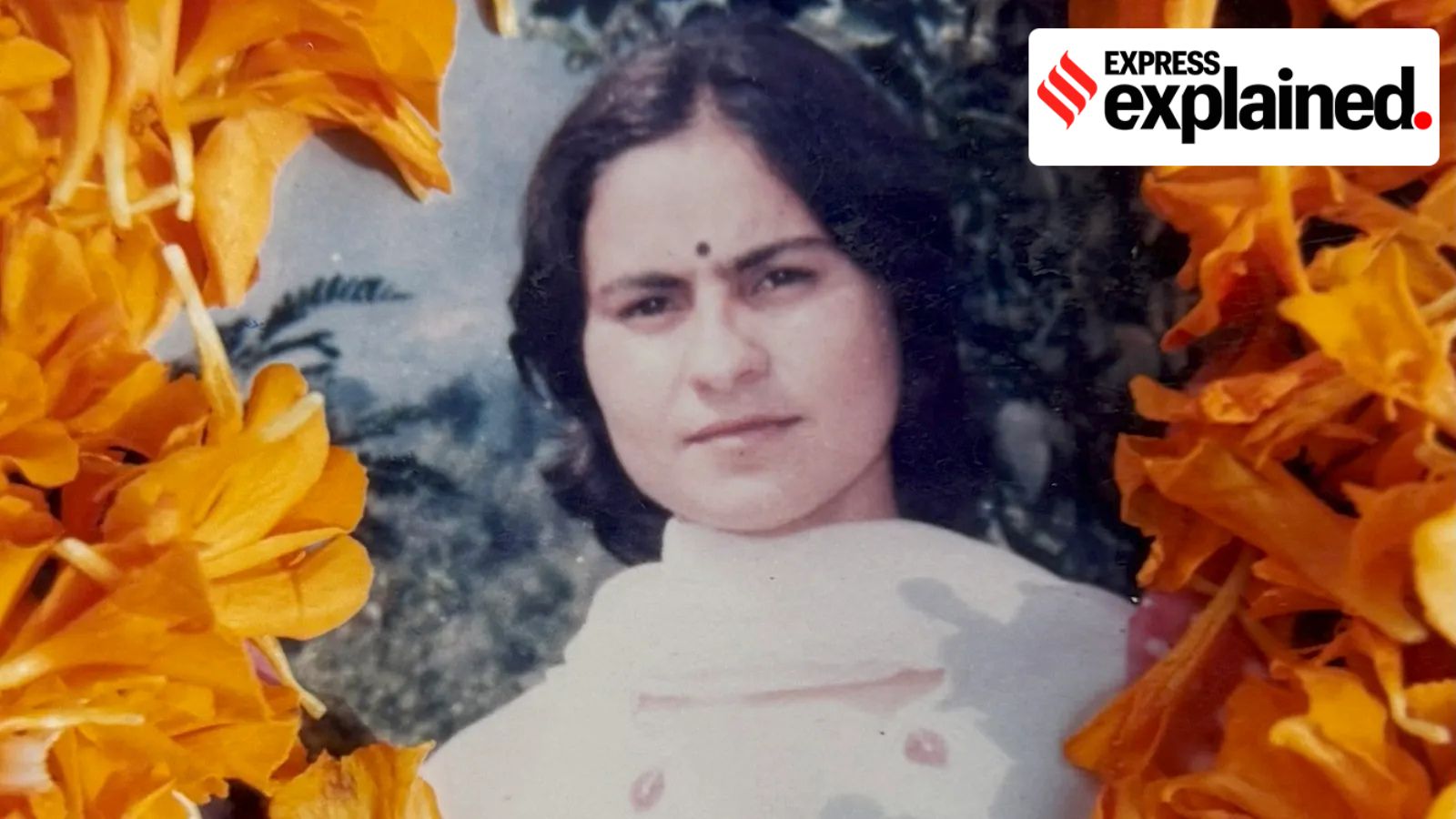
Sarla Bhat was a 27-year-old nurse from Qazibagh neighbourhood of south Kashmir's Anantnag.
Ten months after reopening the case in the murder of Kashmiri pandit nurse Sarla Bhat, the State Investigation Agency (SIA) on Monday (June 29) filed the chargesheet in the case.
The agency has charged five operatives of the banned Jammu Kashmir Liberation Front (JKLF) for murder, including its jailed chief, Yasin Malik. Of the other four accused, three — Abdul Hameed Sheikh, Ghulam Mohammad Taploo and Mohammad Yousuf Sofi — have already been killed, while the fourth one – Khursheed Ahmad Chalkoo is absconding. Chalkoo is believed to be in Pakistan.
We recall.
What was the case?
Sarla Bhat was a 27-year-old nurse from the Qazibagh neighbourhood of south Kashmir’s Anantnag. She was working at the Sheri Kashmir Institute of Medical Sciences (SKIMS) in Srinagar and was abducted and killed allegedly by the JKLF militants.
On April 18, 1990, Bhat was at her hostel when suspected militants barged in and abducted her at gunpoint. Her body, marked by multiple bullet wounds, was recovered the next day from Mallabagh, a locality close to the medical institute. A handwritten note recovered from her body accused her of “being a police informer”.
While most of the Kashmiri Pandits left the valley in early 1990 after the inception of militancy in Jammu and Kashmir, Bhat had decided to stay back.
The J-K Police registered a case (under FIR No 56/1990) against unidentified militants at the Nageen Police Station of Srinagar. Although several Kashmiri Pandit organisations claimed that Bhat was “tortured and raped” before being killed, the police report only mentioned the murder.
Since then, there was limited progress in the investigation, while most FIRs filed by the police in the early 1990s were eventually closed as untraced.
How was the case reopened?
Story continues below this ad
In 2017, ‘Roots in Kashmir’, a Pandit organisation, filed a petition in the Supreme Court seeking the reopening of cases and investigations into the killings of Kashmiri Pandits by an investigating agency outside Kashmir.
A division bench of the apex court, comprising the then Chief Justice of India J S Khehar and Justice D Y Chandrachud, rejected the petition, saying that 27 years had passed since the Pandit exodus from the Valley, and evidence “is unlikely to be available”.
In December 2022, the Supreme Court also dismissed a curative petition filed by the ‘Roots in Kashmir’ seeking a probe into the “genocide” of Kashmiri Pandits.
However, seven months later, the State Investigation Agency reopened the first case related to the murder of Kashmiri Pandits. The case related to the killing of Kashmiri Pandit judge Neelkanth Ganjoo, allegedly by JKLF militants in November 1989 in Srinagar. Ganjoo had sentenced Mohammad Maqbool Bhat, the JKLF founder, to death.
Story continues below this ad
Last August, the SIA reopened the probe into Bhat’s murder, making this the second case to be reopened by the agency. It then raided several places in Srinagar, including the residence of jailed JKLF chief Yasin Malik and former commander Javid Ahmad Mir, besides six other suspected JKLF operatives.
There is no definite number on how many Kashmiri Pandits were killed by militants in the initial years of insurgency. A report compiled by J&K Police in 2008, based on a survey of its own cases, revealed that between 1989 and 1990, militants killed 209 Kashmiri Pandits — 109 in 1990 alone. Kashmiri Pandit organisations, however, say the actual number is much higher than the police figures. According to the police survey, 140 cases were registered at police stations across the Valley. Chargesheets were filed in 24 cases, while 31 local militants were also booked in these cases. In 115 cases, the perpetrators remain unidentified.
Bashaarat Masood is a Special Correspondent with The Indian Express. He has been covering Jammu and Kashmir, especially the conflict-ridden Kashmir valley, for two decades. Bashaarat joined The Indian Express after completing his Masters in Mass Communication and Journalism from the University in Kashmir. He has been writing on politics, conflict and development. Bashaarat was awarded with the Ramnath Goenka Excellence in Journalism Awards in 2012 for his stories on the Pathribal fake encounter.
Expertise and Experience
Two Decades of Frontline Reporting: Bashaarat has spent 20 years documenting the evolution of Kashmir, from high-intensity conflict and political shifts to socio-economic development.
Award-Winning Investigative Journalism: He is a recipient of the prestigious Ramnath Goenka Excellence in Journalism Award (2012). This honor was bestowed for his reporting on the Pathribal fake encounter, a series of stories that highlighted his ability to handle sensitive human rights and security issues with investigative rigor.
Specialized Beats: His authoritative coverage spans:
Political Transitions: Tracking the shift from statehood to Union Territory, electoral dynamics, and the pulse of local governance.
Security & Conflict: Providing nuanced reporting on counter-insurgency, civil liberties, and the impact of the conflict on the civilian population.
Development: Documenting the infrastructure, healthcare, and educational landscape within the Valley.
Academic Background: He holds a Masters in Mass Communication and Journalism from the University of Kashmir, providing him with a localized academic and professional foundation that is rare in regional reporting. ... Read More
Tags:
Express Explained
View original source — Indian Express ↗
Related stories

TechRadar
TechnologyJun 29, 2026 · 1 min
The Steam Machine is overpriced yet it's sold out already in Japan — but be careful about buying a cheap clone
TechRadar

Portugal Resident
TechnologyJun 29, 2026 · 1 min
Throwing litter on ground can lead to heavy fines in Portugal
Portugal Resident

TechRadar
TechnologyJun 29, 2026 · 1 min
Samsung doubles down on 1000-layer NAND for petabyte SSDs as it sets its sights on elusive 32TB M.2 solid state drives…
TechRadar

TechRadar
TechnologyJun 29, 2026 · 1 min
How to watch Brazil vs Japan: Free Streams, TV Channels & Kick-Off time for FIFA World Cup 2026 as Vinicius Jr…
TechRadar