Times of Israel
Trump says next US-Iran meeting to be held in Doha Tuesday amid conflicting reports
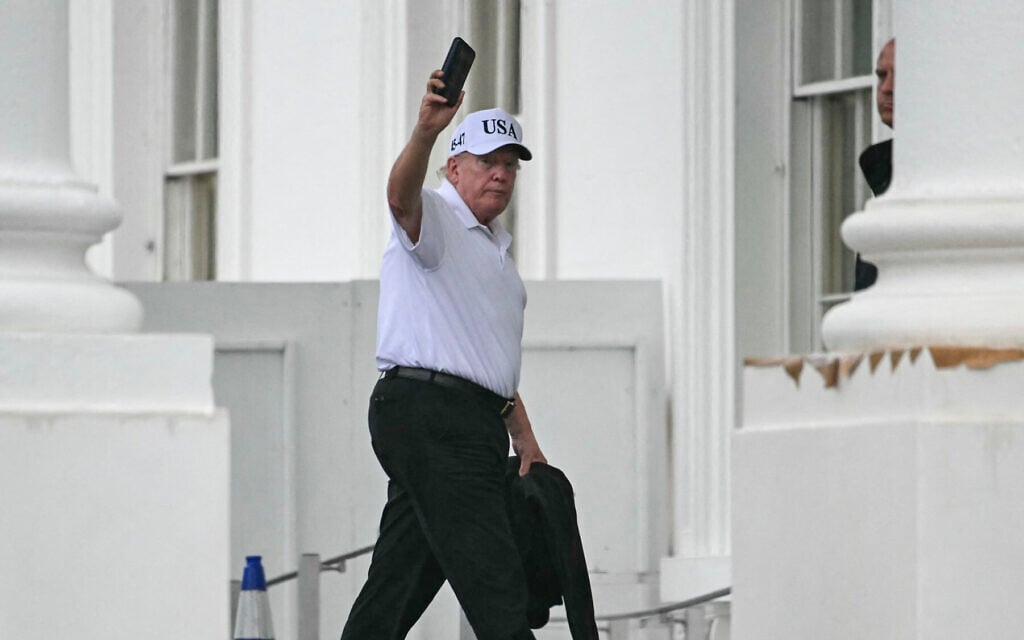
US President Donald Trump said Monday that his country’s next meeting with Iran would take place in Qatar on Tuesday, amid conflicting reports as to whether American and Iranian negotiators would meet in the coming days to continue talks toward a final accord.
“Iran has requested a meeting. It will take place tomorrow in Doha!” Trump said in a post on Truth Social.
Elaborating on the post, White House spokeswoman Karoline Leavitt told Fox News that Trump’s top envoys Steve Witkoff and Jared Kushner would attend the Doha meetings, which she described as “high-level.”
“On the sidelines of those high-level talks, there will be the technical talks,” she said.
Pakistan, a key mediator, also said talks would resume Tuesday, but Iranian officials said earlier Monday that no such meeting was scheduled.
Get The Times of Israel's Daily Edition
by email and never miss our top stories
By signing up, you agree to the terms
“Although consultations with Qatar, including on following up on the implementation of the other side’s commitments, are continuing as usual, reports by some media about technical talks by the working groups being held in Doha are not confirmed,” senior negotiator Kazem Gharibabadi said, in comments published by the official IRNA news agency.
Technical talks involve lower-level diplomats working on the specifics of any deal that would draw top leaders from Iran and the US back to the table.
Iran meets with Oman on Hormuz as traffic slows
Alongside the talks with the US, Gharibabadi said Monday that Iranian representatives had met with Oman, in what he called the first meeting of a joint committee on the Strait of Hormuz.
Gharibabadi said the two countries “exchanged views” on Gulf coastal states’ sovereign rights as well as on the strait’s future management based on the memorandum of understanding signed this month by Tehran and Washington.
In the strait, traffic slowed over the weekend after a vessel was struck while transiting the waterway on Saturday, as a fresh exchange of strikes between the United States and Iran strained their preliminary deal to end the conflict.
In total, 29 commodity vessels crossed on Saturday and 12 transited on Sunday, according to data from the maritime tracking firm Kpler.
Sunday’s figures marked a sharp decline from last week, after the MOU boosted traffic through the strait to its highest level since the start of the US-Israeli war with the Islamic Republic, reaching 70 crossings on Wednesday, according to Kpler.
Despite Iran’s warning against using unapproved shipping lanes, vessels continued to take several routes through the waterway over the weekend, data showed. The website tracks only vessels with active transponders, meaning additional ships may have crossed with their signals switched off.
More ships entered the Gulf over the weekend than departed, reversing a trend seen over the previous week, when efforts focused on evacuating seafarers stranded in the Gulf. A UN-led operation to evacuate 11,000 seafarers was suspended on Thursday after a vessel was struck in the Gulf of Oman.
Four tankers and a container ship used the southern Omani corridor to enter the Gulf Sunday, escorted by US Navy vessels, according to a post on X by HFI Research. No vessels used that corridor to exit the Gulf Sunday, according to Kpler.
Total figures may rise further as crossings are identified retrospectively, notably through satellite imagery.
Pezeshkian claims $6 billion in frozen assets to be released by Qatar
Also on Monday, Iran’s president said that $6 billion in frozen Iranian assets would be released by Qatar as part of the deal signed with the US.
Masoud Pezeshkian’s mention of the funds appeared aimed at selling Iranians on the interim deal, which he called “a great victory for the Iranian people.”
“Based on the plans made, $6 billion out of the total $12 billion of Iranian resources in Qatar will be released and returned to the country, and necessary follow-ups are being carried out,” he said, but did not elaborate.
Pezeshkian, a reformist within Iran’s theocracy, is the highest-ranking official within Iran to reference the release of the funds held by Qatar, a key mediator along with Pakistan in the negotiations.
So far, US officials say no frozen Iranian assets have been released.
Qatar has not acknowledged any such transfer, and Iran attacked a tanker filled with Qatari crude oil this weekend during the crossfire in the Persian Gulf.
View original source — Times of Israel ↗
Related stories

The Punch
PoliticsJun 29, 2026 · 1 min
Why Adamawa will re-elect Tinubu in 2027 – APC chieftain
The Punch
The Punch
PoliticsJun 29, 2026 · 1 min
Institute raises the alarm over rising political violence in Osun
The Punch
The Punch
PoliticsJun 29, 2026 · 1 min
Tinubu swears in RMAFC, NPC commissioners, presides over FEC meeting
The Punch
The Punch
PoliticsJun 29, 2026 · 1 min
Court hears suit challenging Duke’s PRP presidential ticket July 7
The Punch