Times of Israel
Times of Israel··4 min read
Judges again call on prosecution to drop bribery charge from Netanyahu trial
The panel of judges overseeing the corruption trial of Prime Minister Benjamin Netanyahu reiterated on Monday their suggestion that the prosecution drop the bribery charge against the premier, given that it will be difficult to prove and thus drag out the proceedings.
The judges made the same recommendation exactly three years ago for the same reason, but the prosecution declined to drop the charge. The court has since heard extensive testimony from Netanyahu on the allegations, none of which changed the recommendation. On Monday, the judges told the court that their recommendation from June 2023 “remains unchanged.”
During the hearing in the Jerusalem District Court on Monday about expanding sessions to five days a week in the long-running trial, chief defense attorney Amit Hadad suggested the judges were treating Netanyahu in a manner similar to Adolf Eichmann, a key architect of the Holocaust who was captured by the Mossad in Argentina in 1960, put on trial in Israel, convicted and executed.
“No trial has ever been conducted five days a week, only the Eichmann trial,” Hadad argued, insisting that the proposed schedule was unrealistic.
He also warned that keeping the bribery charge on the docket would draw out the trial.
Get The Times of Israel's Daily Edition
by email and never miss our top stories
By signing up, you agree to the terms
“If the bribery charge remains, we’ll have hundreds of witnesses here. There’s no chance we would finish by March 2028,” he said, according to Hebrew media reports.
Judge Rivka Friedman-Feldman, one of the three judges on the panel hearing Netanyahu’s case, is slated for mandatory retirement in March 2028. All judges in Israel are forced to retire when they turn 70 years old.
“I told the prime minister we are facing dire straits, I have no way to provide proper defense,” Hadad said, as quoted by the Ynet news outlet.
He further claimed that the schedule would leave no time for holidays, family, or Netanyahu’s personal life, insisting that it would be “impossible to conduct a trial this way.”
The Eichmann trial is the most famous court proceeding in Israel’s history, and the only time Israel has carried out the death penalty.
The prosecutor in the case, Yehudit Tirosh, concurred that it was unreasonable to hold five hearings a week.
“Five days is a very difficult thing for a prosecution or defense team, close to impossible,” she said, according to Ynet.
She added that the trial’s current intense schedule of four hearings per week has already forced her to ask her team to violate legal limits on working hours.
The attempt to increase the number of hearings per week comes over six years into the trial, which began in May 2020. The initial investigation into Netanyahu was opened almost a decade ago, in late 2016.
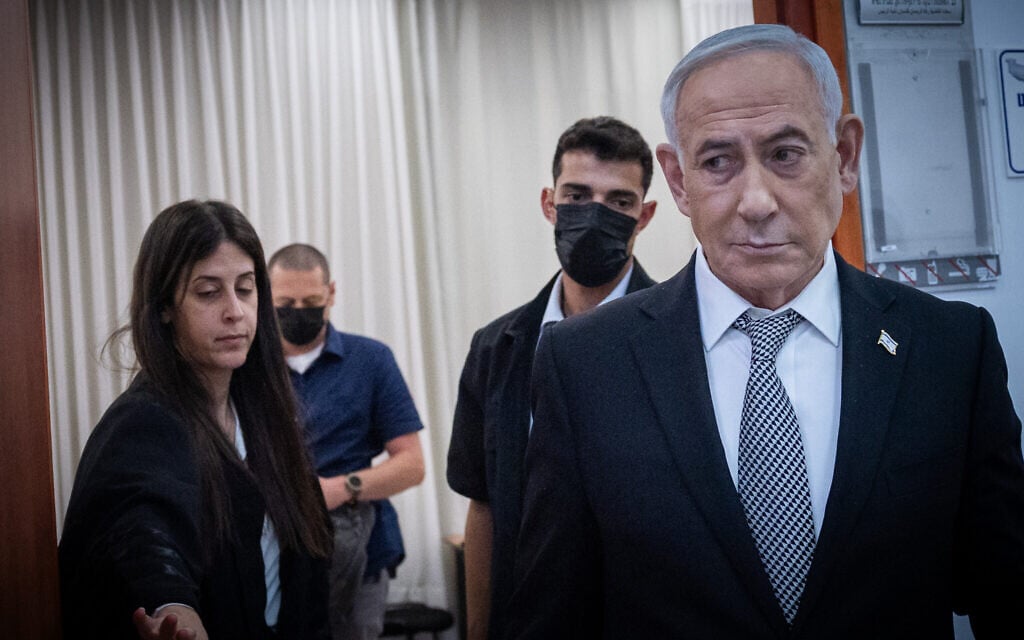
Netanyahu himself turned up at the court hearing on Monday, despite his attendance not being required, after completing his testimony last week following 18 months of hearings. His appearance marked a departure from the near-weekly instances of canceled or curtailed hearings that plagued his testimony, when he frequently cited security concerns as the reason for his absence from the courtroom.
Netanyahu told the court on Monday that Hadad “called me and said ‘this is a catastrophe… We won’t be able to complete the appropriate preparation, to prepare witnesses and to coordinate with you,'” he said, according to Channel 12.
The prime minister repeated his claim that Hadad and all of his attorneys want to quit the case since it is taking up so much of their personal and professional time, leaving them unable to take other cases.
Netanyahu said that his defense team “won’t give up on a single defense witness. They’re coming with baseless claims and we will refute them,” according to Channel 12.
Netanyahu faces a bribery charge in only one of three cases against him, Case 4000, in which he is also accused of fraud and breach of trust in connection with the relations between the Bezeq telecom firm and the Communications Ministry under Netanyahu.
Known as the Bezeq-Walla case, Case 4000 focuses on allegations that Netanyahu authorized regulatory decisions that financially benefited Bezeq telecommunications giant shareholder Shaul Elovitch to the tune of hundreds of millions of shekels. In return, Netanyahu allegedly received favorable media coverage from the Walla news site owned by Elovitch.
Netanyahu is also on trial for two additional counts of fraud and breach of trust — in Case 1000, which concerns gifts he allegedly inappropriately received from billionaire benefactors, and in Case 2000, in which he allegedly negotiated to obtain positive media coverage in a newspaper in exchange for curtailing its competitors.
He denies all wrongdoing in each case and claims, without evidence, that the charges were fabricated in an effort to remove him from power.
View original source — Times of Israel ↗
Related stories

ESPN
SportsJun 30, 2026 · 1 min
Haaland scores as Norway knock out Ivory Coast
ESPN

The Punch
PoliticsJun 30, 2026 · 1 min
Nwifuru reshuffles Ebonyi cabinet, swears in two new commissioners
The Punch
The Punch
SportsJun 30, 2026 · 1 min
Lampard extends Coventry stay after promotion to Premier League
The Punch
The Punch
NewsJun 30, 2026 · 1 min
NECA unveils Africa’s first ESG implementation guide for MSMEs
The Punch