BBC
BBC··3 min read
Jury to consider if PSNI error contributed to Noah death
ByKevin Sharkey
BBC News NI
Updated 1 hour ago
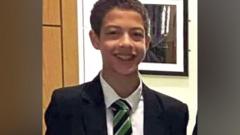
The jury at the Noah Donohoe inquest will consider if police made an error which contributed to the schoolboy's death.
Noah disappeared in north Belfast on 21 June 2020, and his body was found in an underground water tunnel six days after he went missing close to an entrance to the tunnel system.
The coroner, Mr Justice Rooney, said the jury must consider the PSNI's investigation into Noah's disappearance in terms of "what they knew, when they knew it, and what they did in response".
On the second day of his summing-up, known as the coroner's charge to the jury, he said the jury must consider if a potential PSNI error was "minimally, negligibly, or trivially" a factor in Noah's death.
Time of death unknown
He said this means they must consider if there was anything that should have been done differently, and if it could amount to a police "act or omission" which "more likely than not" contributed to Noah's death.
However, Mr Justice Rooney stressed that any finding of error against the PSNI can only be made in relation to any potential act or omission that took place before Noah died.
The exact time of Noah's death is unknown.
The inquest previously heard from a number of expert witnesses who estimated that the 14-year-old could have died during a period from around midnight on 21/22 June 2020 until the following Tuesday 23 June 2020.
It was also indicated that there was a possibility, though unlikely, that the teenage boy was still alive on Wednesday 24 June 2020.
His body was found on Saturday 27 June 2020.
The coroner concluded his summing-up on Monday and the jury is expected to go out to consider its verdict on Tuesday morning.
'High level of information'
PSNI witnesses at the inquest have been criticised by the Donohoe family's legal team about multiple "failings" in the police investigation into Noah's death.
The senior PSNI investigator in the case has apologised to Noah's mother, Fiona Donohoe, for missed investigative opportunities.
During his summing up on Monday, Mr Justice Rooney reminded the jury that the police have explained to the inquest that they were dealing with a "a very high level of information" during the week of the investigation.
He also outlined how the police dealt with more than 600 phone calls in relation to the investigation into Noah's disappearance that week.
He said this was regarded as "unprecedented" in the PSNI's experience in dealing with missing person cases.
The inquest has also heard that the PSNI were dealing with 167 missing person reports across Northern Ireland that week.
Access to tunnel system
The coroner also reminded the jury about evidence from residents at Northwood Road and Premier Drive close to where Noah disappeared in north Belfast.
Both areas adjoin waste land leading to the entrance to the tunnel system where Noah's body was found.
Some residents indicated that they were aware of local access to the waste land where the tunnel entrance is located.
Stormont's Department for Infrastructure (DfI), which maintains the tunnel system, has been criticised at the inquest about safety measures at the site.
DfI witnesses informed the inquest previously that the department was satisfied with the safety measures around the culvert entrance.
Their evidence also stated that access could only be gained to the site by approved maintenance staff, residents in the immediate area, or if members of the public trespassed.
The coroner outlined to the jury how some expert witnesses disagreed on issues about safety at the site.
Mr Justice Rooney also reminded the jury about how some of the searchers who examined the culvert entrance for the first time shouted down the tunnel.
He said they called out "Hello", paused to wait for any response, and then called again, "Hello, Noah".
Related stories

ESPN
SportsJun 29, 2026 · 1 min
Sinner's shaky start raises questions -- is he vul...
ESPN

ESPN
SportsJun 29, 2026 · 1 min
Copy of Brazil avoid World Cup shock with late win vs. Jap...
ESPN

The Punch
NewsJun 29, 2026 · 1 min
FG seeks stronger climate financing to enhance water, sanitation services
The Punch
The Punch
SportsJun 29, 2026 · 1 min
Brazil beat Japan 2-1 to reach World Cup 16
The Punch