Ars Technica
Kalshi sues Illinois over new tax on prediction market sports bets
Predicting versus betting
Illinois now a key battleground in fight over prediction market sports bets.
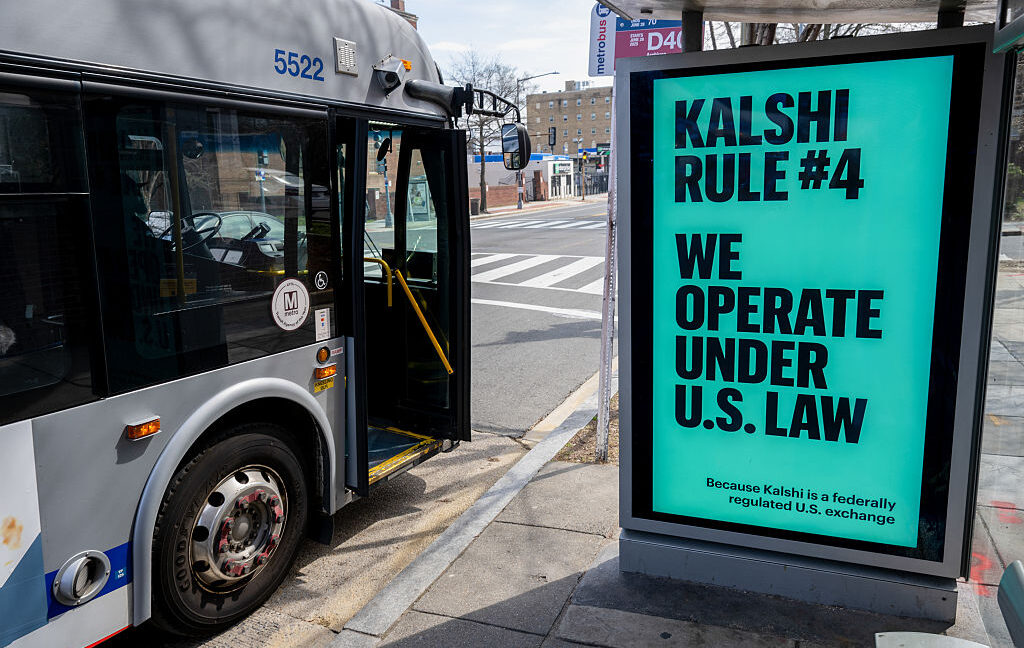
A Kalshi advertisement at a bus stop in Washington, DC. The rapid expansion of prediction markets is facing increasingly aggressive pushback from state officials pursuing a sprawling patchwork of lawsuits and cease-and-desist orders.
Credit:
Bloomberg / Contributor | Bloomberg
A Kalshi advertisement at a bus stop in Washington, DC. The rapid expansion of prediction markets is facing increasingly aggressive pushback from state officials pursuing a sprawling patchwork of lawsuits and cease-and-desist orders.
Credit:
Bloomberg / Contributor | Bloomberg
A fight between states and the federal government over who should regulate sports betting is heating up, as states accuse prediction markets like Kalshi of taking the exact same sports bets as gambling platforms without paying taxes or adhering to stricter controls.
Last Tuesday, Kalshi sued Illinois Attorney General Kwame Raoul, Governor J.B. Pritzker, and other officials after the state classified Kalshi and other prediction markets as unlicensed sports wagering operators.
It’s not the first legal battle between a prediction market and a state, but it is perhaps the most urgent for Kalshi, which is the biggest prediction market for sports bets. Across the board, prediction markets just had their biggest week ever, amid major sporting events like the NBA Finals, the World Cup, and the Stanley Cup. If the law stands, Kalshi would owe taxes no other state is charging and could face felony charges if violations are found.
For Illinois, regulating prediction markets has fast become a priority. Kalshi’s lawsuit came after Illinois logged its most devastating year of legal sports betting losses on record in 2025, when residents lost close to $1.5 billion, the Daily Herald reported. And it’s not just existing exchanges that could siphon more losses off residents. As Meta toys with building a similar sport-wagering platform that could one day accept real money and plug into its vast social networks, it seems likely Illinois is hoping to get ahead on regulatory plans before such betting becomes even more popular and normalized.
Moving to regulate more sports betting in the state, Illinois passed a law adding new taxes specifically on sports betting conducted on prediction markets. Starting July 1, Kalshi would have owed a 1.75 percent tax on the first 5 million sports wagers per fiscal year, then a 3.5 percent tax on every subsequent wager.
Additionally, getting the state license would have cost Kalshi $15 million for the first four years, then $1 million annually. Kalshi—valued at $22 billion—considers the license too “costly and burdensome,” the complaint said.
Kalshi wants exclusive CFTC oversight
Specifically, Kalshi sued to block Illinois from requiring the platform to obtain the expensive sports betting license, verify that bettors are located in the state, and pay additional taxes.
The company has alleged that states like Illinois are overstepping in attempting to regulate prediction markets as if they were sports wagering operators. Instead, a federal agency, the Commodity Futures Trading Commission (CFTC), has exclusive authority to regulate Kalshi, the platform argued.
Further, Kalshi alleged that complying with Illinois law and restricting residents there would violate the CFTC’s requirements to provide uniform access nationwide to its platform.
Without the court’s intervention, Kalshi will be forced to choose between violating state or federal law, the platform argued. It has asked the court to clarify that the CFTC alone can regulate prediction markets and to order a preliminary injunction stopping Illinois from lumping Kalshi in with traditional betting platforms like FanDuel.
Without an injunction, Kalshi may face civil and criminal penalties, the platform said. According to Kalshi, complying with Illinois law—and a patchwork of state laws that could follow—would also require the platform to invest in expensive “technological solutions to limit access.” And there’s no guarantee that Illinois would grant the license, threatening irreparable harms, including income and reputation loss, Kalshi argued.
What is a sports bet according to Kalshi?
The key fight that Kalshi and other prediction markets must win is over the legal definition of sports betting.
Kalshi’s lawsuit comes after the CFTC sued Illinois in April. In that complaint, the CFTC alleged that what Illinois defined as illegal sports bets on Kalshi were rather permissible “swaps” on “directives contracts” known as “event contracts” that the CFTC allows, so that stakeholders can hedge their risks when navigating uncertain but financially significant events.
In its complaint, Kalshi explained that event contracts “are financial tools used to mitigate risk” caused by future events. As Kalshi explained:
“They identify a future event with several possible outcomes, a payment schedule for the outcomes, and an expiration date. Most commonly, event contracts involve a binary question: Every ‘yes’ position has an equal and opposite ’no’ position. For example, a derivatives contract might center around whether a magnitude 8 earthquake will take place in Los Angeles County before January 1, 2027. A purchaser may trade on either the ‘yes’ or the ‘no’ position on the contract. If an earthquake does take place in Los Angeles County before the end of the calendar year, then the ‘yes’ positions would be paid out.”
The primary difference flagged by Kalshi is that there is no “bet” against the “house.”
“Traders do not take a position against the exchange itself,” Kalshi said. Instead, “traders’ ability to hedge risk requires counterparties willing to assume risk in the hope of seeing a return.”
Unlike sports bets, sports event contracts are financial tools for sports industry stakeholders, Kalshi argued. Examples included media companies hedging risks tied to viewership, advertisers weighing how lucrative a sponsorship might be, or insurance companies impacted by ticket revenue.
States disagree on sports bet definition
However, most states disagree that the “swaps” of “event contracts” made on Kalshi—where Pew Research found sports made up 80 percent of trading volume since 2024—are different in any way from traditional sports bets.
The outcome for bettors in both scenarios is always binary, states argued, since they either win or they lose. And neither outcome “serves the traditional hedging, price-information discovery, or risk-allocation purposes of derivatives typically regulated by the CFTC,” states have recently argued.
Earlier this year, Illinois AG Raoul joined officials from 40 states and the District of Columbia in signing a letter to CFTC chair Michael S. Selig, arguing that the CFTC “lacks exclusive jurisdiction” and does not have the “means or ability to regulate sports gambling.” Even under federal law, the common definition is broad, they argued, writing that “any distinction between sportsbook bets and prediction-market bets is illusory.” As states explained:
“On so-called ‘prediction markets,’ users can make all the same wagers they can make at a traditional sportsbook. What team will win a game. The potential spread of a game. The total number of points in a game, and “prop” bets—asking how many points, rebounds, or some other statistic for each player. The same bets are made on sportsbooks. And nothing is different for the bettor.”
“In short: both federal and state law confirm that sports betting occurs whenever someone stakes money on the outcome of a sports contest. That ordinary definition applies to event contracts on prediction markets,” the letter concluded.
Kalshi risks more Illinois fights
Illinois seems certain that there are many questions that courts must answer before prediction markets like Kalshi can keep taking sports wagers. In a motion to stay the CFTC’s lawsuit, Illinois raised questions such as: Are event contracts a form of gambling? And should states be allowed to regulate them alongside the CFTC?
“The question whether prediction markets are subject to state or federal regulation (or both) began percolating in courtrooms across the country around fourteen months ago, and the results so far are mixed,” Illinois’ filing said.
With the support of Donald Trump, the CFTC seems unlikely to back down from the fight with states. About a week before Illinois passed its law classifying prediction markets as sports betting operators, the CFTC proposed new rulemaking that lays out how the commission would manage its exclusive control over regulating these markets. As Illinois’ court battle continues, the CFTC is accepting comments from the public on their proposal through July 27.
If Illinois wins its fight against Kalshi, the prediction market and the federal commission fear the state will be emboldened and next move to regulate “contracts concerning elections and other political events,” a recent CFTC court filing said. Those contracts have been subjected to ever-widening scrutiny over suspected insider trading, and senators have already banned themselves from prediction markets after some lawmakers were found trading on their own elections.
Ashley is a senior policy reporter for Ars Technica, dedicated to tracking social impacts of emerging policies and new technologies. She is a Chicago-based journalist with 20 years of experience.
50 Comments
View original source — Ars Technica ↗
Related stories

The Guardian
TechnologyJun 29, 2026 · 1 min
Offenders in England and Wales who kill current or ex-partners face 10 more years in prison
The Guardian

Philippine Daily Inquirer
TechnologyJun 29, 2026 · 1 min
Why we elect criminals
Philippine Daily Inquirer

Philippine Daily Inquirer
TechnologyJun 29, 2026 · 1 min
Dutertismo: A cult of authoritarian populism
Philippine Daily Inquirer

Ars Technica
TechnologyJun 29, 2026 · 1 min
South Korea to spend $1T on more memory chip production and humanoid robots
Ars Technica