The Next Web
Waymo and Uber quietly part ways in Phoenix after nearly three years of robotaxi collaboration
TL;DR
Waymo and Uber ended their robotaxi partnership in Phoenix as both pursue separate autonomous vehicle strategies across dozens of new markets.
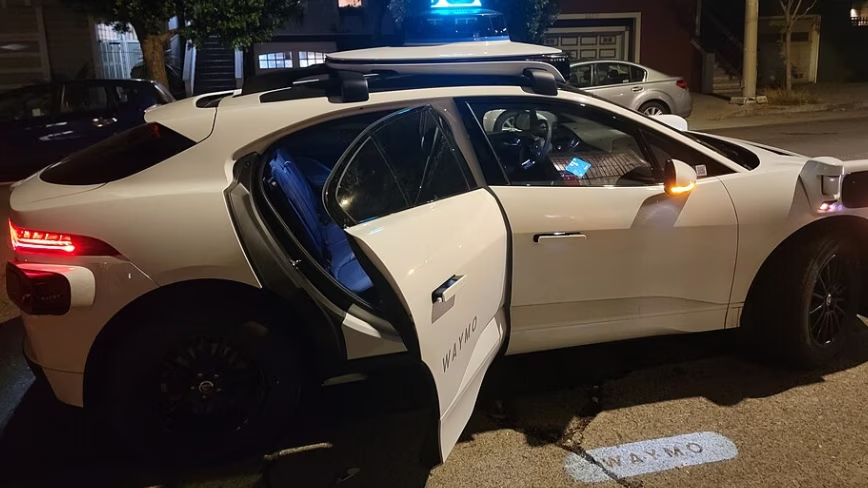
Waymo robotaxis are no longer available on Uber’s app in Phoenix, ending a nearly three-year partnership in the city that served as the first test of whether the two former courtroom rivals could work together. Both companies confirmed the split to TechCrunch on Monday. Waymo said the vehicles have already been folded back into its own Phoenix fleet, where they will continue serving riders through its app, including public transit trips with Via and deliveries with DoorDash.
Uber said it is readying a separate autonomous vehicle partnership in Phoenix but did not name the partner. The quiet breakup, which Waymo said happened in May, was first spotted by riders who noticed the company’s vehicles had disappeared from Uber’s network. Phoenix was the only city where Waymo operated both through its own app and through Uber, an unusual overlap that neither company seemed motivated to sustain.
The split arrives as Waymo is deploying its newest robotaxi, the Zeekr-made Ojai, a purpose-built van that costs roughly 75,000 dollars less per unit to produce than the Jaguar I-PACE it replaces. The two companies are also heading toward a direct confrontation in London, where Waymo plans to launch its own service while Uber is partnering with the British autonomous driving startup Wayve. Both praised the Phoenix collaboration, with Uber calling it an intentionally limited deployment of just over a dozen vehicles that helped it scale faster in Austin and Atlanta.
The 💜 of EU tech
The latest rumblings from the EU tech scene, a story from our wise ol' founder Boris, and some questionable AI art. It's free, every week, in your inbox. Sign up now!
The robotaxi landscape has changed dramatically since the partnership was announced in 2023. At the time, no autonomous operator had reached commercial scale and Cruise was still seen as a viable competitor, before its crisis forced it to suspend operations and fold into General Motors. In the three years since, Waymo has grown its fleet to around 4,000 vehicles and Uber has added dozens of autonomous vehicle partners to its network.
Waymo now operates in 11 US metro areas and offers more than 500,000 trips every week, though its rapid growth has come with operational stumbles including recalls and service suspensions in multiple cities. The company is launching in around 20 new cities this year, including international markets like London and Tokyo. That expansion makes a limited pilot with Uber in a city Waymo already serves on its own harder to justify.
For Uber, the Phoenix exit is less a loss than an evolution. The company described the collaboration as a stepping stone that helped it quickly scale autonomous rides in Austin and Atlanta, where Waymo robotaxis are available exclusively through Uber’s platform. Its broader autonomous strategy now spans far beyond Waymo, with partners including Wayve, Avride, and a recently announced deal for up to 50,000 Rivian-built robotaxis.
The end of the Phoenix partnership is a data point in a pattern. Waymo is expanding to new cities without Uber, launching in Dallas with Moove and Avis as fleet partners rather than through a ride-hail app it does not control. The two companies are no longer figuring out whether they can coexist but mapping where they will compete, and Phoenix was simply the first city where one of them decided there was no longer a reason to share.
View original source — The Next Web ↗
Related stories

The Guardian
TechnologyJun 29, 2026 · 1 min
Offenders in England and Wales who kill current or ex-partners face 10 more years in prison
The Guardian

Philippine Daily Inquirer
TechnologyJun 29, 2026 · 1 min
Why we elect criminals
Philippine Daily Inquirer

Philippine Daily Inquirer
TechnologyJun 29, 2026 · 1 min
Dutertismo: A cult of authoritarian populism
Philippine Daily Inquirer
Ars Technica
TechnologyJun 29, 2026 · 1 min
South Korea to spend $1T on more memory chip production and humanoid robots
Ars Technica