The Next Web
Alibaba and Tencent lose their Washington lobbyists as new Pentagon rule takes effect
TL;DR
Alibaba lost five lobbying firms and Tencent four as a Pentagon rule bars defense work for firms that also lobby for blacklisted Chinese companies.
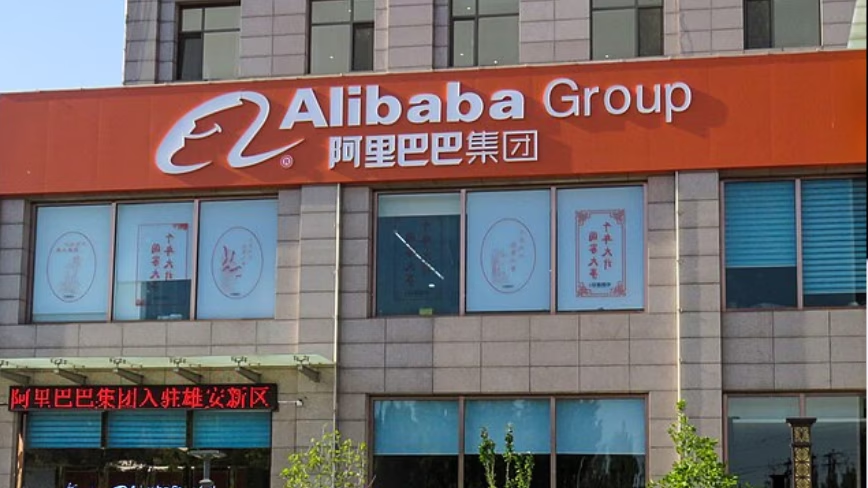
Washington lobbying firms have been quietly dropping Alibaba and Tencent as clients ahead of a new Pentagon rule that takes effect on Tuesday. According to Bloomberg, Alibaba has lost five lobbying firms and Tencent has lost four since the Defense Department expanded its list of Chinese military companies earlier this month. The departures leave two of China’s biggest technology conglomerates without their primary advocates in the US capital at a time when they face escalating pressure on multiple fronts.
The rule in question is Section 851 of the fiscal 2025 National Defense Authorization Act, which bars the Defense Department from contracting with any company that also employs a registered lobbyist for an entity on the Pentagon’s 1260H Chinese military companies list. The provision forces lobbying firms to choose between their defense clients and their Chinese ones. For most firms, the calculation is straightforward: defense work pays more and carries less political risk.
Bloomberg reported that Brownstein Hyatt Farber Schreck and Mercury Public Affairs both dropped Alibaba, while MO Strategies also ended its relationship with the company. Rob Kelner, a partner at Covington & Burling, told Bloomberg that some firms had terminated their Chinese clients even before the law was signed as a precaution. Kit Conklin, a former Trump White House aide now at a lobbying firm, said the exodus picked up speed after the Pentagon added 65 new entities to the 1260H list on June 8.
The updated list now names 188 companies that the Pentagon says support China’s military, including Alibaba, Tencent, Baidu, BYD, and the robotics maker Unitree. Alibaba has since sued the Defense Department in federal court in San Jose to win removal from the list, calling the designation baseless. In its legal complaint, the company argued that the listing prevents it from retaining certain lobbyists it needs to challenge the military-supporter label, a complaint the lobbying departures now confirm.
The lobbying freeze compounds a string of setbacks for both companies in Washington. Anthropic accused Alibaba’s Qwen AI lab last week of using nearly 25,000 fake accounts to harvest Claude’s capabilities in the largest distillation campaign yet against a US AI company. China retaliated against the Pentagon’s list by imposing trade curbs on 56 American firms, including rare-earth miners and drone makers, an escalation that only deepened congressional hostility toward Chinese tech.
For Tencent, which was added to the 1260H list in January 2025 and called the designation a mistake, the loss of four lobbying firms means its ability to shape US policy through conventional channels has all but evaporated. Alibaba spent hundreds of thousands of dollars on Washington lobbying in recent years, according to federal disclosure filings. Both companies now face a regulatory landscape in which no major lobbying firm can afford to represent them without risking its defense contracts.
The broader effect is a kind of political quarantine. By tying lobbying relationships to defense contracting eligibility, Section 851 does what sanctions and blacklists alone could not: it severs the informal networks through which Chinese companies have historically navigated Washington. The law takes effect on Tuesday, and for Alibaba and Tencent, the lobbying firms have already made their choice.
Published June 29, 2026 - 6:47 pm UTC
Back to top
View original source — The Next Web ↗
Related stories

Stuff
TechnologyJun 29, 2026 · 1 min
Video shows police seizing guns from Brian Tamaki’s home
Stuff

The Guardian
TechnologyJun 29, 2026 · 1 min
Offenders in England and Wales who kill current or ex-partners face 10 more years in prison
The Guardian

Philippine Daily Inquirer
TechnologyJun 29, 2026 · 1 min
Why we elect criminals
Philippine Daily Inquirer

Philippine Daily Inquirer
TechnologyJun 29, 2026 · 1 min
Dutertismo: A cult of authoritarian populism
Philippine Daily Inquirer