The Guardian
Naomi Osaka wows Wimbledon crowd with kimono-inspired outfit
It was one of the most anticipated moments on the opening day of Wimbledon: Naomi Osaka’s on-court outfit.
The Japanese tennis star has gained attention for her adventurous style, but questions were raised as to how her outfit would fit in with Wimbledon’s strict rules and emphasis on tradition.
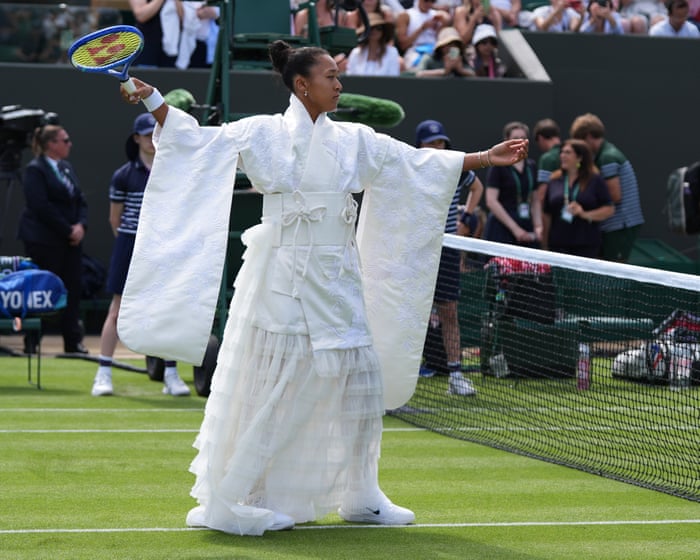
Osaka, 28, arrived on court to whoops and cheers in a floor-length ruffled gown inspired by Japanese ceremonial dress and, crucially, was all in white.
The dress, embroidered with cranes and cherry blossoms, was created alongside Tokyo based designer Hana Yagi. She also wore a traditional kanzashi hair ornament.
The look consisted of seven different textiles upcycled from pieces including vintage kimonos and a traditional shiromuku wedding dress. It featured intricate embroidered cranes and cherry blossoms alongside a traditional obi belt. Underneath, Osaka wore a white Nike performance dress that drew on Japanese kirigami paper-cutting with 3D floral motifs.
Osaka told reporters that Wimbledon’s emphasis on tradition had inspired her to reflect on her own cultural heritage.
“I think about the most iconic silhouette, which for me is a kimono. You don’t have to see the colour of a kimono to know that it is a kimono,” she said.
She also shared an unexpected muse: “I remembered absolutely falling in love with Lucy Liu’s character [in Kill Bill]. She has an all-white kimono, and I remember thinking that was really cool and amazing. Then it just kind of went from there. It was like my interpretation of that while also paying a lot of respect and love to Japan,” she said.
She added that “wearing extravagant outfits” was a personal passion, and that she had approached the designer directly rather than in partnership with Nike. Her choice had prompted lots of locker room questions from fellow players, and she observed fans turning their whole bodies to get a better look during her walk to the court. “I thought that was really fun,” she said, acknowledging that it increased the pressure not to “wear a ball gown and drop out in the first round”.
Osaka told British Vogue: “I like to use fashion as a medium for storytelling. Every walk-out is an opportunity to bring people into my creative world. The fact that people care about it and are excited to see what’s next is also pretty cool.”
Yagi said: “I wanted the garment to exist as the moment before performance. The walk-on surrounds Naomi in ceremony, while the Nike kit represents the athlete in competition. I thought about them as two chapters within the same story.”
Osaka, the No 14 seed, removed her long gown before facing France’s Elsa Jacquemot in a Nike dress adorned with flowers. Osaka’s outfit, which featured seven 3D flowers with bejewelled centres, sold out within hours of being released last week.
Earlier, the All England Lawn Tennis Club (AELTC) chief executive, Sally Bolton, was asked about Osaka’s daring walk-on outfits. She was not concerned. “We’re very relaxed so long as it meets the all-white dress code,” she said.
The opening day got off to a disappointing start for homegrown talent. The top two British players, Emma Raducanu and Jack Draper, were forced to drop out due to injury.
The other six first British players in action fared no better on court: Mika Stojsavjlevic, Alicia Dudeney, Max Basing, Harriet Dart, Cam Norrie, Mimi Xu and Oliver Tarvet were all knocked out of the competition.
There were already 10,000 people in the Wimbledon queue by 8.30am on the first day of the championships, with some fans having joined the line on Saturday morning.
Bolton said the queue had become increasingly popular because fans have more travel options and don’t need to rely on the tube. “We are advising people if they haven’t already set off to travel, not to travel because the queue is effectively full,” Bolton said.
“I think back to that period post-Covid where we were somewhat nervous that the queue might die, and, ironically, the queue has become increasingly popular over that period of time.
“But also the way people travel and engage with things has also changed. For those of you that have queued, you will know that the time you used to have to arrive was the first tube into Southfields. But now with the availability of Lime, and other available branded bikes, people can get to the queue much more easily from slightly further away rather than waiting for the first tubes.”
Queue-goers told the Guardian they had scoured social media for hacks on when to arrive to secure their spots – and insisted the hours-long wait was part of the fun.
Daria Wenger drove from Beckenham, south-east London, and joined the queue at 2am on Monday. She slept with her husband and son in a tent. “The weather was kind to us – not raining, not too hot,” she said. “It takes time, but it’s fun. It’s additional entertainment.”
Lily and Kai Cheng flew in from New York, arriving at 6pm on Sunday. They stayed in a hotel and booked an Uber to arrive at 5am after consulting ChatGPT for advice.
“There were already 5,000 people ahead of us,” said Lily. “We’re New Yorkers. We don’t like standing in queues for too long, but this has been so pleasant. It’s so organised.”
The pair are big tennis fans and Wimbledon has been on their bucket list for more than a decade. “Wimbledon is more fair for people who really want to watch tennis. The US Open is about who has the most money, who can pay the highest price for that little ticket,” said Kai.
Meanwhile, Renee Sang and Joshua Sodergren came by Uber from Crystal Palace, south-east London, at 4am and obtained their ground passes just before noon. “I feel like this is the most orderly queue,” said Sang. “It’s just very well-structured. I thought we’d be roughing it more, but there are bathrooms.”
The pair turned to social media to plan their visit, arriving half an hour earlier than planned, based on advice on Reddit. Their one disappointment was missing Raducanu, who pulled out of Wimbledon on Sunday due to a leg injury.
Nino Bianco, 44, from Luton, left his local hotel by Uber at 4am after missing out on tickets two years ago. “I just love the experience. The queue is like a ritual to get you into the mood,” he said.
Hannah Stuart and Rosie McGahn, both 26, arrived at 7pm to camp overnight on Sunday, after consulting TikTok for tips.
They were handed out a number – 2,200th in the queue – and pitched their tent for the night. “We got pizza and had a nice little time,” said Stuart. They were woken up by stewards at 5am, and rejoined the queue.
Bolton, who is standing down at the end of the championships, said the club was adapting the way it operates the queue due to its popularity. “We’ve got amazing matches, the sun is shining – you know, all of those ingredients to make it so popular – but [the queue] is such an important part of what we do, so we’ll do everything we can to protect it.
“People are getting there earlier and earlier because they recognise that the dynamics of travel have changed a little bit, so you do have to now get here really quite early to be at the front of the queue.”
View original source — The Guardian ↗
Related stories

ESPN
SportsJun 29, 2026 · 1 min
Sources: Ayton opts in to Lakers; Smart declines
ESPN

ESPN
SportsJun 29, 2026 · 1 min
Kings' LaVine picks up $49M option, agent says
ESPN

ESPN
SportsJun 29, 2026 · 1 min
Sources: Champagnie to ink new deal with Spurs
ESPN

ESPN
SportsJun 29, 2026 · 1 min
Sources: Hawks decline Kuminga's $24.3M option
ESPN