The Guardian
Netherlands v Morocco: World Cup 2026 – live
Key events
51m ago
Team news
1h ago
Preamble
David Dyte writes in: “I know we want winners from outside the usual powers, but Paraguay did the thing already today and the Netherlands are a special case. Dutch cyclist Joop Zoetemelk finished second in the Tour de France five times before finally winning the damn thing in 1980. I want the same feeling for Dutch football fans, after three agonizing misses in World Cup finals. They deserve it. Morocco can wait.”
The Morocco fans are also out in full force.
David Wrigley chimes in with a note about Bouaddi: “This kid has the potential to be the coolest footballer since Socrates.”
From Tom Hopkins: “A joy of any World Cup is the things you learn about other countries and other cultures. One thing I’ve learned this time is that Mexico has some genuinely beautiful football grounds. Obviously the Azteca is the icon, but both Monterrey and Guadalajara are wonderful bits of architecture.”
Peter Oh also points out: “It’s good that Morocco aren’t playing this match in Guadalajara’s home stadium of Chivas. The nickname Atlas Lions wouldn’t go over well with the local fans.”
29 June is an eventful day in history for these two sides. Thirty-two years ago, in the group stage of the 1994 World Cup, was the first official match between the Netherlands and Morocco. The Dutch won 2-1.
Exactly 12 years ago, at the 2014 World Cup, a … controversial … late penalty took the Netherlands past Mexico and into the quarter-finals. This fan remembers:
What does this 29 June encounter have in store?
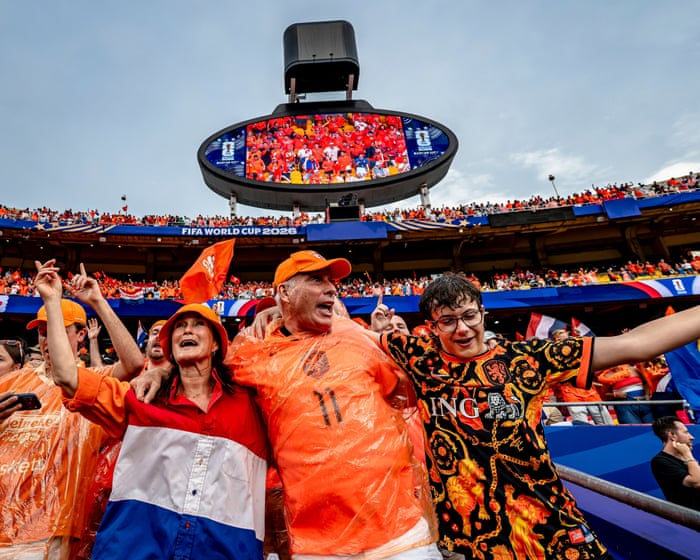
The Oranje fans have already set Kansas City, Dallas and Houston alight. Now it’s Monterrey’s turn.
It was a journey of nearly 1,000mi from Missouri to the mountains of northern Mexico, but they made it. And so did their famous bus!
Ronald Koeman has gone more defensive with his XI for this match. Crysencio Summerville swaps in for Donyell Malen on the wing, plus an extra center-back instead of midfielder Tijjani Reijinders. Stacking up to limit Achraf Hakimi on the flank after his goal and assist v Haiti?
Kári Tulinius writes in with thoughts:
“Koeman loves wing play, and having Van de Ven and Dumfries bombing up the field on the touchline feels very Dutch. Also, if the Moroccan defense stays tight, they can cross it towards Brobbey, but should the Atlas Lions engage the wing-backs, Gakpo and Summerville will have room to maneuver.”
Back in the XI for Morocco is teenage midfielder Ayyoub Bouaddi, a sensation in their tournament opener against Brazil. He’s one of the most sought-after talents at this World Cup: Arsenal, PSG, Bayern Munich and Liverpool are among the clubs watching.
He’s studying for a mathematics and physics degree to “make the most of his free time”. What a coincidence! That’s also how I spent my free time when I was an 18-year-old footballing phenom.
Three players at this World Cup scored in all three group-stage games: Vinícius Júnior, Lionel Messi and Morocco’s Ismael Saibari. The Atlas Lions forward looks bound to join Bayern Munich from PSV Eindhoven after this tournament and has been a breakthrough.
Mary Waltz writes in on the back of that Germany v Paraguay shootout: “All England fans admit it. Germany losing by penalties is the ultimate of Schadenfreud.”
The lack of a clinical goalscorer has hampered the Dutch team in recent years, but Brian Brobbey has been the solution at this World Cup. The Sunderland striker didn’t initially project as a starter; Memphis Depay was their leading scorer up top through qualifying, but he was nursing a thigh injury in the run-up to the tournament.
Brobbey, who had just one international goal in 12 caps entering the World Cup, made his first start against Sweden and has three goals in his three shots on target since. Keep your eye on him during the opening quarter-hour: all three of his goals have come within the first 17 minutes.
Ronald Koeman has opted for a back five for this last-32 tie. Micky van de Ven and Crysencio Summerville, both of whom didn’t start the Tunisia game while on yellow cards, are back in the XI.
A bit of a bold move by Koeman! What do you think?
On the other side, Mohamed Ouahbi makes four changes from the Morocco lineup he started in the group-stage finale against Haiti. Among the notable names back in the XI: left-back Noussair Mazraoui and teenage midfielder Ayyoub Bouaddi.
Team news
Netherlands (3-4-3): Verbuggen; Van Hecke, Van Dijk, Aké; Van de Ven, De Jong, Gravenberch, Dumfries; Summerville, Brobbey, Gakpo
Morocco (4-2-3-1): Bounou; Hakimi, Diop, Riad, Mazroui; Bouaddi, El Aynaoui; Brahim, Ounahi, El Khannous; Saibari
Referee: Wilton Sampaio (Brazil)
Morocco manager Mohamed Ouahbi was asked what would inspire his players to justify the feverish expectation hanging over them. Would they turn to the example of history, or would they draw on something else? “The biggest motivation the players have is to put on the jersey and represent the country,” he began. “That is motivation enough to move mountains.”
Can they move the Cerro de la Silla? From Nick Ames in Monterrey:
Japan exited earlier today, but Morocco still offer hope of a winner from outside the traditional powers. (And after that result, maybe Paraguay should count in that group!)
Jonathan Wilson has more:
Back to this match: the feeling of a Netherlands v Morocco match “is almost that of a derby,” says Jean-Paul Rison, a sports journalist based in Utrecht.
More on the social and cultural ties between these two countries:
Elsewhere in the last 32: penalties!
Preamble
Hello and welcome to one of this World Cup’s most enticing matchups, in both physical beauty – Estadio Monterrey is arguably the most picturesque of the host stadiums – and storylines.
Netherlands v Morocco: the only last-32 tie involving teams who finished the group stage with seven points and who entered the tournament inside the top 10 of Fifa’s rankings. The Dutch finished top of Group F after drawing Japan and beating Sweden and Tunisia; the Atlas Lions were second in Group C, drawing Brazil and beating Scotland and Haiti.
The Netherlands were one of just three teams to hit the 10-goal mark during the group stage. Inserting Brian Brobbey as their striker has added a new dimension to their final third, and now Ronald Koeman’s side are pressing to make an advanced run in the knockouts. Morocco showed their quality and attacking flair through the group stage, dominating early in their draw with Brazil and finding a reliable goalscorer in Bayern-bound Ismael Saibari. This last-32 matchup will be their sternest test yet.
These two sides have a history. Their first-ever meeting was 32 (fitting!) years ago today at the 1994 World Cup. (The Dutch won 2-1.) Many Moroccans moved to the Netherlands in the 1960s, and the street football played between generations of Dutch and Moroccan kids has produced top players for both sides. Three of Morocco’s players in this World Cup squad were born in the Netherlands.
The winner will face Canada on 4 July in Houston. I’ll be back soon with team news and more. In the meantime, send any thoughts to [email protected]. And tune in to Rob Smyth’s liveblog for the finish of Germany v Paraguay!
Ella will be here shortly. In the meantime, here’s a look from Graham Ruthven’s daily watch guide on what to know about this last-32 matchup:
What to watch for
By scoring eight goals in their last two games, the Netherlands have laid down a marker at this World Cup. The introduction of Brian Brobbey as an orthodox focal point in attack has completely changed the dynamic of Ronald Koeman’s side, making them just as dangerous as any other team left in this competition.
Morocco have also made a positive impression. Indeed, the 2022 semi-finalists are unbeaten in three games and have evolved their game since the last World Cup. The Atlas Lions are now able to control games with the ball and have a number of natural creators. They don’t, however, have an elite-level forward.
Player to watch: Brian Brobbey, Netherlands – The Sunderland forward is a physical threat, but also does a lot to bring the other Dutch attackers into the game. Cody Gakpo, for example, is better for having Brobbey to play off.
View original source — The Guardian ↗
Related stories

ESPN
SportsJun 30, 2026 · 1 min
Paraguay stun Germany on pens after VAR drama
ESPN

Philippine Daily Inquirer
SportsJun 30, 2026 · 1 min
Jade Riccio sings OST of first Filipino Hollywood series 'Nurse The dead'
Philippine Daily Inquirer
Sky Sports
SportsJun 30, 2026 · 1 min
Germany dumped out of World Cup on penalties by Paraguay
Sky Sports

ESPN
SportsJun 30, 2026 · 1 min
Porzingis back with Dubs on 2-year, $40M deal
ESPN