The Guardian
Canale and Gill the heroes as Paraguay hand Germany first World Cup shootout defeat
Germany exited the World Cup in Boston not with a whimper or even a cry of pain, just an extended wrestle into the dust at the hands of a thrillingly dogged Paraguay, followed by the most extraordinary of penalty shootouts.
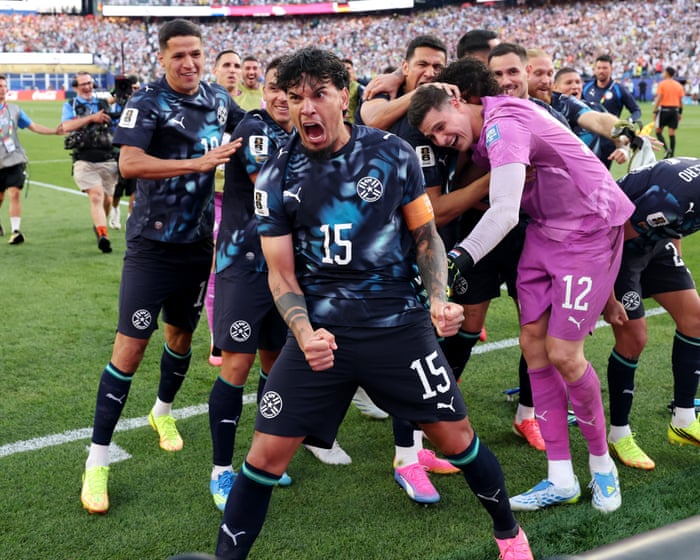
Not only did Germany lose their first shootout since the original Panenka one of 1976. They did so in a whirl of errors, shanked kicks and what amounted to a sporting meltdown in the New England gloaming. Paraguay will now progress to play a last-16 tie in Philadelphia, but not before celebrating this result as surely the greatest in their football history. And rightly so, after a performance of wonderful heart and defensive discipline.
For Julian Nagelsmann New England feels like the end of the road. This is not the Germany of the high-end academy boom years. But they’re better than this. Jürgen Klopp has spent the current tournament cheerfully judging Nagelsmann from the TV studio, apologising for judging him, and generally trying to pretend he wouldn’t actively love to have a go in the job. That chance might just be around the corner. Be careful what you wish for Jürgen.
Boston Stadium has been a lovely host site, a huge rolling green and fragrant campus with a sense of comfortable old-fashioned grandeur, the kind of place where you half expect a vast presidential float to come rumbling in at one end. It was full here at kick-off, packed out to its sweeping upper tiers, blasted by the violent afternoon sun, a ziggurat of sweeping, swooping angles.
And this was a bright, lively game at the start, for at least the opening 70 seconds. By the six-minute mark the first Mexican wave was breaking out.
And by half-time Paraguay had produced what was in its own way a perfectly minimalist 45 minutes. No wonder Germany looked bewildered as they trudged off for the break. At that stage they had taken 79% possession and made 308 passes to Paraguay’s 55. They were also 1-0 down and panting for breath in a very firm but very deathly Paraguayan defensive chokehold.
This was Germany’s first World Cup knockout game since they won it in Brazil in 2014. There had been some pressure on Julian Nagelsmann to shift Joshua Kimmich into midfield, so poor was the performance against Ecuador at the end of the group phase. But he stuck with the same central pivot here, Denis Undav as a scurrying No 10 the only change.
Paraguay’s head coach, Gustavo Alfaro, has a haggard, agreeably soulful look, a 63-year-old itinerant Argentinian with a belief in deep, throbbingly morbid defensive football, who has also talked at this World Cup of the duty of the sport to represent the poor, the people, the anti-Fifa.
And Alfaro’s patterns settled over this game early on: Germany moving laterally in front of a fiercely dogged Paraguayan 4-5-1. This was at last a fluid 4-5-1. Occasionally it shifted to 4-6-0. There was no space to move, no angles to be found as Germany pressed up against that reinforced barricade. This was a game so soporific the hydration break felt like a sudden burst of much-needed activity. This was at least a World Cup highlight: the greatest hydration break yet. Mainly because it was not the actual game.
With 27 minutes gone, Antonio Rüdiger seemed to tire of wandering around with the ball at his feet trying to imagine up some football in front of him and launched a booming punt over the top of the entire conjoined blue and white human crush and straight out for a goal-kick, like a man who just wants to feel something. But it did not seem like it was any more fun.
Then Paraguay scored, out of nowhere, applying pressure and urgency at the perfect moment. This was a goal so smart, and indeed so surprising, the finish was a power-header by Julio Enciso, who is 5ft 6in tall and the 17th shortest player at this World Cup. It was brilliantly made. Manuel Neuer punched clear Miguel Almirón’s corner. The ball was recycled back out to him and he played a really smart little nudged reverse pass into the run of Matías Galarza, steaming up on the outside. His cross was hard, flat and whipped perfectly on to the head of Enciso, who had a jarringly huge expanse of green all around him, enough to make you blink a little in a game of such stifling spaces everywhere else.
Leon Goretzka came on at half-time for Felix Nmecha and Germany looked more purposeful in midfield in those early moments, although not before Enciso might have doubled the lead, picking up a horribly shanked Kimmich back-pass but seeing his finish smothered by the advancing Neuer.
Germany made it 1-1 on 54 minutes by doing something different. This was not exactly slinging it into the box for the big man. But it was a high-craft version, Florian Wirtz sneaking out to the left touchline, jinking inside then whipping in a fine diagonal cross. The finish from Kai Havertz was lovely, an elegant pivoting flicked header directed on its way and into the corner. Maybe this, then, was what would save Germany’s World Cup. A little Premier League-honed direct football.
With 63 minutes gone Jamal Musiala came on for his replacement in this game, Undav, who had managed the extraordinary feat of almost total invisibility while surrounded closely by 21 other men on a televised global stage, a masterclass in the loneliness of crowds.
But by now the game had settled again into its wary, stodgy rhythms, enlivened out of nowhere on 75 minutes as Wirtz and Havertz combined again, in almost exactly the same way, only for Orlando Gill to produce a fine close-in save.
With two minutes remaining in normal time Nagelsmann sent on the cavalry, with the proviso that the calvary, in this instance, was Nick Woltemade, who roamed around vaguely in those final moments like a creaky wooden medieval siege tower.
With the evening sun melting away across the pitch extra time arrived like one of life’s inevitabilities, like New York traffic, aimless possession, tactical Paraguayan fouls, death. Germany still had all of the ball, and a few more openings now, Woltemade spurning one with a studied side-foot close to goal, and saw another blocked.
Paraguay had defended themselves into the ground by now, dropping so deep they were pretty much entirely behind their own goalline. A Germany goal was coming. And it finally arrived on 103 minutes – or did it? Jonathan Tah seemed to have scored with a brilliant back-post header, but it was ruled out on VAR review as Waldemar Anton had fouled the goalkeeper as the ball came in, and also because frankly, the fates had long since decreed this to be a day of footballing pain that must end in the most agonising way for everyone concerned
Watching Paraguay see this out you hoped, vaguely, that they would at least remember to kick their penalties forward and not backwards, to run towards the ball on its spot, not away from it to cover any possible quick breaks the other way. But as the final, final whistle blew there was a surge around the stadium, perhaps just at the certainty that something decisive must now happen.
The players linked arms. The stadium fell into a state of deep and painful unease. Havertz missed the first kick, waiting, waiting some more then producing a weak, telegraphed effort that was well saved.
For there, as Paraguay slotted their penalties with startling levels of calm and skill, you could feel Germany already edging toward the exit door, checking their luggage, preparing for the shared public angst. Woltemade mooched in and mustered another weak, saved kick.
There was time for Antonio Sanabria to miss and Fabián Balbuena to have his kick saved as the hitherto nonexistent Manuel Neuer aura briefly returned. No matter, Tah hoofed his effort absolutely miles over the bar. And José Canale produced the final cut, slow death at the end of the much longer slow death of Boston Stadium.
The Paraguayan bench streamed on to the pitch. And that, finally, was that.
Even in a game like this the World Cup does strange and darkly wonderful things. Across 120 minutes these two teams had six shots on target. For long periods the entire spectacle seemed to have condensed into an oddly unignorable sporting migraine, and an incurable one too, just light and sound and a large green space with moving shapes, tortured patterns, endless stubbed toes and false leads. But still, by the end it felt epic.
View original source — The Guardian ↗
Related stories

ESPN
SportsJun 30, 2026 · 1 min
Paraguay were more than just 'uncomfortable' for s...
ESPN

ESPN
SportsJun 30, 2026 · 1 min
Sources: RFA Duren to meet with Lakers, Kings
ESPN

The Punch
SportsJun 30, 2026 · 1 min
Ekong credits Bafana defender Mbokazi despite exit
The Punch
The Punch
SportsJun 30, 2026 · 1 min
Fortune FA wins seventh JOF U-13 Cup
The Punch