Indian Express
‘Money laundering scars economy’: IAS officer denied bail in Rs 3 crore ‘bribery’ case
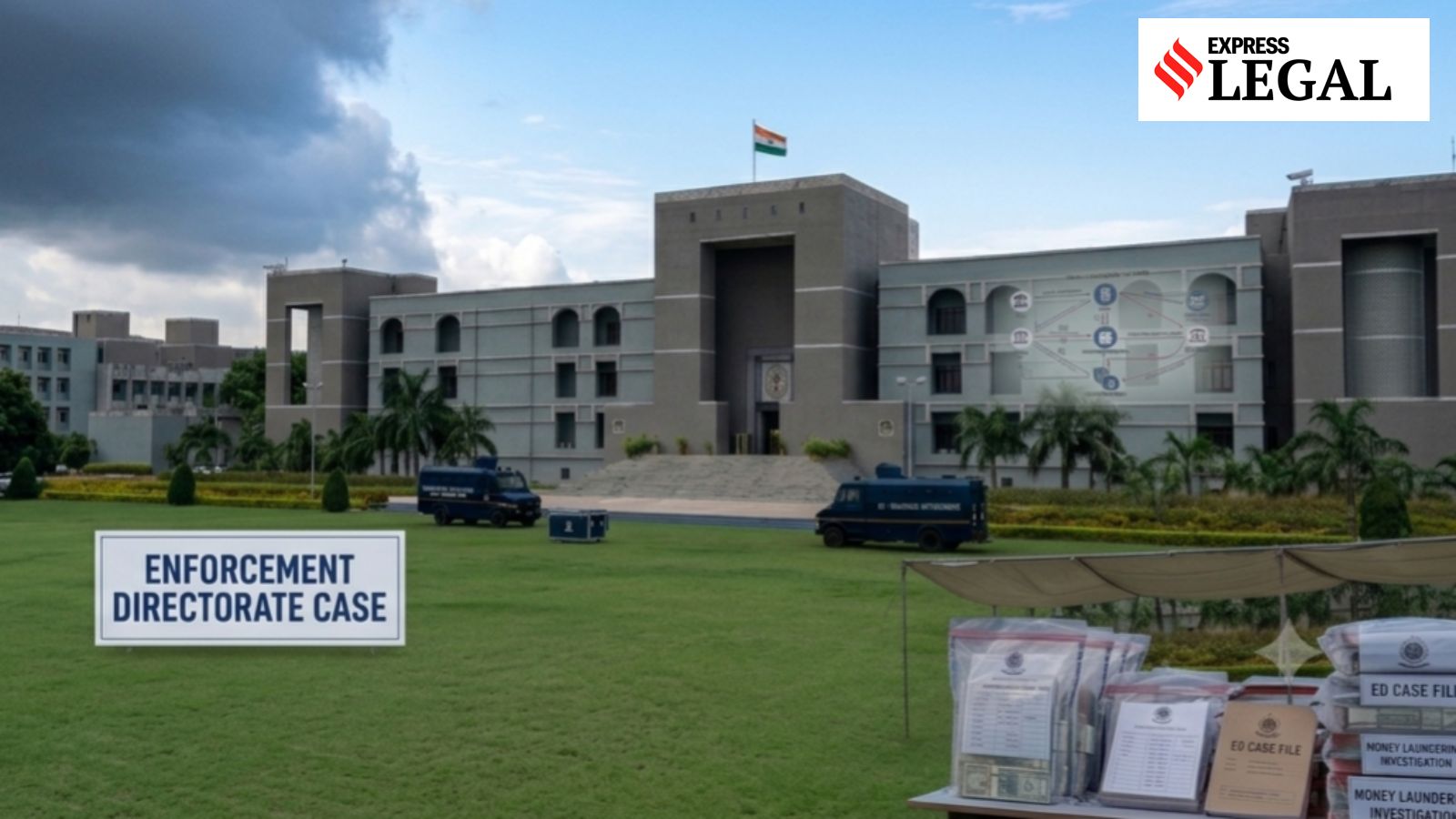
Holding that corruption corrodes governance and money laundering threatens the nation’s economic health, the Gujarat High Court has refused regular bail to suspended IAS officer and former Surendranagar collector Rajendrakumar Mahendrabhai Patel in a money laundering case in which he allegedly pocketed over Rs 3.12 crore through a land conversion bribery racket.
Justice Hasmukh D Suthar was hearing Patel’s regular bail application in connection with a case registered under the Prevention of Money Laundering Act (PMLA). The court was examining whether the applicant had satisfied the stringent twin conditions for grant of bail under Section 45 of the PMLA.
“The main object of PMLA is to prevent money laundering. The economic health of the Nation needs to be protected and money laundering scars the economic condition of nation as a whole. It is needless to say that Sovereignty of nation always prevail over personal liberty,” the court said on June 29.
The case originates from an alleged bribery network operating inside the Surendranagar collectorate for clearing change of land use (CLU) applications. According to the Enforcement Directorate (ED), officials had allegedly fixed rates for converting agricultural land into non-agricultural use, with Patel, then the district collector, receiving a 50 per cent share of the illegal gratification. Based on 501 applications processed during his tenure, the agency quantified his alleged proceeds of crime at Rs 3,12,62,230.
Under Section 45 of the PMLA, an accused can be granted bail only after satisfying the court’s stringent “twin conditions”. First, the court must have reasonable grounds to believe that the accused is not guilty of the offence of money laundering. Second, the court must be satisfied that the accused is not likely to commit any offence while on bail. These conditions make securing bail under the PMLA significantly more difficult than in ordinary criminal cases.
Justice Hasmukh D Suthar said corruption by government officials has become a grave challenge to constitutional governance and national progress.
ED alleges fixed bribe rates
According to the prosecution, the alleged racket surfaced on December 23, 2025, after the ED recovered Rs 67.50 lakh in cash and alleged “hisaab sheets” from the residence of deputy mamlatdar Chandrasinh Mori.
The agency alleged the records revealed a structured mechanism for collecting bribes for land conversion approvals. It claimed officials charged Rs 10 per square metre for applications under sections 65 and 65B (conversion of agricultural land for non-agricultural purposes) of the Gujarat Land Revenue Code and Rs 5 per square metre under sections 54 and 55 (regulating sale of agricultural land) of the Saurashtra Gharkhed Tenancy Settlement and Agricultural Lands Ordinance.
Story continues below this ad
The alleged proceeds were distributed according to a fixed formula, with the collector receiving 50 per cent, the resident additional collector 25 per cent, the chitnis and mamlatdar 10 per cent each and the clerk 5 per cent.
Digital proof, ‘hisaab sheets’
The court noted the ED’s submission that its investigation had uncovered “hisaab sheets”, digital records, handwritten calculations and statements recorded under Section 50 (powers to summon individuals, compel production of documents) of the PMLA, all of which allegedly linked Patel to the offence.
The agency also relied on witness statements claiming bribes were routinely paid to secure quicker clearance of CLU applications and that unnecessary objections were raised until illegal gratification was paid. It further claimed digital evidence recovered during investigation corroborated the allegations.
Patel argued that the money laundering proceedings could not continue because no chargesheet had been filed in the scheduled offence under the Prevention of Corruption Act.
Story continues below this ad
Rejecting the contention, the high court held that investigation into the predicate offence is not decisive while considering bail under the PMLA. Relying on Supreme Court judgments, it held that the ED can proceed under the PMLA while simultaneously informing the jurisdictional agency under Section 66(2) (share probe information with revelant law enforcement agencies on uncovering evidence of separate, non-PMLA offense), and that money laundering remains an independent offence so long as the scheduled offence survives.
No parity with other accused
Patel also argued that several co-accused had not been arrested and that he deserved similar treatment. The court rejected the plea, observing that the applicant’s alleged role was distinct because he was the final authority approving CLU applications and was allegedly the biggest beneficiary of the bribe proceeds.
It held that parity cannot be claimed merely because other accused have not been arrested and that each accused must be evaluated according to his individual role and the evidence against him.
‘Absolute power corrupts absolutely’
The high court said corruption by government officials has become a grave challenge to constitutional governance and national progress. Rampant corruption by highly placed public servants “has led to the economic unrest in the country which adversely affect the progress of society and prosperity of nation.”
Corruption “not only poses grave danger to the concept of constitutional governance but affects the foundation of democracy and rule of law.” The court observed that Patel, as the collector, should have worked with integrity, commitment and righteous approach but he indulged in corruption and continued to allow it “with an open eye.”
Quoting from English historian Lord John Dalberg Acton’s essay Freedom and Power, the judge observed, “Power tends to corrupt, and absolute power corrupts absolutely.” The phrase “crystallizes timeless concern about the coercive influence of power on human character.”
The court noted that investigators had recovered about 800 photographs of CLU applications and files from the applicant’s email account.
It observed that Patel allegedly attempted to reset his Samsung S24 Ultra mobile phone a day before the ED raid, adding that “such conduct speaks volume” and prima facie indicated evidence tampering as well as his involvement in the money laundering offence.
Medical grounds rejected
The suspended IAS officer also sought bail on medical grounds, citing a knee injury requiring arthroscopic surgery. The high court held that the ailment was neither terminal nor life-threatening and therefore did not attract the proviso to Section 45 (cognisable, non-bailable offences) of the PMLA. It observed that Patel could receive treatment in jail or seek temporary bail, if necessary, for medical reasons.
Story continues below this ad
Bail refused
After considering the evidence and legal principles governing bail under the PMLA, the high court concluded that Patel had failed to satisfy the mandatory twin conditions under Section 45.
Holding that economic offences involving corruption and money laundering have far-reaching consequences for society and the nation’s economy, the court dismissed the bail application, observing that sufficient prima facie material existed to justify his continued custody pending further proceedings.
View original source — Indian Express ↗
Related stories
Bloomberg
BusinessJun 30, 2026 · 1 min
World Bank Approves $750 Million Kenya Loan, Agrees to Back Loan
Bloomberg

Bloomberg
BusinessJun 30, 2026 · 1 min
Japan Has Spent Billions to Prop Up the Yen. Why Isn’t It Working?
Bloomberg

Rio Times
BusinessJun 30, 2026 · 1 min
After 15 Weeks, Brazil’s Inflation Forecasts Finally Stop Rising
Rio Times

Japan Times
BusinessJun 30, 2026 · 1 min
Russia’s small businesses pay the price of spiraling Ukraine war
Japan Times