Times of India
Times of India··3 min read
Russia's 28,000-tonne nuclear cruiser is back at sea — and Nato will be watching
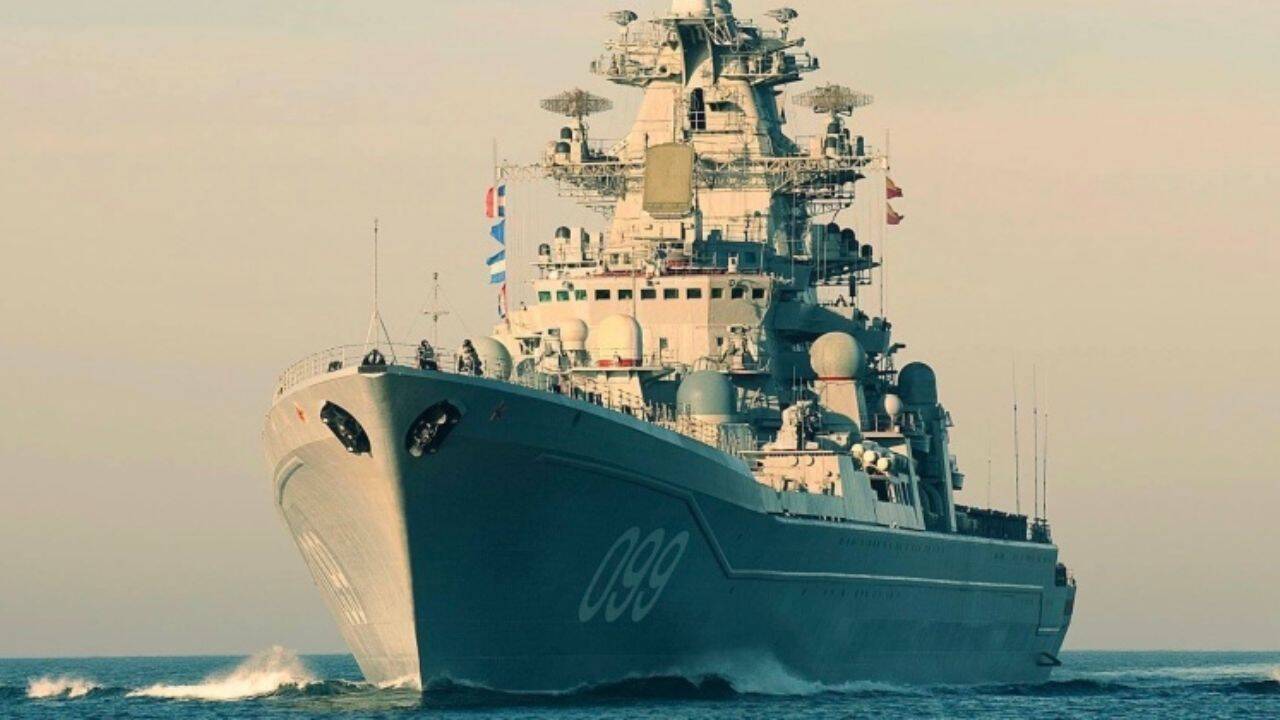
Photo credit: Military watch magazine
The symbol of Soviet navy might the 28,000 tonnes nuclear powered Kirov class missile cruiser, RFS ( Russian federation ship) Admiral Nakhimov has been deployed near key NATO sea routes in the Arctic, marking the operational return of a vessel that has spent nearly three decades out of frontline service.Deployed to Severomorsk, the headquarters of Russia's northern fleet, the cruiser returns after undergoing one of the most extensive naval modernization programmes undertaken by the Russian Navy since the collapse of the Soviet Union.
Russia Unleashes 28,000-Ton Kirov Nuclear Cruiser Against U.S. Zumwalt Stealth Destroyer | WATCH
The RFS Admiral Nakhimov last went to sea in 1997 and was then laid up in a dry dock at the Sevmash shipyard in Severodvinsk, northern Russia. The 1990s were a turbulent time for the Russian navy with funds and forcing the navy to downsize and decommission several warships.About Nakhimov:RFS Admiral Nakhimov is one of the four Project 1144 Orlan, better known by its NATO designation as the Kirov-class, nuclear-powered battlecruiser built for the Soviet Navy. It was laid down at the Baltic shipyard in Leningrad on May 1983, launched on 25 April 1986, and commissioned into the Soviet navy on 30 December 1988 as Kalinin, the third ship of the Kirov class.Following the dissolution of the Soviet Union, the cruiser was renamed Admiral Nakhimov in 1992 in honour of Admiral Pavel Nakhimov, one of Russia's most distinguished 19th-century naval commanders who played a key role during the Crimean War.
During the Cold War, Admiral Nakhimov was among the Soviet Navy's most feared surface combatants, armed with 20 P-700 Granit (SS-N-19 Shipwreck) long-range anti-ship cruise missiles housed in distinctive angled launchers along its bow. The missile has the range of around 400 km and weight around 7,000 kg. I can also carry nuclear warheads.Designed to hunt Nato carrier strike groups and serve as the flagship of Soviet naval task forces, the Kirov-class combined nuclear propulsion, heavy missile armament and layered air-defence systems, making it one of the largest and heavily armed surface ship.After its last deployment in 1997, the cruiser was withdrawn from active service and moved to the Sevmash Shipyard at Severodvinsk, where it remained in reserve. Initially intended for repairs, the project later evolved into a comprehensive modernization programme that effectively rebuilt the vessel with new weapons, sensors, combat systems and propulsion upgrades.Work officially began in 2014 and, after more than a decade of delays and extensive reconstruction, the ship returned to sea for trials in 2025, paving the way for its return as the flagship of the Russian navy.Ship capabilities after moderisation:
Before the modernization, its was a cold war-era missile cruiser optimised primarily for destroying Nato carrier battle groups using fixed P-700 Granit missiles. Now the ship is fitted with vertical launch cells, to carry out wide range of missions.
The Ship is now equipped with 10 UKSK (3S14) Universal Vertical Launch System (VLS) modules, each with 8 cells. This results in 80 launch cells reserved for launching Russia’s most modern missiles such as the subsonic Kalibr cruise missile, the supersonic Oniks anti-ship missile, and the hypersonic Zicron cruise missiles.
For air defence it is upgraded to Fort-M air-defence system with 96 vertical launch cells for long-range surface-to-air missiles and six Pantsir-M naval air-defence systems.. The modernization significantly improves the ship's ability to intercept aircraft, cruise missiles and drones through a layered air-defence network.
Most radar, fire-control and navigation systems have been replaced with modern digital sensors.
Both the nuclear reactor are completely overhauled and refuelled during the modernization.
It has a virtually unlimited range due to its nuclear propulsion, and can travel at the speeds of up to 32 knots (59 km/h) .
The return of Admiral Nakhimov will significantly strengthen the Russian Navy's surface fleet, offering a much-needed capability boost as the service grapples with an ageing cruiser force, delays in new warship construction and the gradual decline of its blue-water fleet.As one of the world's most heavily armed surface combatants, the modernised cruiser is expected to serve as the flagship of the Russian Navy, strengthen Moscow's military presence in the Arctic and North Atlantic.
View original source — Times of India ↗
Related stories

The Punch
TechnologyJun 30, 2026 · 1 min
Elon Musk claims Africa deaths fell after US aid cuts
The Punch
The Punch
NewsJun 30, 2026 · 1 min
Amotekun rescues Ondo kidnap victim, arrests father, three sons
The Punch
The Punch
NewsJun 30, 2026 · 1 min
Police sympathise with Kogi journalists involved in road crash
The Punch
The Punch
NewsJun 30, 2026 · 1 min
Afenifere backs Operation Kosaye, commends Lagos-Ogun kidnap crackdown
The Punch