Indian Express
Expert Explains | How displacement shaped rebellion and remembrance in the Santal community
A well-known Santal origin narrative, in the form of a song, names Hihiri-Pipiri and Sasan Beda as places in the community’s remembered beginning, even though they cannot be located or identified geographically. They have remained part of the Santal origin story even as the community moved elsewhere.
The Santals have long lived with movement. Families moved when life became difficult, and oral tradition kept traces of those journeys. Yet migration acquired a different weight in the forests around the Rajmahal hills during the late eighteenth and early nineteenth centuries. On the 171st anniversary of the Santal rebellion of 1855, known as Hul Diwas, this article retraces how two centuries of displacement shaped how the Santal community dealt with questions of identity and belonging.
From settlement to attachment
British officials encouraged the settlement of the Santals in Damin-i-Koh (present-day eastern Jharkhand), a tract carved out along the Rajmahal hills in 1832.
The area was intended as a frontier zone of cultivation and revenue expansion, and would soon become the centre of Santal life in the region. Many Santal families arrived there from regions such as Manbhum and Chotanagpur.
The Santals worked diligently, cleared forests, established villages and, as a result, fields spread across land that had been jungle a generation earlier. People also raised families there and began to think of it as home. Revenue considerations shaped colonial policy, but settlement also created attachment.
The older song recalled origins. Another, remembered from the years around the Hul, posed a different question: “Shall we go or shall we stay?” The question captured a dilemma. While migration had always remained a possibility for the Santals, it became harder to choose once memories had gathered around a place across a generation of labour.
Story continues below this ad
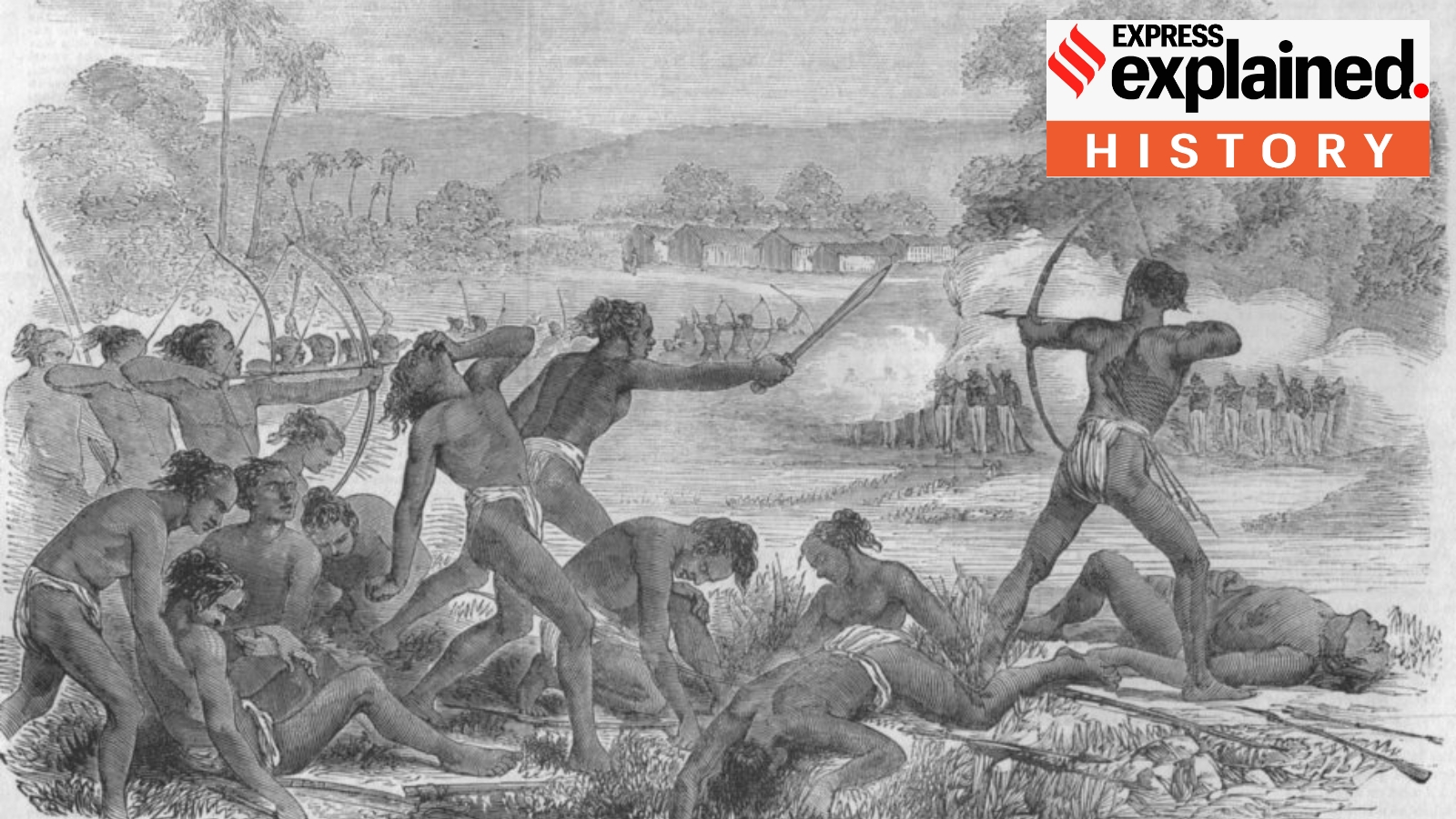
It was in the forested hills of Damin-i-Koh — in the village of Bhognadih — on June 30, 1855, that the brothers Sido and Kanhu Murmu called upon the community to resist a system that had steadily narrowed the conditions under which settled life remained possible. This armed uprising is remembered simply as Hul (‘rebellion’ in Santali).
A stamp depicts the brothers Sido and Kanhu Murmu, who led the Santal uprising of 1855. Wikimedia Commons
The Santals had faced immense difficulties as rent demands rose, debts spread through families with little means to contest them, and intermediaries multiplied between the cultivators and any prospect of redress. Instances of affronts to their elders and women, and a failure on the part of the administration to address their grievances, further aggravated the insecurities.
Simone Weil observed in The Need for Roots that a person can remain in a familiar place and still lose the conditions that make belonging possible, that uprootedness is not only a consequence of displacement but of dispossession. The Santals of Damin-i-Koh faced the damage that extended beyond physical displacement. The Hul grew out of those pressures, and its suppression scattered the people further across the region.
The dispersal of the community
The Bengal District Gazetteer of 1910 recorded that dispersal. Many families travelled eastward toward Purnea, Malda and Burdwan. Others entered Assam’s tea gardens, manifesting their so-called “domestication” by the British. The gazetteer notes nearly 31,000 Santal Pargana residents already working there by 1901, with ten thousand more settled in Jalpaiguri.
Story continues below this ad
W G Archer records a Santal proverb in The Hill of Flutes: Life, Love and Poetry in Tribal India: A Portrait of the Santals that “a million Santals have a single word”. The line reads differently against a history of communities scattered across tea gardens and distant districts, families separated by hundreds of miles and children growing up in places their grandparents never saw. Distance alone could not dissolve that sense of belonging.
Alasdair MacIntyre argued, in After Virtue, that a person’s identity depends less on where they stand than on the story they take themselves to be continuing, a narrative inherited rather than chosen, carried forward by people who never meet most of the others carrying it. Archer’s proverb describes exactly that kind of inheritance. A million Santals scattered across tea gardens, road camps and Pargana villages may still share a single voice because they continue a single story rather than because they occupy a single place.
A common script
In 1925, Pandit Raghunath Murmu designed the Ol Chiki script for Santali. The script arrived after decades of migration and dispersal. Santali speakers gained a script made for their own sounds rather than borrowed from another tradition. Santali entered the Eighth Schedule of the Constitution in 2003.
Story continues below this ad
However, the single voice Archer described, and MacIntyre’s idea would predict, has had to compete with several scripts, as Santali was also written in Roman, Bengali, Odia and Devanagari. Large sections of the community, particularly in Santal Pargana, still read and write Santali in scripts other than Ol Chiki. During a call for a closure in Dumka district demanding faster implementation of Ol Chiki, I asked a group of protesters how they felt about the script itself. None of them, as it turned out, could read or write it.
On one hand, the protest depicted solidarity in its purest form, people standing up for something larger than their own literacy. On the other hand, it was the same exclusion the protest meant to end, visible in the very people protesting it. In this sense, the question of which script belongs to the language may, in places, harden into a question of which script belongs to the community.
Modern-day migrations
Geography has as much to do with such divergences in script and practice, and, in that sense, unity does not necessarily mean that everyone has to live in the same place or even use the same script. Today, many Santals leave their region for work or other opportunities, while those who stay continue to preserve their community and culture. Jharkhand’s 2023 Migration Survey estimated that around 45 lakh residents of the state live and work elsewhere.
Story continues below this ad
Many come from Dumka, Godda and Pakur, districts that formed the centre of the old Santal heartland. Some travelled to Leh-Ladakh for road construction in high-altitude terrain. Others moved toward cities, factories and farms across the country.
Many Santals entered Assam’s tea gardens. Wikimedia Commons
Numbers such as these describe movement at scale, but they say less about the arrangements families make around an absence. During my time as Deputy Commissioner of Dumka, I visited a village in an area where kala-azar had long been endemic. By chance, our team met a four-year-old girl running a persistent fever. Tests later confirmed the diagnosis. Her mother had died. Her father spent most of the year working outside the district as a seasonal migrant. Her elder brother, a boy of eight or nine, had taken on much of her care. Throughout the conversation, she kept close to him. Whenever unfamiliar people gathered around, she drifted back toward him.
In many villages, the story of migration belongs as much to those who remain, and in their history, MacIntyre’s question — which story am I a part of? — belongs to everyone. It belongs to the girl who kept drifting back towards her brother. It belongs to the families who answered the call at Bhognadih, to the labourers who entered Assam’s tea gardens and to those who built roads through Leh-Ladakh. It belongs even to the protesters in Dumka arguing over a script most of them could not read.
Across two centuries, the Santals have answered that question in their own way: through movement and memory, through an origin narrative that preserved a dilemma, and through a script that preserved a language. For them, movement has not been the opposite of belonging. Often, it has been the only way belonging could survive.
Story continues below this ad
The author is a 2012-batch IAS officer in the Jharkhand cadre. He is currently studying at the School of Geography and Environment at the University of Oxford. The views expressed are personal.
View original source — Indian Express ↗
Related stories

AllAfrica
TechnologyJun 30, 2026 · 1 min
Liberia: Rights Groups Raise Alarm Over Boakai's Suspension of INCHR Chair
AllAfrica

Lovin Malta
TechnologyJun 30, 2026 · 1 min
Watch: Maltese Government Looks Back On Its First 30 Days Back In Office
Lovin Malta

TechRadar
TechnologyJun 30, 2026 · 1 min
The original Christopher Lee Dracula is coming to 4K Blu-ray in a new 'painstakingly restored' version with 'long-lost'…
TechRadar

Times of Israel
TechnologyJun 30, 2026 · 1 min
Daily Briefing June 30: Why Netanyahu won’t publicly take on Trump over Iran
Times of Israel