The Guardian
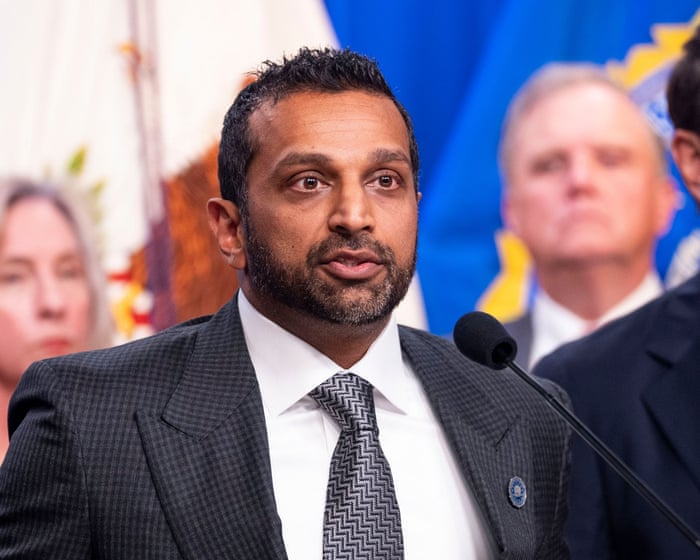
Kash Patel draws flak for posting FBI case details on social media ‘to make himself look good’
Kash Patel may have flouted legal constraints and the FBI’s disciplinary code in prematurely divulging arrests in an alleged plot to attack this month’s Ultimate Fighting Championship bout at the White House, bureau veterans have alleged.
The FBI director was accused of “jumping the gun” by posting details on social media of five arrests in an investigation carried out in conjunction with the Secret Service.
It subsequently emerged the inquiry was sealed by a court order, theoretically constraining Patel from publicly disclosing it. There is a general prohibition against publicising information related to sealed cases while the order remains in force, under US federal law. Although exceptions exist allowing for revealing their contents, formal court authorization would be needed to do so. Patel has previously invoked court orders sealing grand jury testimony as justification for the FBI’s inability to release many of its files on Jeffrey Epstein.
On 16 June, two days after the White House cage match, Patel revealed in an early morning tweet that five men suspected of planning to attack the event with drones and explosives had been “stopped cold”, and praised “the rapid action of the FBI, our partners, and the Department of Justice in a multi-state operation”. But the problem, according to several law enforcement officials involved in the case, was that the investigation was still ongoing and agents were still actively searching for additional suspects at the time Patel shared his post.
“While the result represented the best of investigative work, it was also nothing out of the ordinary for this law enforcement team – we are built to detect, respond to, and bring to justice those who threaten the lives of American citizens – particularly during large gatherings like the historic UFC 250 fight,” Patel wrote.
FBI insiders say the post is consistent with the director’s appetite for details of investigations that he can then publicize on social media. Lauren Anderson, who oversaw counterterrorism investigations in the US and abroad during a 29-year career at the agency, said several current and former agents who had been in meetings with Patel told her he was more focused details that he could release than on investigative developments and said they had been pressed to pass on such information.
Patel’s tendency towards premature publicity also undermined trust in the FBI from other law enforcement agencies it had to work with, she said, including the Secret Service.
The UFC post triggered an implicit rebuke from Matt Quinn, the deputy director of the Secret Service, who – without naming Patel – told journalists: “I’ll tell you a phrase I learned early in my career in the New York field office and that’s ‘Don’t choke on your own smoke.’
“The Secret Service led that investigation from the beginning,” Quinn continued. “I’ll tell you that case is ongoing. In order to maintain the integrity of the investigation and the security plan, we chose not to leak it.”
Hours after Patel’s social media announcement, the justice department formally announced it had arrested five men for allegedly conspiring to “plan and execute a mass casualty event”. Two more men have since been arrested and charged in connection with the alleged plot, according to the justice department.
But FBI veterans say Patel’s precipitous revelations put the investigation at risk and could undermine the future prosecution.
Anderson, whose period at the FBI included serving under Robert Mueller as director, said Patel’s rush to publicize the arrests may have bypassed legal restrictions and the bureau’s internal guidelines, violation of which could trigger an inquiry by the office of professional responsibility, an entity within the bureau tasked with investigating misconduct and enforcing ethical standards.
“This [case] was sealed, so that brings in to question the legal possibility of whether the court would look at this violation of a sealed order,” she said. “Theoretically, the court could issue sanctions. They could ensure contempt citations. It’s a very serious thing.”
Other FBI employees, junior or senior, acting similarly would face severe internal repercussions and potential court sanctions, she said.
“If I had chosen to release that information in any way, shape, or form, never mind on social media, but to share it with a local or state law enforcement official who wasn’t immediately involved with the case, that would have brought anything from a reprimand to a full investigation, which … could have resulted in me being suspended [or] being fired,” Anderson said.
In response, an FBI official denied the publicity had undermined the investigation. “Any suggestion the investigation was compromised is totally false,” the official said. “There have been eight arrests made so far, and the investigation is ongoing, and no subjects or charges were identified prior to unsealing.”
Current senior agents had recounted being pressured by Patel on conference calls to disclose information on specific investigations that he could then relay on social media, Anderson said.
“When he does want to get involved, he’s demanding updates at a rate that is inconsistent with being able to continue with the investigation,” she said. “He has repeatedly said in these calls, ‘We have to get something out on social media, let’s craft what my tweet should look like,’ rather than focusing on the substantive developments in the investigation.
“That is what he most frequently wants to talk about and his conduct and speech has bordered on being unprofessional in these calls.”
Patel, a fierce loyalist of Trump who has faced a litany of misconduct allegations since ascending to the role – all of which he has denied – has previously been criticised for premature social media announcements of individuals being taken into custody over the murder of the conservative activist, Charlie Kirk, last September and over a deadly shooting at Brown University in December, in which two people were killed and nine were injured.
In both instances, the people initially detained were later released without charge. An hour and a half after announcing that a suspect was being held for Kirk’s murder, Patel was forced to reverse himself by posting that the man had been released after interrogation. A different man, Tyler Robinson, was later arrested and charged with the crime.
In the Brown University case, Patel posted that FBI agents had detained “a person of interest” in relation to the campus shooting, but the next day a second person was shot dead in Brookline, Massachusetts. The gunman responsible for both incidents, Cláudio Manuel Neves Valente, was found dead from a self-inflicted gunshot wound on 18 December in a storage facility in Salem, New Hampshire, after police moved in to arrest him.
Patel has responded to such criticisms by citing his own “transparency”.
Defending his initial post about Kirk’s murder on an appearance on Fox and Friends, he said: “Could I have worded it a little better in the heat of the moment? Sure. But do I regret putting it out? Absolutely not. I was telling the world what the FBI was doing as we were doing and I’m continuing to do that.”
He added: “I challenge anyone out there to find a director that has been more transparent and more willing to work the media on high-profile cases or any case the FBI is handling than we have been under my leadership.”
Patel was also condemned for posting photographic evidence of a shooting at an Immigration and Customs Enforcement facility in Dallas last year.
Anderson said Patel’s premature announcements, including publicizing a wrongful arrest, could undermine or compromise the prosecutor’s case.
“There are absolutely potential downstream issues with this, and it gives defense counsel a lot more to work with in terms of challenging what [the prosecution’s] statements and charges are,” she said.
The FBI official said bureau investigators and their partners caught Kirk’s suspected assassin “in 33 hours … less than numerous other high-profile suspects”, citing the perpetrators of the 2013 Boston marathon bombing as a comparison.
But Philip Field, a former FBI counterintelligence analyst who resigned following Patel’s confirmation last year, said the director’s desire for publicity was at odds with the discreet traditions of his predecessors – and endangered lives.
“The old loose lips sink ships is absolutely the warning that he didn’t get,” he said. “One of the big dangers [of Patel’s premature announcements] is that you’ve now created a false sense of security within the community, both with the public and with law enforcement, where some people will hear that and say: ‘Oh, well, it’s safe to go out and resume my business.’”
Comparing Patel, who had no previous experience at the agency prior to his confirmation, to past directors, he went on: “The director can speak about what happens at the FBI [because] obviously it’s his organization, but there is an expectation that they will respect the investigation[s] and not compromise them.
“I worked on cases like ISIS [the Islamic State] and al-Qaida, but I will never be able to speak about most of the work that I did at the FBI.”
Field noted he will likely never be able to discuss many of the counterterrorism cases he worked on – including investigations into groups such as al-Qaida and the Islamic State.
“The people actually doing the work will never get a credit for any of it. They accept that because they know that what they’re doing is important,” he said. “But Kash Patel doesn’t care. His goal is to make himself look good.”
View original source — The Guardian ↗
Related stories

The Punch
PoliticsJun 30, 2026 · 1 min
FG vows action against Côte d’Ivoire over Nigerian’s death in prison
The Punch
The Punch
PoliticsJun 30, 2026 · 1 min
Tinubu hails veteran journalist Tunji Bello at 65
The Punch

TASS
PoliticsJun 30, 2026 · 1 min
Tokayev shares his impressions of his visit to Brussels with Putin — Kremlin
TASS
The Punch
PoliticsJun 30, 2026 · 1 min
Okpebholo urges govs to tackle insecurity
The Punch