Times of India
Times of India··3 min read
Europe heatwave: Indian AC makers eye market, face competition from China, South Korea
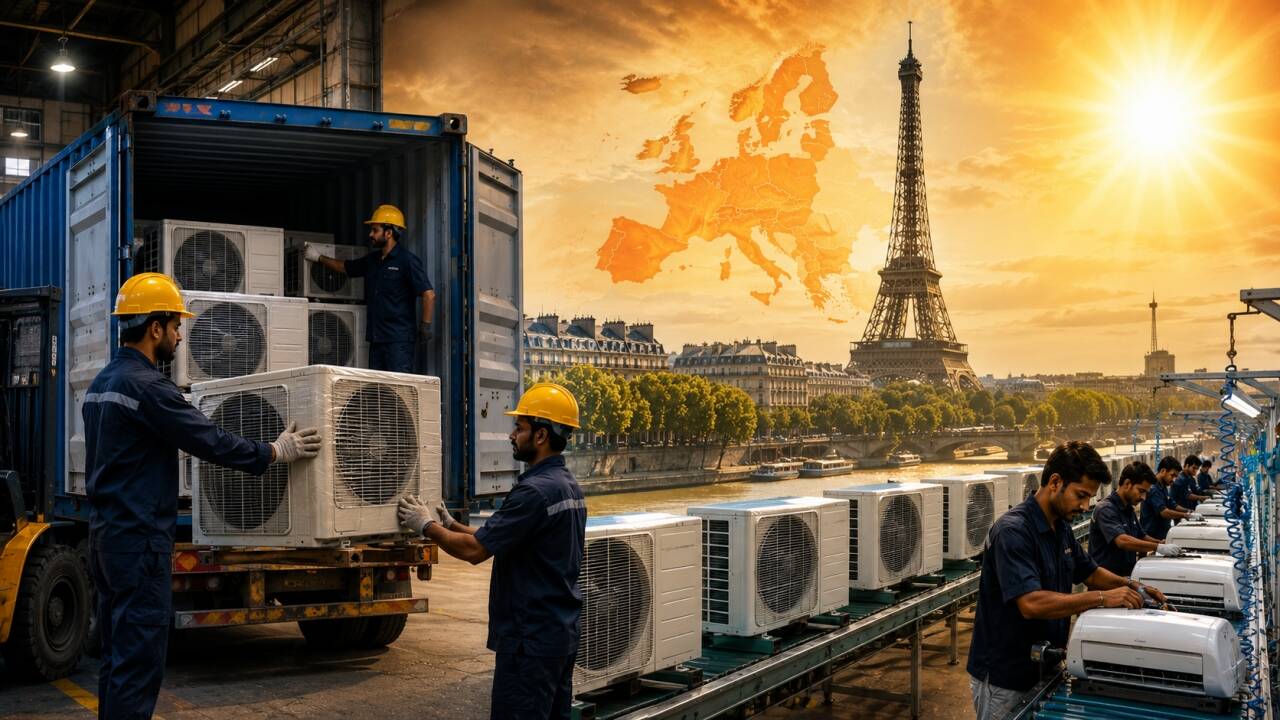
Demand for cooling products in Europe has risen sharply, with both sales and customer enquiries increasing two to three times. (AI image)
Europe heatwave impact: Indian manufacturers of air conditioners are gearing up to enter the European market, encouraged by surging demand for cooling products following record-breaking heatwaves and the growing impact of global warming.
However, they are expected to face stiff competition from Chinese and South Korean brands, which currently dominate the region and reportedly enjoy a 15-18% cost advantage over Indian manufacturers.Demand for cooling products in Europe has risen sharply, with both sales and customer enquiries increasing two to three times. Recognising the sector's potential, the Centre has, since last year, identified air conditioners as a high-value manufacturing opportunity similar to smartphones.
Commerce and Industry Minister Piyush Goyal and Electronics and Information Technology Minister Ashwini Vaishnaw have also urged manufacturers to expand exports.The World Health Organization (WHO) has cautioned that Europe's "once-in-a-generation" heatwaves are increasingly becoming an annual event due to climate change. WHO Director-General Tedros Adhanom Ghebreyesus said that more than 1,300 excess deaths have been recorded since June 21 because of extreme temperatures.
He added that Europe is "the fastest-warming continent on Earth," with temperatures rising at twice the global average. According to the WHO, nearly 150 million people across Europe are currently living under extreme heat conditions.
Europe a new market for Indian AC makers
Before entering the market, Indian companies will have to comply with Europe's stringent certification and product quality requirements. Industry executives told ET that commercial exports from India are likely to begin only from 2027. "While we had been studying opportunities in Europe since last year, this year's heatwaves have opened our eyes," said Kamal Nandi, Head of the Appliances Business at Godrej Enterprises Group. "Immediate sales are not possible because of stringent certification requirements, but we definitely plan to launch by next summer."So far, exports have remained limited, partly because domestic air-conditioner penetration in India is still only around 10-11%.
Air conditioners are also the only white goods segment covered under the production-linked incentive (PLI) scheme, prompting the government to push for higher export earnings from the industry.Noida-based Havells plans to start exporting air conditioners and fans to Europe through distributors after initially concentrating on the US market.Contract manufacturers, including Amber Enterprises—which supplies products to brands such as LG, Daikin, Samsung and Blue Star—are also assessing opportunities to export.
At the same time, global companies including LG, Daikin and Haier are expanding their manufacturing capacity in India by setting up export-oriented production units. According to industry executives, this will allow them to ship part of their India-made output directly to European markets.
Not an easy fruit to pick
According to Godrej's internal assessment, heat pump air conditioners—which offer both cooling and heating—currently make up nearly 80% of residential AC sales in Europe. While similar products are already available in markets such as Jammu & Kashmir and the Delhi-NCR region, manufacturers said their designs would need to be adapted for European homes, where installation costs are significantly higher. They also pointed out that many buildings across Europe are not designed to accommodate conventional air-conditioning systems, while heritage structures are subject to regulations that prohibit the installation of outdoor split AC units.Manufacturers are also working to satisfy Europe's strict regulatory requirements, including CE (Conformité Européenne) certification, energy-labelling norms and eco-design standards. "It's not that easy," said Jasbir Singh, Chief Executive Officer of Amber Enterprises, India's largest contract manufacturer of air conditioners. "First, we have to get the product ready for those countries and clear their energy-efficiency norms.
"Industry executives believe, however, that the biggest hurdle will be competing with well-established global players such as Daikin and LG, along with Chinese manufacturers including Midea, Gree and Haier."Matching the Chinese competition in Europe will not be easy," said B. Thiagarajan, Managing Director of Blue Star. "It also remains to be seen whether this is just a one- or two-month phenomenon that fades when winter sets in." Blue Star is currently concentrating on exports of commercial air-conditioning systems.
View original source — Times of India ↗
Related stories

The Punch
NewsJun 30, 2026 · 1 min
VIDEO: Babcock, you’ll pay N100,000 before you see me — Carter Efe
The Punch
The Punch
NewsJun 30, 2026 · 1 min
271 Nigerians evacuated from South Africa arrive Lagos
The Punch
The Punch
PoliticsJun 30, 2026 · 1 min
FG vows action against Côte d’Ivoire over Nigerian’s death in prison
The Punch
The Punch
NewsJun 30, 2026 · 1 min
Abia begins enforcement of motorcycle restrictions, unveils toll-free complaints line
The Punch