Indian Express
Indian Express··5 min read
This Santal Hool, the shrinking space for tradition — and the women who pay the price for it
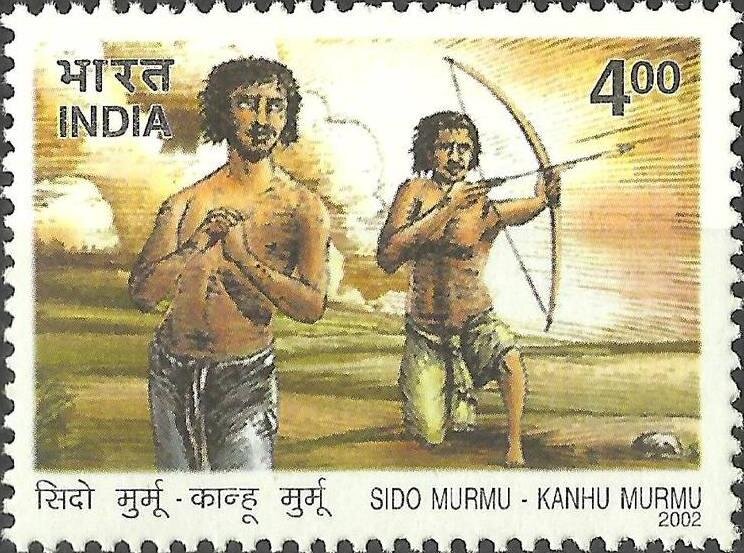
A stamp depicts the brothers Sido and Kanhu Murmu, who led the Santal uprising of 1855. Wikimedia Commons
6 min readJun 30, 2026 04:10 PM IST
First published on: Jun 30, 2026 at 04:10 PM IST
Written by Shalini Saboo
It was not only Sidho, Kanho, Chand, and Bhairav Murmu, the siblings who led the Santal rebellion, but also their sisters, Phulo and Jhano, who dared to enter enemy camps, gathering intelligence and neutralising British forces. On June 30 this year, the nation marks 170 years of Santal Hool, commemorating the uprising of the Santal Adivasis against the land alienation practices of the colonial authorities in the Santhal Pargana area of today’s Jharkhand comprising the then Rajmahal Hills and Damin-i-Koh region and parts of West Bengal; the role of Santali women in it cannot be undermined. They were not only active participants but key combatants and agents in the 1856 revolution. Sadly, these tribal women who were active defenders of their territory remain deprived of land inheritance rights under the customary and colonial laws post the Santal rebellion.
The Structural Exclusion of Women from Ancestral Lineage
Even today, a clan-based patrilineal kinship system forms the foundation of the Santal tribe, where links between land, kinship and ancestors are extremely strong and inextricably associated with the very existence of the community. Therefore, as a daughter, wife and mother, a Santali woman cannot make an ownership claim on the land of her ancestors.
The occasion marking a victory against a fierce battle to abolish the zamindari system and preserve indigenous land offers a perfect juncture to go back in history and pay allegiance to the role of women from the tribe. Like their other tribal brethren in the region, was there an intent to keep the Santali women completely out of the inheritance lineage? A discernment of the primordial custom of “taben jom” in Santhal Pargana, much before women of the tribe started facing complete exclusion by the patriarchal system of inheritance, does not answer the question in the affirmative.
The Erosion of Taben Jom and Statutory Neglect
W G Archer, a British civil servant and an ethnographer who served as deputy commissioner of the Santhal Parganas in the early 1940s, in his seminal anthropological and legal report Tribal Law and Justice: A Report on the Santal, records the customary practice of “taben jom” in the Santal tribe where a daughter is granted land at the time of marriage. The custom, which literally means “sufficient to eat,” takes two forms in which land is given to a daughter either for her lifetime or forever. Such land was given out of affection or as a security against a bad marriage. However, it was a and not an obligatory claim of the daughter, which could only be made if it received the sanction at the village meeting. With time, this custom has lost its effectiveness. Currently, instead of ‘taben,’ which in Santali means flattened rice or ‘poha’, a feast is arranged during the festival of Sohrai where brothers invite sisters to their natal village as a symbol of affection.
Even the Santal Parganas Tenancy (Supplementary Provisions) Act, 1949, which currently governs land inheritance rights in the region, makes no mention of “taben jom”. It, however, refers to a gift from a brother/father to a sister/daughter, but only after obtaining prior permission from the deputy commissioner. The custom has not only gone into disuse over a period of time, but even the state has hardly attempted to accommodate it as some form of claim in the legislation. Above all, its unawareness among the women diminishes even a slight chance of their making any demands on the pretext of this custom.
Another contested aspect of female property relations within the tribe is the “Ghar Jawai” system of marriage. A “Ghar Jawai” in a Santal society is equivalent to an adopted son who gets all the rights of a male heir. However, this has to be done with the consent of the male agnates of the daughter; if missing, such marriage is considered invalid. On the day of the wedding, the “Ghar Jawai,” accompanied by the girl’s father and other village officials, is shown all the lands that he would inherit as an adopted son. This ritual is symbolic of the social sanction. It must be noted here that the actual heir is not the son-in-law belonging to a different clan but the daughter. This custom too has changed, much to the disadvantage of the Santal women.
The Ghar Jawai System and the Crisis of Social Legitimacy
The Village Assembly, considered the facilitator of social legitimacy in “Ghar Jawai” marriages, remains conspicuously absent, rendering its social sanction aspect meaningless. This void has created space for the police and courts to step in. This has even led to a situation where previous “Ghar Jawai” marriages have come under attack by the male agnates. More than eighty per cent of land disputes in Santal Pargana relate to “Ghar Jawai” marriages. These disputes reveal hostility between social sanctions and court decisions in which the influential side emerges mightier. In recent years, the registration department has stopped registering these marriages citing technical reasons. Such complex enmeshment points towards the negativity surrounding female inheritance rights in the Santal tribe. A situation which reminds us that the triumph of Hool being rejoiced outside is yet to be won within the community.
Once, legal pluralist Marc Galanter, while scrutinising state intrusion into non-state laws, pointed out that “people’s law” might not be strong enough to establish harmonious egalitarianism. If communitarian values of the indigenous people do not include gender parity in their legal system, how can it be a viable alternative to the modern judiciary? Commemorating more than a century of the epochal Santal Hool shall remain incomplete if the women warriors of the rebellion remain deprived of the very rights they fought for.
The writer is Junior Fellow, Centre for Contemporary Studies, Prime Minister’s Museum and Library, Teen Murti House, New Delhi
View original source — Indian Express ↗
Related stories

The Punch
NewsJun 30, 2026 · 1 min
VIDEO: Babcock, you’ll pay N100,000 before you see me — Carter Efe
The Punch
The Punch
NewsJun 30, 2026 · 1 min
271 Nigerians evacuated from South Africa arrive Lagos
The Punch
The Punch
PoliticsJun 30, 2026 · 1 min
FG vows action against Côte d’Ivoire over Nigerian’s death in prison
The Punch
The Punch
NewsJun 30, 2026 · 1 min
Abia begins enforcement of motorcycle restrictions, unveils toll-free complaints line
The Punch