Indian Express
Mumbai-Ahmedabad bullet train: How India’s first high-speed rail project could transform the regional economy
Mumbai-Ahmedabad bullet train project: The Ministry of Railways is targeting the commissioning of the priority stretch between Surat and Bilimora in Gujarat, the first operational segment of the Mumbai-Ahmedabad Bullet Train corridor, next year. For this, the National High Speed Rail Corporation Limited (NHSRCL) is working in full swing to meet the deadline.
In a statement issued in November 2025, the national transporter said the 47-km-long priority section between Surat and Bilimora had reached an advanced stage of construction, with all civil works and track-bed laying completed. It added that the corridor has been built using advanced engineering techniques in line with international standards.
The 508-km-long Mumbai-Ahmedabad High-Speed Rail (MAHSR) corridor passes through Maharashtra, Gujarat, and Dadra & Nagar Haveli. Since its foundation stone was laid in September 2017, the project has aimed not only to reduce travel time between Mumbai and Ahmedabad significantly but also to improve passenger comfort and safety.
The MAHSR corridor comprises 12 stations: Mumbai (BKC), Thane, Virar, Boisar, Vapi, Bilimora, Surat, Bharuch, Vadodara, Anand, Ahmedabad, and Sabarmati. The NHSRCL plans to develop these stations as multimodal transport hubs, integrating the bullet train with metro, Bus Rapid Transit System (BRTS) and Indian Railways networks to enable seamless passenger connectivity.
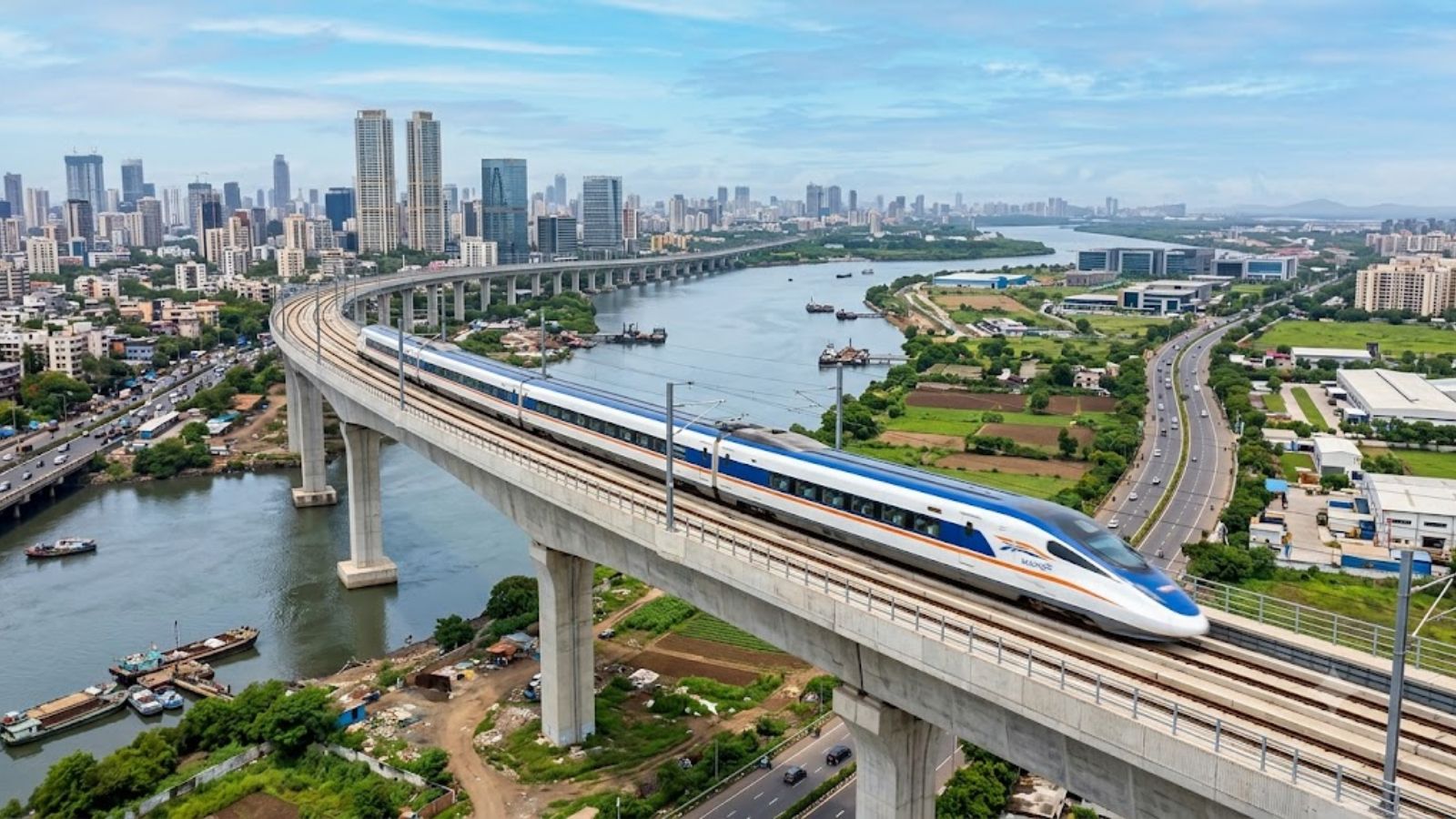
India’s first bullet train project (Image: NHSRCL/Enhanced with AI)
Bullet train project in India: How Mumbai-Ahmedabad HSR could reshape regional economy
Although India’s first bullet train project faced delays due to land acquisition challenges, the construction has now gathered pace. Earlier, Railway Minister Ashwini Vaishnaw said that the country’s first bullet train will begin operations on August 15, 2027. The Railway Minister further added that the bullet train services will be extended to Thane by 2028 and will finally reach Mumbai by 2029. He also stated that the entire project is expected to be completed by December, 2029.
Once the entire corridor is operational, the bullet train is expected to reduce the travel time between Mumbai and Ahmedabad to around two hours, compared with the current 8 to 9 hours by road or railways. This will enable business travellers, professionals, students and other passengers to make a same-day return trip, like departing from Mumbai in the morning, reaching Ahmedabad within two hours, completing their work or other engagements and returning home by the evening.
As the first operational section of the MAHSR corridor nears completion, here’s a look at how the Surat-Bilimora stretch could transform the region’s economy.
Story continues below this ad
Surat is popularly known as one of the world’s leading diamond cutting and polishing centres and is also a major hub for textile manufacturing. The city also has a presence in engineering, chemicals, information technology and other industries.
Bilimora, located in south Gujarat near the Maharashtra border, is also close to several industrial clusters, including pharmaceutical, engineering, and manufacturing units. Its proximity to Mumbai and other key economic centres makes it an important link in the region’s industrial ecosystem.
Vapi, located just south of Bilimora on the Mumbai route, is also one of Gujarat’s major industrial cities. It is known for its pharmaceutical, chemical, textile, and plastics industries, along with many small and medium-sized manufacturing units. Its proximity to Bilimora makes the priority section of the Mumbai-Ahmedabad Bullet Train corridor important for the region’s industrial and economic growth.
Speaking to Indianexpress.com, Dharmendra Tewari, Additional Director General (Public Relations) at the Railway Board, said that with the bullet train reducing travel time to Mumbai, Surat could witness greater business opportunities and investment.
Story continues below this ad
According to him, Surat could see an increase in business travel and private investment, expansion of corporate offices, growth in real estate around the bullet train station, a boost to tourism and the hospitality sector and better access to a skilled workforce.
“Professionals could live in Surat while commuting to Mumbai, making the city even more attractive due to its relatively lower cost of living,” he added.
On Bilimora and Vapi, Tewari said the region is already well connected by road and railways. The bullet train would further improve accessibility, making it easier for investors, business executives and skilled workers to reach the industrial belt, he said.
According to him, this could lead to faster business decisions, new industrial investments, expansion of manufacturing units, higher employment, improved logistics and it would also serve as a gateway between Mumbai and Gujarat.
Story continues below this ad
He said bullet train stations often act as catalysts for urban development. According to the railway official, areas around the Surat and Vapi stations are likely to see commercial developments, hotels, office spaces, residential townships, etc.
“This can create new economic zones around the stations where an entrepreneur can open businesses in Gujarat while serving Mumbai markets, travel frequently without relocating, expand supply chains and employment generation,” he noted.
Mumbai-Ahmedabad bullet train will further strengthen economic integration between the two cities. He stated that the businesses will benefit from: shorter travel times, easier same-day business meetings, better collaboration between industries in Mumbai, Surat and Vapi; development of real estate and urban infrastructure.
“The Mumbai-Ahmedabad bullet train is not merely a transport project. It is expected to improve regional connectivity, attract domestic and foreign investment, strengthen industrial corridors and encourage urbanisation around stations. It will enhance Surat’s role as a commercial powerhouse and Vapi’s position as a leading manufacturing hub,” he added.
Story continues below this ad
Apart from improving connectivity and businesses, the Mumbai-Ahmedabad High-Speed Rail (MAHSR) corridor is also expected to give a boost to tourism. The route passes through regions known for their natural beauty, cultural heritage and historical attractions. It will make it easier and faster for tourists to travel between destinations.
Thus, the country’s first high-speed rail corridor is set to boost economic growth by bringing Mumbai, Surat and the Vapi industrial belt closer in terms of travel time, business and investment.
View original source — Indian Express ↗
Related stories

The Punch
BusinessJun 30, 2026 · 1 min
NIPHID bill won’t duplicate NCDC roles, acting CEO
The Punch
Bloomberg
BusinessJun 30, 2026 · 1 min
Copper Traders Gear Up for Another Round of Tariff Turmoil
Bloomberg
MarketWatch
BusinessJun 30, 2026 · 1 min
A 23% plunge in personal wealth leaves this country trailing its global peers
MarketWatch

TASS
BusinessJun 30, 2026 · 1 min
Akkuyu project to help Turkey achieve carbon neutrality goal — company
TASS