Times of Israel
Impoverished Venezuelan Jews open synagogues to help shelter hundreds of earthquake victims
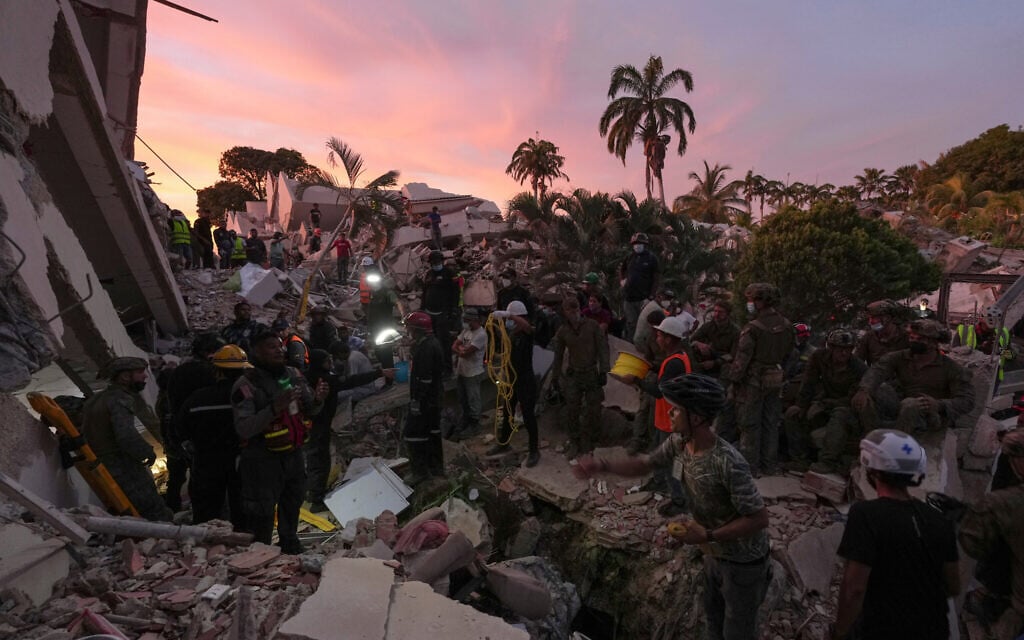
When two powerful earthquakes rocked Venezuela’s capital city of Caracas and nearby La Guaira last Wednesday, volunteers from the country’s Jewish community sprang into action almost immediately, opening synagogues and community centers to hundreds of frightened residents.
The magnitude 7.2 and 7.5 quakes struck seconds apart, killing more than 1,700 people, leaving tens of thousands missing or trapped, destroying hundreds of buildings, and causing billions of dollars in damage, according to reports.
“It was just after 6 p.m. on Wednesday, and it was a national holiday, so most people were in their homes,” recalled Roberto Mishkin, president of Venezuela’s main Ashkenazi congregation, Union Israelita de Caracas. “It was a massive earthquake. I don’t know of anyone who didn’t have some sort of damage in their house.”
The Jewish community is well organized when it comes to security procedures, said Mishkin, and in the hours that followed the quake, hundreds of people arrived at the Hebraica Jewish Community Center and the main synagogue, buildings that serve as the community’s main hubs.
“They were filled with people whose homes were damaged or destroyed, as well as many who came because they were too frightened to sleep in their buildings,” Mishkin said. “We started looking for food, water and blankets for everyone. Only around midnight, after everyone had checked on their own families, did the community’s crisis committee finally have a chance to sit down to meet.”
Get The Times of Israel's Daily Edition
by email and never miss our top stories
By signing up, you agree to the terms
As of Sunday evening, three members of the country’s 5,000-strong Jewish community have been confirmed dead, and four are still missing, Mishkin said. At least 15 Jewish families have seen their homes destroyed, along with another 30-35 families whose apartments have been rendered unlivable. About 100 people continue to sleep in the Hebraica center every night since the tremor, Mishkin said.
The disaster struck when things were finally starting to look up for Venezuela’s Jewish community after the United States captured President Nicolás Maduro in January, following decades of anti-Zionist and authoritarian rule under Maduro and his predecessor, Hugo Chavez. Government officials have sharply changed their antisemitic tone since Maduro’s replacement, Delcy Rodriguez, was installed, members of the community said.
But even as rescue teams from around the world, including Israel, arrive to provide assistance, many fear that the rebuilding process will be a long and difficult one.
“This is an impoverished community that has always relied heavily on social services,” Mishkin said. “Now, people have lost their livelihoods and their homes, and we are starting to think about how we will be able to help everyone. We appreciate that Jewish institutions and communities around the world are offering their support, but we need a lot of help.”
A fundraising campaign by the community had raised just under half of its $2 million goal as of Tuesday afternoon.
Years of challenges
Venezuela’s Jewish history dates back at least 200 years to around the time the country achieved independence from Spain in 1821, with an influx of Sephardic Jews engaged in trade and commerce. Later waves of immigration in the 20th century swelled the community’s ranks, and the country peaked at around 30,000 Jews in the years before authoritarian leader Chávez came to power in 1999.
“We used to be a very prominent, prosperous community that contributed to Jewish causes around the world,” Mishkin said.
But Venezuelans fled the country in droves as the Chávez government openly punished political opponents and nationalized the economy, turning wealth into rampant poverty. That trend only escalated after Maduro replaced Chávez in 2013. Today, the Jewish community has dwindled to just about 5,000 people, mostly elderly people who couldn’t afford to leave.
“Demographically, we are an inverted pyramid, with mostly older folks who are not economically productive, and very few young people,” Mishkin said.
Meanwhile, about 2,500 Venezuelan nationals currently live in Israel, according to Diego Sarmientos, who emigrated from Caracas 10 years ago.
Today, nearly all of the country’s Jews live in Caracas, and the community provides an extensive network of social services for its poorest members. Even before the earthquakes, a massive centralized charity operation was feeding more than 300 families every day, Mishkin said.
The community is tight-knit, with the Ashkenazi Union Israelita de Caracas and the Sephardic Asociación Israelita de Venezuela working together to provide social services for everyone, Mishkin said. A few synagogues and the Hebraica Jewish Community Center comprise the country’s primary Jewish institutions.
Since the earthquakes, community members have been working around the clock to provide food, shelter, medical care, and a sense of safety for victims. Volunteers from local organizations such as Hatzalah have sourced medication for elderly people, arranged cots and mattresses in the JCC, and even organized Shabbat services in the synagogue, residents said.
“We are currently working very hard at a collection center, where people are bringing us all sorts of supplies for us to distribute among the needy,” noted Miguel Truzman, national coordinating director of the Confederation of Jewish Associations of Venezuela (CAIV), which serves as an umbrella organization for Venezuelan Jews. “This tragedy has been very hard for the country, [but] we are united and in solidarity in the face of the tragedy.”
Global aid efforts
International response teams are also helping out, including 17 search and rescue volunteers sent from Israel by the Magen company, and nonprofits Ready for Rescue and SmartAID. The group has begun to work alongside local forces on the ground to locate and rescue survivors and provide humanitarian aid, said a spokesperson for the delegation.
Cadena, a Jewish-led humanitarian group based in Mexico, also arrived in the country on Friday, Mishkin noted. Jewish organizations IsraAid, NATAN Worldwide Disaster Relief, and the Joint Distribution Committee have also been working to offer assistance.
The United States, meanwhile, is working to provide a strong disaster response to a country that it now calls an ally after Maduro’s deposition in January. The government promised an “unprecedented, large-scale response” that includes a 250-person emergency response team and $150 million in humanitarian assistance.
Changing geopolitics
Some in the Jewish community are hopeful that all this signals broader changes in Venezuela’s relationship with the country’s Jewish community, the United States, and Israel.
“Maduro would have refused any assistance from Israel, but our current president, Delcy Rodríguez, has no problem with it,” said Óscar Reyes-Matute, a Jewish scholar based in Caracas. “After the US incursion in January, our geopolitical situation has completely changed.”
Venezuela hasn’t had diplomatic ties with Israel since Caracas severed them during Israel’s Operation Cast Lead in Gaza in 2008-2009. But after Maduro was deposed in January, many in the Jewish community were wary of celebrating the prospects of regime change too early.
Years of violence and threats to expropriate Jewish schools, restaurants, and other institutions, as well as the government’s pro-Iranian, anti-Israel political stance, made any public declarations against the government risky for the entire Jewish community, said some of its members.
“There was always a fear that if something happens, people will blame Israel and the Jews,” Daniel Behar, a Venezuelan expatriate, previously told The Times of Israel. Unlike in Europe and elsewhere, antisemitism in Venezuela has been largely tied to the regime’s policies, not public sentiment, he noted.
But the new government, headed by Delcy Rodríguez, has been quietly changing its tune, even if its policies regarding Israel remain unchanged, sources in the community said. Anti-Israel rhetoric from government officials has tapered down, and Rodríguez sent the community a blessing on social media before Passover, something that would have been unthinkable previously.
Now, some are even quietly hoping that Venezuela could one day reestablish diplomatic relations with Israel.
“The Jewish community was starting to feel a bit more confident before the earthquake, and the discourse of hatred is fading,” Reyes-Matute said. “During this tragedy, there is a strong feeling of solidarity throughout Venezuela. I hope it will help awaken us to a new era.”
For Mishkin, though, diplomacy can wait.
“Right now,” he said, “our priority is making sure every family has somewhere to sleep, food to eat, and hope that we’ll rebuild together.”
View original source — Times of Israel ↗
Related stories

TechRadar
TechnologyJun 30, 2026 · 1 min
Declare independence from slow, outdated tech with these 11 unmissable 4th of July PC accessory deals from HP
TechRadar

TechCrunch
TechnologyJun 30, 2026 · 1 min
X now offers an MCP server to make its platform easier for AI tools to use
TechCrunch

The Guardian
TechnologyJun 30, 2026 · 1 min
House prices fall in four capital cities as Sydney values drop nearly $50,000 this year
The Guardian

TechCrunch
TechnologyJun 30, 2026 · 1 min
Arcturus could halve the grid’s electrical losses using its nano-infused copper
TechCrunch