Times of Israel
Comptroller flags key failures in evacuation, rehabilitation, of October 7 wounded
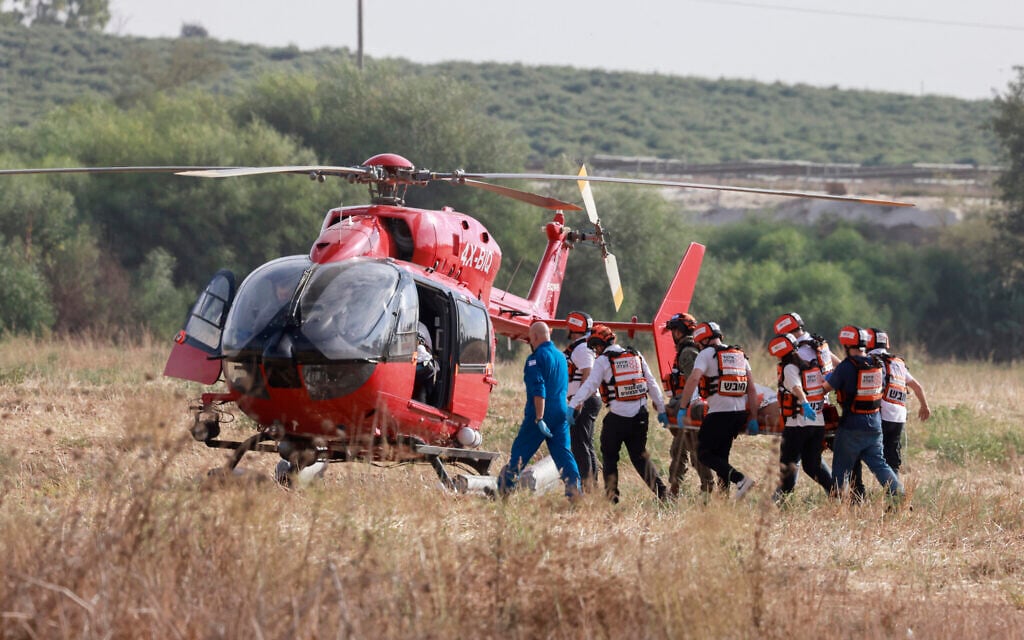
Military officials and ambulance services failed to coordinate the evacuation of wounded civilians from terror-struck communities and across southern Israel on October 7, 2023, contributing to the chaos amid the attack and likely keeping some from receiving life-saving care, the state comptroller charged in a report published Tuesday.
The report from auditor Matanyahu Englman offers the sole broad official reckoning with the catastrophic failures surrounding the attack in the absence of a state inquiry. It further found that hospital loads were mismanaged during the crisis, leading to two medical centers being inundated while other facilities had unused capacity, and that the Health Ministry had failed to prepare for rehabilitating large numbers of people following a mass casualty event.
According to the report, the Israel Defense Forces should have been responsible for evacuating the injured as Hamas gunmen stormed communities, towns, music festivals and other sites on the morning of October 7.
Instead, it relied on ambulance services such as Magen David Adom, which lacked protective gear needed to operate in active combat zones and, unbeknownst to the army, had ordered ambulance drivers not to enter communities where terrorists were present.
During the attack, civilians and local security squads were largely left to fend for themselves, with many never receiving care, and others making harrowing journeys through deadly fire in private vehicles to reach medical care.
Get The Times of Israel's Daily Edition
by email and never miss our top stories
By signing up, you agree to the terms
“The responsibility for evacuating the wounded from the combat zones on October 7 was that of the IDF’s Southern Command and the Gaza Division, since they are the military bodies responsible for the Gaza border area communities,” the report said.
While taking responsibility for failing to protect Gaza border communities that day, the IDF responded that under the complex circumstances on the ground and the need to repel the terrorists and achieve operational control to save lives, the number of evacuated wounded was relatively high.
Though 1,640 emergency incidents were registered that day, only 525 wounded individuals were evacuated in medical vehicles, 84 of them in bulletproof ambulances and 21 people by helicopter.
According to the comptroller, there had been warnings since 2016 about the need for more armored ambulances, but funding for them had not been allocated.
On the eve of the Hamas invasion, there were 24 armored ambulances nationwide, when 50 had been needed, and just one was in the region, stationed in the city of Sderot.
While information about the wounded was being received by MDA, the army apparently did not understand that it also had access to the same data.
The emergency service told the State Comptroller’s Office that it had installed a “digital medical situation room” at the IDF’s Gaza Division HQ in 2022 and tested it just four days before the Hamas invasion, which left some 1,200 dead and thousands injured. The platform shared details about every emergency call-out in real time, with exact locations of the wounded and the distribution of ambulances in the area.
Despite this, the person serving as the divisional medical officer on October 7 said that since taking up his post in August 2023, no one had told him about the digital platform, and that during numerous conversations with MDA on October 7, no one raised it either. The IDF denied that such a platform was available.
Furthermore, the IDF had no idea that MDA had told ambulances not to enter the communities infiltrated by the terrorists to evacuate wounded people.
“The result was that the information about the wounded that was in MDA’s possession and that could have assisted the military forces in reaching the wounded civilians and providing medical assistance did not reach the military forces in the combat zone,” the report said.
According to internal investigations, the military leadership was caught unprepared and experienced a profound breakdown in command and control, leaving it unable to grasp what was happening for hours.
The Gaza Division, responsible for the Strip and protecting southern Israel, was “defeated” for several hours, with the result that Israel’s defensive mobilization and counterattack were catastrophically slowed.
Only 767 troops were stationed on the border to face over 5,000 invading terrorists, which prevented the General Staff from forming an accurate operational picture. Commanders struggled to prioritize efforts or direct forces to the correct locations amid a fog of chaos and broken communication channels.
It took eight hours for the Gaza Division to tell MDA exactly where it could hand over the injured for transfer to hospitals, the state comptroller said.
Information was also not relayed to the Health Ministry in an organized fashion.
The comptroller found that while problems at the Health Ministry’s division responsible for operations during emergencies had been flagged as early as 2021, they were not addressed.
There was no established procedure for linking up with self-evacuating wounded, nor a procedure for incorporating private ambulance companies into emergency operations.
The report criticized the ministry for failing to resolve a longstanding feud between MDA and United Hatzalah, another volunteer-based emergency medical organization, as a result of which the two organizations failed to exchange information, potentially preventing better use of available resources.
Furthermore, even though senior figures in the Health Ministry, the Clalit Health Fund, and a National Situation Room within the ministry were aware that Barzilai Medical Center in Ashkelon and Beersheba’s Soroka Hospital were overloaded with wounded, while other hospitals were ready to receive the injured, they did not convene the committee charged with managing hospital loads in an emergency until 2 p.m., over seven hours after the Hamas attack began.
Soroka and Barzilai were so overloaded that over 40 percent of the wounded there waited for more than five hours before being transported to hospitals elsewhere, the report said.
The state comptroller noted that the IDF, which has conducted internal reviews into its failure to protect various communities, had not investigated its failures in evacuating the wounded.
Meanwhile, the report said, more than two years after the event, a Health Ministry probe had only been partially published, and MDA had failed to complete its own operational investigation.
Englman also noted that having a single figure — Moshe Arbel of Shas — fill the roles of both health and interior minister during and after October 7 hindered effective crisis management.
In its response, the IDF said that while “continuous dialogue” was maintained, situational assessments were made, and medical updates were sent to “all relevant parties” on October 7, the information provided by MDA throughout the day was too “general.” As a result, it said, aerial evacuation focused on dozens of wounded people whose exact locations were provided by other sources.
The statement said that MDA had not trained IDF personnel to use the digital interface and that at no point during the day did MDA direct soldiers to the platform, “assuming it was [even] installed and working.”
It added that United Hatzalah was not defined as an auxiliary organization under the Civil Defense Law, so the Home Front Command was not authorized to train or activate it in an emergency.
Rehabilitation of the wounded
Some 20,000 soldiers and security force members were wounded during the ensuing war in Gaza as of September 2025.
Around 1,660 soldiers, security service personnel, and civilians received treatment from hospital rehabilitation units between October 7, 2023, and July 2025.
Between December 2024 and August 2025, the State Comptroller’s Office examined the quality of that rehabilitation.
It found that despite knowing that hospital rehabilitation departments were severely understaffed, the Health Ministry had not updated staffing requirements for over 20 years.
“On the eve of October 7, there was a shortage of thousands of workers in the professions of physical therapy, speech therapy, and occupational therapy in the public sector,” the report said. “Hospital staffing standards did not meet the population’s needs even during routine times.”
According to an assessment by an inter-ministerial team examining gaps in health professional personnel, in 2020, there was a shortage of 1,947 physical therapists, 2,189 speech therapists, and 2,570 occupational therapists.
The result was that Sheba Medical Center in central Ramat Gan, which absorbed 47% of war-wounded needing hospitalization, had to take 72 beds from geriatric wards to accommodate demand for rehabilitation.
Data from Sheba indicated that patients received fewer than 2.2 treatments per day on average, nearly one full treatment below the accepted standard.
Furthermore, the Health Ministry lacked an operative, written plan for managing national rehabilitation during mass-casualty emergencies and failed to maintain a digital infrastructure to track ward occupancy, treatment quality, or patient wait times.
To provide immediate aid, the Rehabilitation Department implemented a “Rehabilitation First” policy, offering medical and psychological treatment and financial advances to all applicants while postponing formal medical boards. While this expedited initial care, it also created long-term complications, according to the audit.
As of August 2025, medical boards for war-wounded individuals had yet to resume.
Despite the creation of a Customer Relations Division, a June 2024 survey found that approximately 80% of wounded veterans reported having a low-to-moderate understanding of their rights and often relied on anecdotal information.
As of May 2025, around 7,000 out of the 26,000 wounded who applied for disability status had not had their status resolved by the Defense Ministry. Of these, roughly 2,200 recognition requests had been pending for over a year, triple the department’s own processing standard.
Crucial projects like the “Gateway” initiative, which sought to digitize recognition processes, medical boards, and benefits and allowances, remained unfinished as of October 2025, with delays in expense reimbursements causing significant resentment among veterans, according to the report.
Coordinating between needs, donors, and volunteers
Around 2.23 million Israeli residents, or roughly one in every two adults, volunteered their help between October and December 2023, with an average of 3.6 million people donating money each month, the State Comptroller found.
More than 1,000 civilian initiatives were launched to benefit over 2 million recipients.
The Advisory Unit for Multi-Sector Collaborations in the Prime Minister’s Office was established following a 2008 government decision to promote and strengthen work between government ministries and donor and volunteer organizations, the report explained.
However, the audit found “a substantive gap” between the unit’s responsibilities and the funding and fulfillment of those responsibilities. The unit employed just one person during the first two months after October 7, after which an additional person was employed.
The PMO failed to respond to volunteer and donor requests that it set up a unified government call center to help with inquiries, the audit found.
In what the report called a conservative estimate, the state comptroller said that the cash value of donations and volunteer efforts during the three months following October 7 totaled around NIS 14.78 billion ($4.9 billion).
The government allocated NIS 11.8 billion ($3.9 billion) during the same period.
View original source — Times of Israel ↗
Related stories

TechRadar
TechnologyJun 30, 2026 · 1 min
Declare independence from slow, outdated tech with these 11 unmissable 4th of July PC accessory deals from HP
TechRadar

TechCrunch
TechnologyJun 30, 2026 · 1 min
X now offers an MCP server to make its platform easier for AI tools to use
TechCrunch

TechCrunch
TechnologyJun 30, 2026 · 1 min
Arcturus could halve the grid’s electrical losses using its nano-infused copper
TechCrunch

The Guardian
TechnologyJun 30, 2026 · 1 min
‘He isn’t political’: the Ukrainian-born oligarch targeted by a Monaco bomber
The Guardian