The Next Web
SAP hands AI product oversight to its CEO and COO in a reshuffle
Europe’s largest software company is redistributing product and engineering responsibilities in its second top-level reorganisation of the year, with AI at the centre.
When a company reorganises its leadership once in a year, it is housekeeping. When it does so twice, with the same word at the centre of both, it is a strategy under pressure.
SAP is dividing up oversight of its product and engineering functions and handing more of it to its most senior executives, the second top-level reshuffle this year at Europe’s largest software company, as it scrambles to keep pace with rivals moving fast on artificial intelligence.
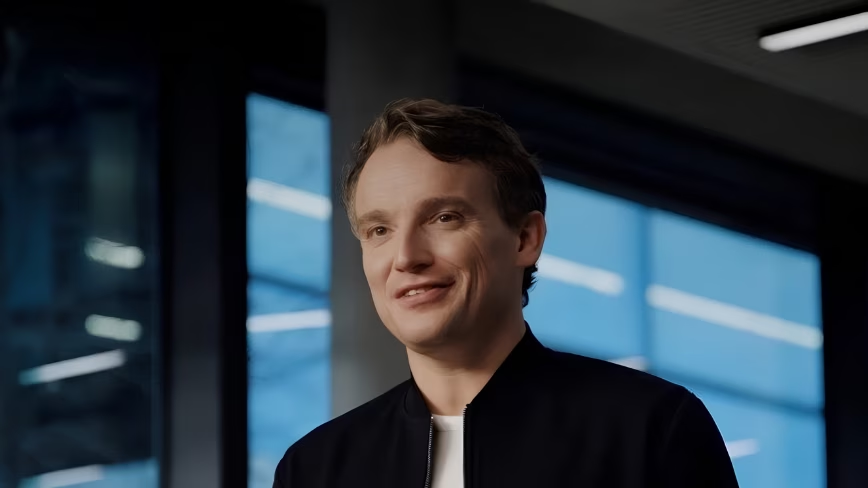
The latest changes distribute responsibility for product across the top of the house, drawing AI oversight closer to chief executive Christian Klein and the company’s operating leadership rather than leaving it parcelled out lower down.
The aim, in the language SAP has used around the move, is to shorten the distance between the people setting AI strategy and the teams building it, on the theory that the gap is where momentum gets lost.
It follows a March reorganisation that pointed in the same direction. In that earlier shuffle, Klein handed oversight of the sales department to Thomas Saueressig, who became chief customer officer from the start of April, a move explicitly designed to free Klein to concentrate on AI.
The June changes extend the logic from sales into product and engineering, the parts of the company where AI features are actually conceived and shipped.
Klein has not been subtle about the urgency. “The AI evolution is moving rapidly, and we need to keep pace,” he has said, framing the task as a need to “transform SAP end to end, going all in on AI.”
For a company whose software runs the back offices of much of the corporate world, the phrase “end to end” is a large commitment, implying changes that reach from the underlying platform to the products customers touch.
The pressure behind the rhetoric is partly investor-driven. SAP has faced scrutiny over whether its AI strategy is keeping up with a market that is rewarding speed and punishing hesitation, and repeated reorganisations are, among other things, a signal to shareholders that management is responding rather than drifting.
The risk is that two reshuffles in four months reads less as decisiveness than as a company still searching for the right shape.
SAP’s position is distinctive within the AI race. It is not a model developer competing with the labs, but the dominant supplier of enterprise resource planning software, the systems that handle finance, supply chains, and operations for thousands of large organisations.
Its AI opportunity lies in weaving automation into those workflows, and its AI threat is that a more nimble competitor, or the model providers themselves, could insert intelligence into enterprise processes without going through SAP at all.
That contest is playing out across the enterprise-software industry. Rivals are racing to embed AI agents into corporate systems, and the question of how those agents are governed and secured has become its own competitive battleground.
Even SAP’s neighbours in the cloud are restructuring around the same forces, with Oracle cutting jobs as it reorients toward AI and data centres. The reshuffles are local symptoms of an industry-wide reordering.
SAP has not detailed how the new responsibilities will translate into specific products or timelines, and the practical effect of moving oversight upward will only show in what the company ships and how quickly.
What the reorganisation makes unmistakable is the priority. Klein has put his own attention, and now a redrawn org chart, behind the bet that SAP’s future depends on getting AI into its products faster than the competition can get around it.
View original source — The Next Web ↗
Related stories

Euronews
TechnologyJun 30, 2026 · 1 min
Billions of mRNA vaccine doses’ review underpins their effectiveness
Euronews

CBC
TechnologyJun 30, 2026 · 1 min
WhatsApp will allow users to go by usernames, closing a privacy blind spot
CBC

Euronews
TechnologyJun 30, 2026 · 1 min
Starmer sets out to strengthen UK and European defence with cash for drones and AI systems
Euronews

Antara News
TechnologyJun 30, 2026 · 1 min
Meta deactivates 185,000 Indonesian underage accounts
Antara News