Times of Israel
Eisenkot accuses Bennett and Lapid of weakening Zionist opposition with merger
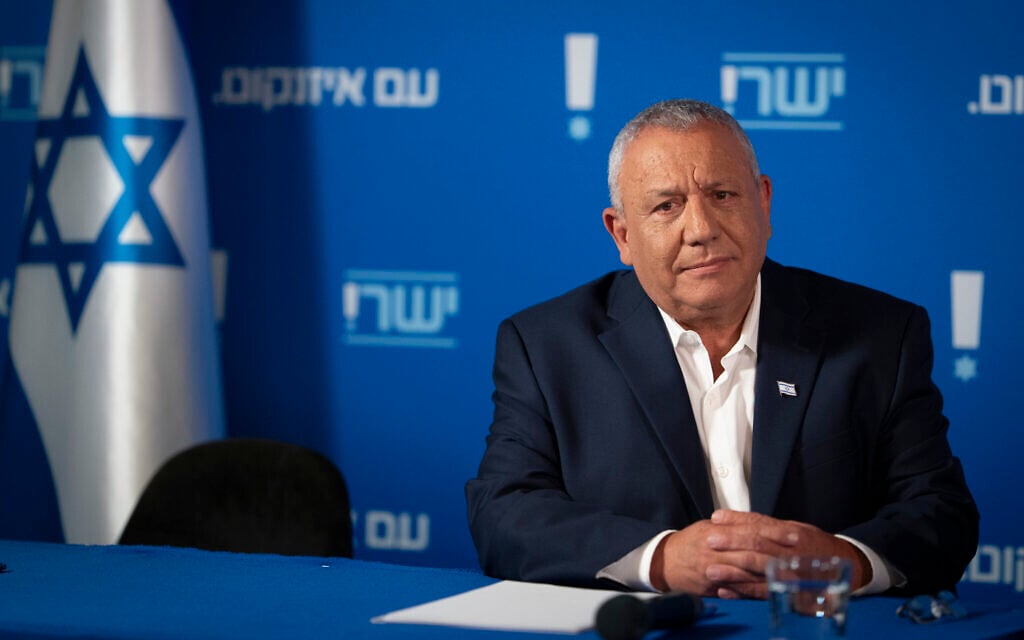
Former IDF chief Gadi Eisenkot has accused fellow Zionist opposition leaders Naftali Bennett and Yair Lapid of weakening the bloc by forming their joint electoral slate after rejecting his offer of a three-way “super-party,” in comments published Tuesday.
The Yashar party head, who recently passed Bennett as the lead candidate to unseat Prime Minister Benjamin Netanyahu in the polls, also reportedly said he would not form a coalition with “detached” far-right Finance Minister Bezalel Smotrich, whom Bennett has touted as a potential partner.
Speaking at a Sunday night campaign event in Yavne, Eisenkot said he had proposed to Bennett and Lapid, who then respectively led the Bennett 2026 and Yesh Atid parties, the formation of “a super-party, a large aircraft carrier of all three parties,” according to audio published by the Walla news site.
Eisenkot said he had conveyed to the two former premiers that “we’ll establish core principles, decide on the people and go forward.”
“There was resistance,” and the offer fell through, Eisenkot added.
Get The Times of Israel's Daily Edition
by email and never miss our top stories
By signing up, you agree to the terms
In April, as polls put Lapid’s party on the cusp of disappearing, Lapid and Bennett jointly launched the Together party, without Eisenkot.
“I very much respect their decision, though I think it was wrong,” Eisenkot said in the recording published by Walla. “It would have been more correct, in my view, to do a three-way merger in an organized manner.”
Eisenkot said that “ego aside,” he would have joined Bennett and Lapid if he were convinced a three-way merger would help the Zionist opposition bloc win the election.
But “every analysis, study and survey shows it shrinks the party and the bloc,” he claimed.
According to Eisenkot, the bloc was previously projected to win 60 of the Knesset’s 120 seats, but “today it holds just 58 or 59.”
Eisenkot reportedly says Smotrich’s designs on West Bank disqualify him as partner
Eisenkot also reportedly told the Sunday gathering that Smotrich’s bid to “take over the lands of Judea and Samaria,” the West Bank’s biblical name, disqualifies the Religious Zionism party chief as a coalition partner.
Smotrich, a former political ally of Bennett, believes “Israel needs to dismantle the Palestinian Authority, take over the lands of Judea and Samaria, assume responsibility for 2.8 million Palestinians and get them to do ‘relocation,'” Eisenkot said, according to Walla.
“According to him, whoever chooses not to emigrate should get the right to vote and be drafted to the IDF,” Eisenkot was quoted saying of Smotrich.
“In my view, that’s a detached idea of a detached leader making a detached proposal” that would lead to “the elimination of the Jewish majority in the State of Israel and the elimination of the State of Israel as a Jewish and democratic state,” Eisenkot said, according to Walla. “As long as he doesn’t let it go, I see no partnership with him.”
Bennett, by contrast, has said he “doesn’t boycott” Smotrich or extremist National Security Minister Itamar Ben Gvir as potential coalition partners, according to a video that religious news site Kipa published in February from a Bennett 2026 campaign event in the West Bank settlement of Efrat.
Bennett said in the recording that Ben Gvir was incompetent while Smotrich “knows how to work.”
Amid uproar in the opposition over the recording, Bennett said he would not form a government with the “failed minister” Ben Gvir, but did not rule out a potential partnership with Smotrich.
Polls in Hebrew media, including The Times of Israel’s sister site Zman Yisrael, regularly show the Zionist opposition bloc would be unable to form a government without at least some support from either Netanyahu’s bloc or Arab parties. Bennett has explicitly rejected a government with Arab parties, while Eisenkot has not.
The next election is set to take place by October 27.
View original source — Times of Israel ↗
Related stories

TechRadar
TechnologyJun 30, 2026 · 1 min
Declare independence from slow, outdated tech with these 11 unmissable 4th of July PC accessory deals from HP
TechRadar

TechCrunch
TechnologyJun 30, 2026 · 1 min
X now offers an MCP server to make its platform easier for AI tools to use
TechCrunch

The Guardian
TechnologyJun 30, 2026 · 1 min
House prices fall in four capital cities as Sydney values drop nearly $50,000 this year
The Guardian

TechCrunch
TechnologyJun 30, 2026 · 1 min
Arcturus could halve the grid’s electrical losses using its nano-infused copper
TechCrunch