The Next Web
Google releases Nano Banana 2 Lite, its fastest and cheapest AI image generator yet
TL;DR
Google launched Nano Banana 2 Lite, an image model that generates in four seconds for under four cents per thousand images.
Google on Tuesday released Nano Banana 2 Lite, the fastest and cheapest model in its Nano Banana family of AI image generators. The model produces images in four seconds and costs under four cents per thousand images, making it the company’s most aggressive play yet for developers who need to generate visuals at scale. It is available immediately in Google AI Studio, the Gemini API, and the Gemini Enterprise Agent Platform.
Nano Banana 2 Lite is built for speed, not quality. Google positions it as the model for “rapid ideation and high-velocity developer pipelines” where latency and cost matter more than fine detail. The company’s existing Nano Banana 2, launched in February, remains the recommended model for work that demands higher fidelity, while Nano Banana Pro handles complex professional use cases.
The new model replaces the original Nano Banana, which Google now calls its “legacy model.” Despite prioritizing speed, Nano Banana 2 Lite retains what Google describes as reliable prompt adherence, strong character consistency, and legible text rendering inside images. It is also rolling out to consumer surfaces including AI Mode in Search, the Gemini app, NotebookLM, Google Photos, Stitch, Google Flow, and Google Ads.
The 💜 of EU tech
The latest rumblings from the EU tech scene, a story from our wise ol' founder Boris, and some questionable AI art. It's free, every week, in your inbox. Sign up now!
Alongside the image model, Google announced a wider release of Gemini Omni Flash, its video-generation model first introduced at Google I/O in May. Omni Flash is now available to developers through the Gemini API and Google AI Studio for the first time, priced at ten cents per second of video output. Clips are capped at ten seconds, with longer durations expected later.
Google is pitching the two models as a pipeline. Developers can use Nano Banana 2 Lite to rapidly generate and iterate on images, then pass those images to Omni Flash to animate them into video. A new demo app called Omni Product Studio converts static images into what Google calls “cinematic e-commerce videos,” and two other demos let users place themselves into landmark photos or reimagine room interiors.
The releases land in a market where AI-generated imagery remains deeply polarizing. A recent study found that 60 percent of TikTok videos are now classified as AI-generated content, and the term “AI slop” has entered everyday vocabulary to describe low-quality machine-made media flooding social platforms. Google has leaned heavily into marketing its image tools for advertising and business use rather than consumer creativity, a framing that sidesteps some of the backlash but not all of it.
The company’s relationship with Hollywood is also drawing scrutiny. Google DeepMind struck a $75 million deal with indie studio A24 last week to develop AI filmmaking tools, a partnership that prompted significant criticism from fans and creative communities who accused A24 of undermining the artists it built its reputation championing. A24 has defended the partnership, saying it wants to “dictate what tools get built for artists” rather than leave those decisions to technology companies alone.
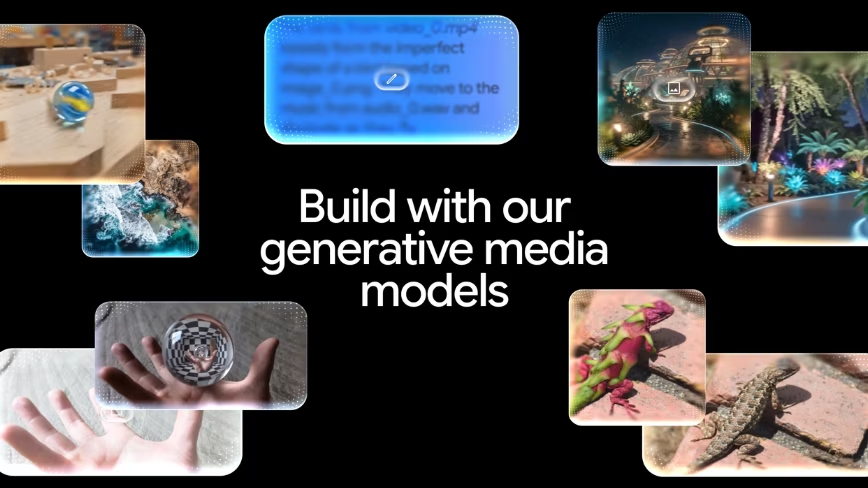
Nano Banana 2 Lite and Omni Flash are the latest additions to a generative-media stack Google has been building out aggressively since last year. The strategic bet is that making image and video generation fast enough and cheap enough will embed these tools into everyday developer workflows before the debate over their social costs is resolved.
View original source — The Next Web ↗
Related stories

Engadget
TechnologyJun 30, 2026 · 1 min
Amazon will pay $2.25 million to settle FTC identity theft case
Engadget

BBC
TechnologyJun 30, 2026 · 1 min
Dangerous heatwave to hit US ahead of holiday weekend
BBC

The New York Times
TechnologyJun 30, 2026 · 1 min
Aid Workers in Venezuela Fear Disease Outbreaks After Twin Quakes
The New York Times

The New York Times
TechnologyJun 30, 2026 · 1 min
The Vera Rubin Telescope Begins Surveying Our Cosmos
The New York Times