BBC
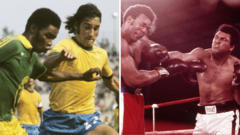
Bigger than Rumble in the Jungle? DR Congo bid for World Cup history
Three games, three defeats, 14 goals conceded, no goals scored - DR Congo's Fifa World Cup debut in 1974 was certainly one to forget.
The first side from sub-Saharan Africa to qualify for the finals, the country then known as Zaire lost 2-0 to Scotland and 9-0 against Yugoslavia before another infamous moment in their final group game against Brazil.
Trailing 2-0 late in the second half, Leopards defender Mwepu Ilunga bolted out of the defensive wall as the defending champions prepared to take a free-kick and thumped the ball high and long downfield.
The right-back was booked and ridicule followed - including suggestions that Zaire's players did not even know the laws of the game. Almost 40 years later Ilunga revealed it was an act of protest.
"I was aware of football regulations. I did it on purpose," he told the BBC in 2010, five years before his death.
Later in 1974, the world's eyes were back on the central African country when its capital Kinshasa became the stage for one of sport's greatest ever events.
At huge expense, Zaire's president Mobutu Sese Seko secured hosting rights for the heavyweight world title clash between Muhammad Ali and George Foreman, the fight that became known as the Rumble in the Jungle.
"Geopolitically, President Mobutu really pulled off a media coup because his country was discovered and became known across the world," recalls journalist Justin Kabala Mwana, who covered the bout.
Now, 52 years on from both one of the country's darkest sporting chapters and one of its most celebrated occasions, DR Congo face England in the last 32 at this year's World Cup on Wednesday (17:00 BST).
And like the Rumble in the Jungle, Kabala sees the game in Atlanta as a chance for a country hit hard by conflict and corruption over decades to "regain its unity and dignity".
Congo had been granted independence from Belgium in 1960, but Mobutu seized power in a military coup in 1965 before renaming the country Zaire six years later. As the president used his power to amass a huge personal fortune, the local economy suffered.
"The price of copper was slashed drastically - very seriously. Petrol had stopped flowing at the pumps and the World Bank had got involved to steer Zaire's economy," Kubala recalled.
"It was a crisis."
Yet the country's footballers were making a mark on the continental stage, claiming three African club titles between 1967 and 1973, the Africa Cup of Nations (Afcon) in 1968 and 1974, and then World Cup qualification.
President Mobutu rewarded those in the Leopards squad with a house and car each, and made sure preparations for the World Cup were on track.
"President Mobutu took us under his wing," former Zaire forward Mayanga Maku told BBC Sport Africa.
"We withdrew from our respective clubs and we focused solely on the national team.
"He was the one who ran everything. We were on the right track until we arrived there."
Zaire travelled to West Germany in June 1974 on a high after claiming their second Afcon title three months earlier, but all was not well behind the scenes.
Players initially refused to play against Yugoslavia in protest over unpaid allowances received from Fifa, which they accused football federation bosses of spending.
"We were not a bad team. If we got [to the World Cup], it was providence," reserve goalkeeper Mohamed Kalambay told Sporting Witness in 2022.
"We were missing one small thing: recognition. We didn't get our bonuses.
"You don't have the morale to play. And that's what happened to us."
The players did take the field against Yugoslavia but were resoundingly thrashed, with goalkeeper Kazadi Mwamba substituted in the 21st minute when 3-0 down and striker Pierre Ndaye Mulamba sent off soon afterwards.
Then came their final group outing against Brazil and Ilunga's moment that has entered football folklore.
"I don't regret it at all," he claimed. "I wanted to be given a red card so I could leave the field.
"Why should I play for the benefit of officials of our country's football association who took the players' money provided by Fifa?
"But I didn't succeed, the referee didn't give me a red card."
A few months on from the disappointment at the World Cup, Zaire rolled out the red carpet for two of boxing's biggest stars.
Ali had been stripped of his world titles in 1967 and banned for three and a half years after refusing to fight for the US army in Vietnam, and four years after his return to the ring he was still looking to reclaim his undisputed heavyweight crown.
Via promoter Don King, President Mobutu paid $5m dollars to both Ali and Foreman to stage the fight in Kinshasa.
"Mobutu said that the dignity of his country was beyond price, and that he was prepared to pay whatever it took," Kabala told BBC Sport Africa.
"The whole country was mobilised to welcome this super fight of the century, as if to rise to the challenge.
"President Mobutu had spared no expense to make sure it all went off under good conditions. He was absolutely determined to put himself on the world stage."
Kabala remembers a carnival-like atmosphere at a packed Stade du 20 Mai, with most of the locals supporting Ali.
Those present on 30 October witnessed an incredible bout as Ali sucked up all Foreman could throw at him, with his 'rope-a-dope' tactics designed to tire out his younger opponent.
Towards the end of the eighth round, Ali floored Foreman with a devastating combination to reclaim the heavyweight title.
"That day it was a celebration all over the country," said Kabala.
"People partied right through the night. Beer was flowing freely for up to 48 hours after the fight.
"Zaire caught its breath a little. Except economically, that wasn't really the case.
"You could feel that once the party was over, it was goodbye to the good times."
The current squad have managed to achieve things the Leopards of 1974 would have targeted - a first World Cup goal and point came against Portugal in their opening game, then a first victory against Uzbekistan to reach the knockout stage.
DR Congo still endures its struggles today, with conflict raging in the east of the country and a recent outbreak of the Ebola virus which affected preparations for the World Cup.
"When we were last here, our jerseys looked different, the country was known as Zaire, it was a whole different time," supporter Tanya Maria told BBC Sport Africa in the United States.
"The World Cup has given people an investment into our country.
"And I think when people care about a country, when they care about the people that live there. That's when change can happen."
There is hope that new leadership of Fecofa, elected in May, can build on World Cup qualification and revive the domestic league.
Conditions are much better for the players, too.
"We're very privileged to have everything that we need," centre-back Axel Tuanzebe told the BBC just before scoring the crucial goal which booked the team's World Cup spot via an intercontinental play-off against Jamaica in March.
"We're not longing for anything and it enables us to go and perform the best we can."
The squad know they are playing for a bigger cause than mere success on the football field.
"It's not easy in our country," striker Yoane Wissa said after the victory over Uzbekistan.
"There's a war in East Congo. Every day, every time we wear this shirt, we think about them.
"Because we want peace and for them, I just say 'thank you'. Thank you because we came from far. We came from nothing to be here.
"Now we write our story."
For Kabala, Wednesday's last-32 tie is "almost" bigger than the Rumble in the Jungle.
The Leopards could certainly land a huge blow to England's ambitions of claiming a second World Cup title.
Compiled by BBC Sport Africa's Rob Stevens from interviews by Peter Musembi, Lucy Provan, Ian Williams, Alassane Dia and Celestine Karoney.
Related stories

ESPN
SportsJun 30, 2026 · 1 min
Koeman quits as Netherlands boss after WC exit
ESPN

ESPN
SportsJun 30, 2026 · 1 min
WNBA's Thomas got death threats over Clark tiff
ESPN

ESPN
SportsJun 30, 2026 · 1 min
NHL free agency 2026: Which players improved their...
ESPN

ESPN
SportsJun 30, 2026 · 1 min
Haaland, 'the greatest goalscorer,' saves Norway
ESPN