Times of Israel
Eisenkot launches election campaign, vows to unify after ‘chaos’ wrought by current government
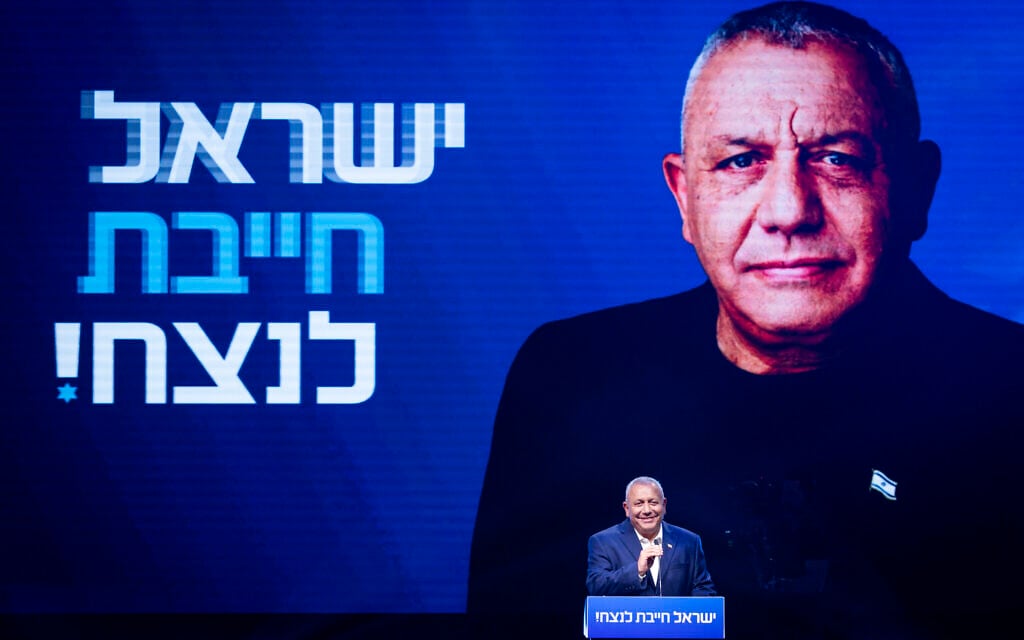
Gadi Eisenkot, the current frontrunner to serve as the main challenger to Prime Minister Benjamin Netanyahu in the upcoming election, formally launched his campaign on Tuesday, vowing to be a unifying leader and replace a government he accused of creating “chaos.”
The head of the new centrist Yashar party declared he is running for prime minister and unveiled wide-ranging plans he promised to implement, from education, economy and public security to recruiting the Haredi and Arab publics to military and national service, and reversing the trend of brain drain.
Under the slogan “Israel must win,” he called the upcoming elections “fateful for the security, unity and soul of Israel.”
“This coming October, the government of the terrible October will come to its end,” he said, referring to the Hamas onslaught of October 7, 2023. “We will open a new and much better chapter in Israel’s history. We will write it together.”
Eisenkot, a former IDF chief of staff who left Benny Gantz’s Blue and White party to lead his own movement, vowed to be a “unifying” leader rooted in “the tradition of Israel, its heritage and Torah” and “to be a prime minister for all Israeli citizens.”
Get The Times of Israel's Daily Edition
by email and never miss our top stories
By signing up, you agree to the terms
While he did not mention Netanyahu by name, he said there were “those” who sow division and “advance steps that go against the national interest and are a slap in the face of the Israelis who work, serve and are willing to sacrifice their lives for this homeland” — a reference to the government’s attempts to pass legislation reinstating blanket military exemptions for ultra-Orthodox men and to cancel sanctions for draft evasion.
After Netanyahu said recently that he wants to form a “broad national unity government,” Eisenkot said: “The leadership is using the term ‘national unity’ as a cynical election campaign. I will do everything to unify the nation.”
“This is a leadership for which the words ‘accountability’ and ‘personal example’ are foreign. It is a leadership that lies. As if there is no other way besides the chaos in which we live, which fuels division as if it has no cost; whose only way of governing is to pull us apart,” Eisenkot charged.
“We have a duty to put an end to this madness… because the State of Israel doesn’t have the privilege of getting it wrong again,” he added. “We will replace a leadership devoid of any vision and strategy.”
“Will we accept the continuation of social divisions and go full throttle toward the next disaster,” he asked, “or will we heal and rebuild?”
Eisenkot promised to immediately form a state commission of inquiry into the October 7 Hamas-led massacres, in which some 1,200 people were killed and 251 were abducted to Gaza. Its conclusions would be used to “learn from the past and prepare for the future,” he said.
He also listed the rehabilitation of the north and south as one of his key goals, and vowed to “care for anyone physically or mentally harmed during the war.”
As many reservists have complained of an immense burden after being forced to serve hundreds of days during the yearslong war amid a chronic shortage of manpower, Eisenkot introduced a plan that would cap reserve service at 50 days per year and “grow the ranks of the military to make it significantly easier for conscripts and reservists — without compromising on security.”
Amid pressure from Naftali Bennett’s and Yair Lapid’s Together party to team up, Eisenkot suggested he didn’t intend to form an alliance with any other factions that he wouldn’t head.
Political outsider and security hawk
The former general — who entered politics only four years ago, entered Netanyahu’s war cabinet after October 7, but then quit in 2024, accusing him of lacking a strategy in Gaza — has emerged as the premier’s most serious challenger in elections likely to be held on or a bit before October 27.
Like nearly all of the prime minister’s rivals, Eisenkot has broadly supported Israeli military operations in places such as Gaza, Lebanon and Iran.
But he has also accused Netanyahu of strategic failure in the wake of the October 7 attack and said his vision of a more isolated Israel is a threat to the future of the state.
In recent days, Netanyahu, who leads the right-wing Likud party, has fired back, saying if he had listened to Eisenkot, who was opposed to certain operations in Gaza, then Hamas would still be in control of all the territory.
A 66-year-old son of Jewish Moroccan immigrants, Eisenkot stands in stark contrast to Netanyahu, a US-educated elite. He comes from a working-class family. His English is unpolished. He spent four decades in the IDF.
He has also never campaigned on having ties to US President Donald Trump. And his 25-year-old son, Gal Meir Eisenkot, was killed in combat in Gaza, while Netanyahu’s son Yair, a podcaster and a highly divisive figure, lived part-time in Florida.
Losing a son — as well as two nephews — to the war has raised Eisenkot’s profile among Israelis and given him credibility as someone who, having paid the ultimate price, won’t needlessly sacrifice soldiers.
He has projected an image as a political outsider and security hawk whose humble background and family sacrifices stand in vivid contrast to Netanyahu’s decades in high office and lingering corruption cases.
In Israel’s fractured multi-party system, it would be difficult for any of the prime minister’s challengers to form a coalition broad enough to unseat him.
If Eisenkot’s party wins more seats than Netanyahu’s — as a Times of Israel poll recently predicted for the first time that it would — it will still need to form alliances with enough other parties to constitute a majority. Eisenkot has said he will not compromise on legislation mandating military service for the ultra-Orthodox, who also wield political power.
He will also need to decide whether to include Arab-led parties to get over the 61-seat threshold to form a majority coalition in the 120-member Knesset — something Netanyahu and his far-right allies have already used as an attack line.
While his new party is entering the election run-up with plenty of momentum after rising in the polls over recent weeks and months, Tamar Hermann, a political scientist and senior fellow at the Israel Democracy Institute, says Netanyahu could still manage a comeback.
“Netanyahu in a way is like a political Houdini; he manages in a way to get out of unfathomable corners,” Hermann said.
View original source — Times of Israel ↗
Related stories

France 24
PoliticsJun 30, 2026 · 1 min
France sets presidential election date as Macron finishes final term
France 24

The Hill
PoliticsJun 30, 2026 · 1 min
Just 7 percent of Ukrainians approve of US leadership: Gallup
The Hill
Times of India
PoliticsJun 30, 2026 · 1 min
'Ready for war': Iran draws red line for US, says no final talks until MoU terms are met
Times of India
CNA
PoliticsJun 30, 2026 · 1 min
PM Anwar’s coalition partners pledge to finish term, despite state polls feud: Selangor chief minister
CNA