CNA
Commentary: Football’s Asian century is still on hold
Commentary
World Cup 2026 has shown that the future of football is not in Asia yet, says Gearoid Reidy for Bloomberg Opinion.
01 Jul 2026 05:58AM
(Updated: 01 Jul 2026 07:13AM)
TOKYO: In the early 2000s Sepp Blatter, the then-head of football’s governing body FIFA, spoke of where he saw the sport going.
“In Asia you have more than half the world’s population,” he said. “The future of football must be in Asia.”
With a clear link between finances and on-pitch success, it was a common sentiment for the growing region, and as the World Cup opened in Japan and South Korea in 2002, many predicted the new century would see a winner emerge from this part of the world.
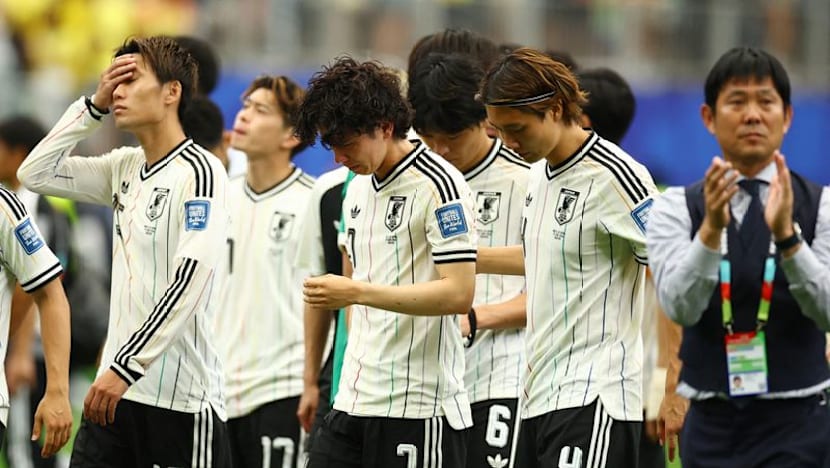
The 2026 World Cup, the biggest ever, featured a record nine Asian teams, up from six in the previous tournament. But after Japan crashed out to a late goal against Brazil on Monday (Jun 29), it only leaves Australia, which joined the Asian Football Confederation as recently as 2006.
The contrast is stark with Africa, with nine out of the 10 nations that qualified advancing to the knockout stages, even minnows like Cape Verde.
FAILINGS TO FACE UP TO
There is no single explanation for the Asian teams’ underwhelming performances. But the region has a lot of failings to face up to, if the future of football is to belong to it.
There’s no shame for Japan, saddled with a difficult group and a tough draw against Brazil. Many of us here are rather sick of the low expectations that overlook the progress made on the pitch in favour of a focus on fans and players cleaning up stadiums. Japan has done most things right over the past three decades to build the grassroots game and develop a pipeline of elite players.
But against Brazil, familiar failings were on display for a country that has qualified for every tournament since 1998 but never won a knockout game.
Manager Hajime Moriyasu made a baffling decision to go ultra-defensive after Japan’s best 45 minutes of football. And when his counterpart Carlo Ancelotti switched tactics at half-time, Moriyasu retreated instead of playing to his team’s strengths.
Ancelotti has won five Champions Leagues, while Moriyasu has never managed outside of Japan, and when Brazil’s additional-time winner came it was with a sense of inevitability. It’s the third tournament in a row that Japan has blown a lead in a knockout tie.
So long as it’s content to be the tidying-up team, it won’t go far. What Japan needs now - as well as a new manager - is the self-belief of Shohei Ohtani, who before the World Baseball Classic final in 2023 urged his teammates to stop idolising the opposing US stars.
Perhaps it could use a fraction of South Korea’s refusal to accept mediocrity. Outgoing manager Hong Myung-bo is facing death threats and public recriminations, with President Lee Jae Myung expressing his “utter bewilderment,” as the team crashed out of a relatively easy group.
The vitriol is over the top, but the underperformance should force a reckoning with the football administrators; Lee suggested that “favouritism and cronyism” were to blame, amid an ongoing police investigation into allegations of interference in Hong’s appointment.
ROOM FOR THE GAME TO GROW
The West Asian states that increasingly dominate the region’s football politics face different issues. Iran can be forgiven for its disappointing showing, given the war and the well-noted struggles to obtain visas. Less so Qatar, Asian champions for the last two tournaments, which also had a top-tier coach in Spain’s Julen Lopetegui.
Saudi Arabia will host the World Cup in 2034, but its domestic league still lags behind despite the presence of superstars like Cristiano Ronaldo. Perhaps in a few decades it can ship its homegrown players to Europe, but for now, money remains no substitute for a deep footballing culture.
Then there are the countries that didn’t even make it to the tournament. China and India make up nearly 60 per cent of the region’s population, but India has never appeared at the finals, and China just once in 2002.
Xi Jinping, then Chinese vice president, in 2011 revealed his “three wishes” of qualifying for the tournament, hosting it and eventually winning it. But at this rate, it’s questionable if he’ll even see his first come true within his lifetime.
Elsewhere, there is room for the game to grow. Hosting the 2002 competition was instrumental in boosting the sport’s popularity in Japan and South Korea, and Asia needs more such opportunities rather than sportswashing projects in the Middle East.
No Southeast Asian country has ever made it to the finals save Indonesia (then the Dutch East Indies) at the third-ever tournament in 1938. That’s one reason to cheer a mooted joint bid for the 2046 tournament, which could also include Thailand, Malaysia and Singapore as well as Japan, South Korea, and China - though, let’s see how long that aspiration survives contact with political reality.
Proximity to the game’s highest levels might be key. These days, almost all Japan’s players ply their trade at European clubs, like their opponents. The Japanese football association should prioritise creating a generation of elite Japanese coaches just as it has players.
Geography also helps African teams. Players, coaches and federations are plugged into Europe’s most competitive systems, while significant numbers of players from Morocco, Senegal and Algeria were born in Europe.
In modern football, the diaspora is a development model that Asia has much less access to. If anything, 2026 has shown that the future of football is not in Asia yet.
Source: Bloomberg/zw(el)
Related stories

ESPN
SportsJul 1, 2026 · 1 min
FAQ: What does the Supreme Court ruling mean for t...
ESPN

ESPN
SportsJul 1, 2026 · 1 min
Wizards to shun trade offers for Davis, source say...
ESPN

The Punch
SportsJul 1, 2026 · 1 min
World Cup: France beat Sweden 3-0, set last 16 clash with Paraguay
The Punch
ESPN
SportsJul 1, 2026 · 1 min
Butler's Hinkle Fieldhouse to host NBA Cup final
ESPN