The Guardian
Antisemitism isn’t always overt. A torrent of suspicion is questioning Jewish Australians’ loyalty to the country we…
Which master is he loyal to and whom is he in service to?
This is just one of hundreds of antisemitic comments which formed part of my submission to the royal commission, and of tens of thousands I have received over the last few years.
It’s easy to dismiss comments like these as political commentary. I’ve often been told that for a member of parliament it’s just part of the job.
But to a Jewish Australian, it represents something much more sinister – something that has haunted my family for generations.
The accusation that Jews can never truly belong to the countries they call home is one of the oldest antisemitic tropes in history. In Spain Jews were forced to convert to Catholicism or face expulsion; in France they were asked to assimilate by practising their Judaism in private; and in the Soviet Union Jews were pressured to abandon religious practice and suppress expressions of Jewish identity.
No matter how long the Jewish community contributed to a society, we were always suspected of serving someone else.
Time has passed and the language has changed but the accusation has not. For the past three years, I have seen this rhetoric become normalised. Online forums and comment sections have become a cesspool of antisemitic abuse.
Add to that a layer of misogyny and violent sexualised comments directed at my partner, and even harm wished upon our newborn baby.
It’s not just one comment or a hundred. It’s a torrent of suspicion and dehumanisation questioning our loyalty to the country we love.
Antisemitism doesn’t always show itself as overt bigotry or deliberate hate. Criticism that begins as opposition to the actions of a foreign government too often descends into conspiracies, dehumanisation and blame directed at Jewish people on the other side of the world.
Historic prejudices that demonise, generalise or hold Jewish people collectively responsible are now presenting themselves on both sides of politics. The result is an environment in which antisemitism becomes legitimised from multiple directions at once.
I have seen this in far-right groups celebrating abuse and hostility directed at public figures because, in their minds, Jewish people don’t belong. I have seen activists in progressive spaces justify or minimise the same behaviours when targeted towards the “wrong” kind of Jew – one whose identity is somehow defined by the actions of a foreign government. This was the case when my office was firebombed, vandalised and had its windows smashed.
While the justifications are different, the outcome for Jewish Australians is the same – fear, exclusion and hatred.
And on 14 December 2025, that hatred led to 15 innocent people being killed in the worst terrorist attack in Australian history.
Not all words lead to violence but every act of violence begins with words.
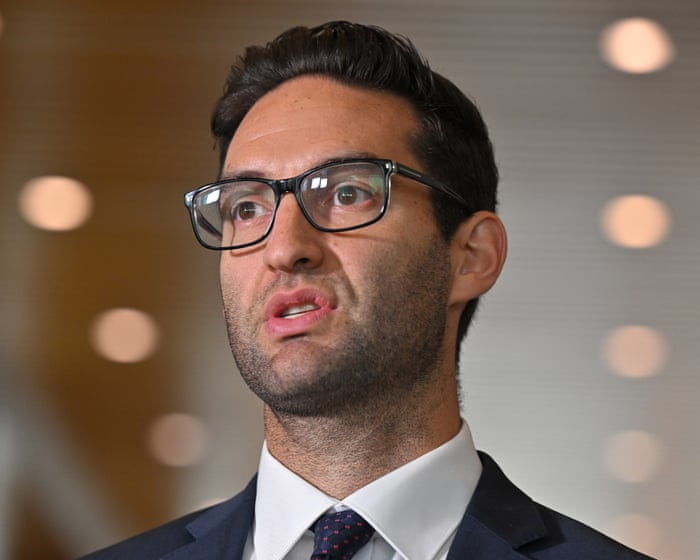
As the member for Macnamara, I am proud to represent one of Victoria’s most diverse and multicultural communities. But on Tuesday I appeared before the royal commission not as an MP but as the grandson of a refugee who fled Nazi Germany, a father to two incredible girls, and a proud Jewish Australian.
All of us are shaped by our family, culture and history. For me that’s the story of my grandmother, who sought refuge in Australia as a little girl. She was deemed stateless before she could read. Her parents travelled as far as possible from their home in Germany in hope of safety and freedom.
In Australia they found a safe haven. Just two generations later, I still pinch myself that I am a member of the federal parliament.
Australia gave my family everything that was denied to the Jewish people of Europe in the 1940s – safety, freedom and equality before the law. To grow up in Australia’s Jewish community was to be told by survivors of the Holocaust how fortunate we were to live in our country.
I can count on one hand the number of times I experienced antisemitism growing up. I never felt as though I didn’t belong or had to worry that being Jewish might be a barrier to what I could become or achieve.
But the unfortunate reality is that Jewish life in Australia has become increasingly isolating and, on too many occasions, it has become dangerous.
It doesn’t have to be this way.
My message to the royal commission was simple – Jewish Australians are not asking for criticism or debate to be silenced. We know what that feels like. But we are asking for the dehumanisation and diminishing of our experiences to end.
Not because we want freedom of expression to be curtailed in this country but because we want to see Australians of every faith, ethnicity and sexuality have the freedom to express themselves without vilification.
That freedom is exactly why my family, and so many others, fled persecution to come here. It’s the same freedom that has allowed them to safely participate in Australian life as equals for generations. And it must always be protected.
View original source — The Guardian ↗
Related stories

The Punch
PoliticsJul 1, 2026 · 1 min
Saudi Airlines mum over N6m NCAA sanction
The Punch
ABC News
PoliticsJul 1, 2026 · 1 min
Plan to add hundreds of parking meters at Sydney beaches rejected
ABC News
Dawn
PoliticsJul 1, 2026 · 1 min
Balance between population and resources must for progress: PM Shehbaz
Dawn
South China Morning Post
PoliticsJul 1, 2026 · 1 min
India’s ruling party risks being sucked into Uttar Pradesh temple donation probe row
South China Morning Post