Times of Israel
Times of Israel··10 min read
Iran says it won’t meet with US envoys, clouding prospects for peace deal
The Times of Israel is liveblogging Wednesday’s events as they unfold.
Upstate New York woman arrested for funding Palestinian Islamic Jihad
US federal authorities arrest a woman from Upstate New York for allegedly sending funds to Palestinian Islamic Jihad.
Catherine Beth Washburn, 37, from the Rochester area, is charged with attempting to provide material support and resources to a designated foreign terrorist organization, the US Department of Justice says in a statement.
Washburn is a leader of the Direct Action Movement for Palestinian Liberation, a group that rejects peaceful protests and instead favors “direct action,” such as acts of sabotage, to support Palestinians, the statement says.
The FBI’s Joint Terrorism Task Force executed search warrants on Washburn’s electronic devices earlier this year.
The investigators allegedly recovered messages between Washburn and a Palestinian Islamic Jihad fighter in Gaza who claimed he had attacked Israel.
Washburn’s messages included, “I wish every day were October 7th,” that she hated Jews “very much,” that she wished Israel “would disappear,” and that if she lived in Gaza, she “would fight alongside the resistance.”
“I feel very excited every time I see news of the killing of an occupation soldier,” she said, according to the Department of Justice.
Financial records showed that Washburn had sent 80 transfers of cryptocurrency to the individual, amounting to $30,116.
She faces a maximum penalty of 20 years in prison and a $250,000 fine.
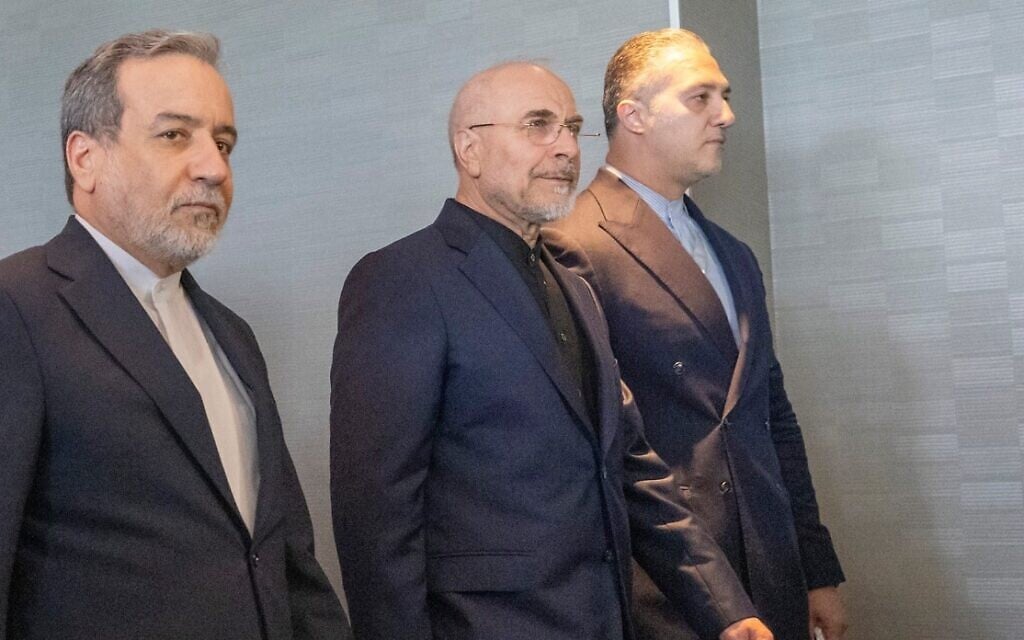
Iran says it won’t meet with US envoys, clouding prospects for peace deal
Iran says that it would not meet with top US envoys who flew to the region following an outbreak of hostilities, clouding the prospects for a lasting peace between the two countries.
Iranian officials also say the two sides must still sort out the terms of a ceasefire they signed two weeks ago before they could tackle more difficult topics, such as possible limits to its nuclear program.
The developments indicate that the two sides are far apart on key pillars of the initial framework, which calls for Iran to lift its chokehold on the Strait of Hormuz in exchange for financial incentives and sets up 60 days of negotiations to work out a permanent peace deal.
US President Donald Trump’s son-in-law Jared Kushner and envoy Steve Witkoff arrived in Doha for what the White House described as “high-level” talks, but Iran and host Qatar said they would meet with mediators, rather than the Iranians themselves.
“No meeting at any level with the American side has been scheduled for the coming days,” Iranian Foreign Ministry spokesperson Esmaeil Baghaei says.
The two countries were due to commence lower-level technical talks.
Shipping has partially resumed through the strait, which handled one-fifth of global oil and liquefied natural gas before the war broke out on February 28.
But Iranian officials have insisted on their right to manage traffic along with US ally Oman, which lies on the other side of the strategic waterway. Iranian officials said they would impose tolls in mid-August, when the 60-day period expires.
“The sovereignty of the Strait of Hormuz lies with Iran and Oman, and traffic in the Strait is subject to arrangements determined by Iran,” Iran’s top negotiator, Mohammed Baqer Qalibaf, says on state TV.
Despite the uncertainty, oil prices have fallen since the weekend, when the US bombed Iranian military facilities in response to drone strikes on commercial ships and Iran attacked US military sites in Kuwait and Bahrain.
Vulnerable economies, however, could remain at risk from food and fuel price increases even after energy markets feel relief, the UN trade and development agency says.
Guterres warns UNRWA nearing ‘breaking point’
UN Secretary-General Antonio Guterres urges countries to cover a $100 million gap in funding for the UN Palestinian refugee agency UNRWA, saying the body is nearing a breaking point after deep cost-cutting and austerity measures.
Guterres tells an ad hoc meeting of the General Assembly on voluntary contributions that UNRWA’s situation is increasingly precarious given sweeping restrictions throughout Palestinian territory that impede its work and the large cash shortfall.
The United Nations agency operates in Gaza, the West Bank, Lebanon, Jordan and Syria, providing aid, schooling, healthcare, social services and shelter to 2.6 million Palestinians.
The US was UNRWA’s biggest donor, but cut funding in January 2024 after revelations that some of its members took part in the deadly October 7, 2023, attack by Hamas terrorists that triggered the war in Gaza. Sweden also cut its 2025 funding. Other big donors paused funding for UNRWA while the Hamas charges were investigated, but most have resumed their contributions.
Guterres says the agency’s liquidity crisis jeopardized its ability to meet its mandate, which was renewed by the General Assembly six months ago with overwhelming member support.
“They cannot keep going like this without urgent backing and financial support from member states,” Guterres says, noting that the agency had taken decisive steps to implement reforms and update its policy on outside and political activities following revelations of some of its staff’s ties to Hamas.
“UNRWA is a stabilizing force in an age of instability,” he says, rejecting what he calls continued efforts to undermine the agency through “disinformation, smear campaigns, legislative actions, operational restrictions, diplomatic roadblocks and more.”
Such actions threatened the well-being of millions of Palestinians as well as UNRWA staff, Guterres says, noting that 390 UNRWA staff had been killed in Gaza since October 2023.
The UN has said it fired nine UNRWA staff who may have been involved in the October 2023 attack, which killed about 1,200 Israelis and foreign nationals. A Hamas commander in Lebanon, killed in September by Israel, was also found to have had a UNRWA job. The UN has disputed links with Hamas and vowed to investigate all accusations.
UNRWA had reduced its service delivery hours by 20% this year, cutting salaries for local personnel and keeping 15% of international posts vacant, Guterres says, adding, “Any further cuts could push conditions past the breaking point.”
UN spokesman Stephane Dujarric says the agency faced an existential crisis. He says the results of the ad hoc meeting on voluntary contributions would be announced on Wednesday.
In 2025, UNRWA received about $887 million in pledges and $829 million in contributions, according to its website, accounting for just 27% of total funding needs of $3.3 billion.
Add ToI as a preferred source on Google
Qatar reaffirms mediation role in US-Iran talks after meeting with Witkoff
Qatari Prime Minister Sheikh Mohammed bin Abdulrahman al-Thani affirmed his country’s continued mediation efforts and its support for all tracks of talks stemming from the memorandum of understanding between the US and Iran, Qatar’s Foreign Ministry says.
Sheikh Mohammed’s remarks come in a meeting with US envoy Steve Witkoff and President Donald Trump’s son-in-law Jared Kushner, where they discussed developments in ongoing US-Iran talks.
The statement does not provide further details on the content of the discussions.
Prime Minister and Minister of Foreign Affairs @MBA_AlThani_ Meets US Envoys
Doha | June 30, 2026
HE Prime Minister and Minister of Foreign Affairs Sheikh Mohammed bin Abdulrahman bin Jassim Al-Thani met on Tuesday with HE Steve Witkoff and HE Jared Kushner, the US Envoys.
The… pic.twitter.com/ULBbdzNcyq
— Ministry of Foreign Affairs – Qatar (@MofaQatar_EN) June 30, 2026
PM tells Erdogan to ‘calm down’ with anti-Israel rhetoric, says he raised Egyptian military presence in Sinai with Cairo
Prime Minister Benjamin Netanyahu says Turkish President Recep Tayyip Erdogan should “calm down” in the face of his increasingly hostile rhetoric toward Israel.
Asked during his Channel 14 interview if recent rhetoric coming out of Turkey concerns him, Netanyahu replies: “Of course it concerns me.”
Erdogan and other senior Turkish officials have ramped up threats against Jerusalem recently, with Turkey’s interior minister calling earlier this month for the country to “liberate” Jerusalem. Some Western and Israeli outlets reported that Erdogan called for God to destroy Israel during a prayer service marking the end of Ramadan in March 2025, saying: “May Allah, for the sake of his name… destroy and devastate Zionist Israel.”
Netanyahu charges that “what is happening in Turkey is a result of Iran’s decline in power. Iran is the extreme Shiite axis, while Turkey represents the axis of the Muslim Brotherhood — an equally extreme movement.”
“The things Erdogan says about wanting to destroy Israel and wanting to once again rule Jerusalem — I think he has forgotten that the 400 years of Ottoman rule have come to an end. Today, there is a strong state here called Israel. There is the Israel Defense Forces. There are the people of Israel. And there is a government of Israel. And it would be wise for him to calm down.”
“We will not allow anyone to threaten our existence. We will not allow anyone to threaten our security. And I think we have demonstrated what we are capable of,” he says.
The interviewer also asks Netanyahu about Israeli concerns over Egypt, apparently referring to Israeli media reports throughout the past year of growing concern in Jerusalem over an expanding military footprint in the Sinai Peninsula, which Israel is said to claim violates the demilitarization clauses of their 1979 peace treaty with Cairo.
“I have held discussions with the Egyptians, and I told them what I expect to be done. Part of it is already being carried out. These are matters that simply involve upholding the agreements between us,” he says, without elaborating.
“I think we need to safeguard our borders. But we must understand: as one power declines, another power rises. That is always the way things work. And the power that must continue rising — and to rise faster — is the State of Israel,” Netanyahu says.
PM says lesson of October 7 is that buffer zones must be established beyond Israel’s borders
Asked during his Channel 14 appearance if he was changed by the Hamas-led October 7, 2023, attack, Prime Minister Benjamin Netanyahu says the invasion and massacre affected his approach to Israel’s security doctrine, citing the need for buffer zones inside enemy territory.
“Let’s just say that I learned lessons. I drew conclusions. And you have to move with reality,” he says.
“The most important thing, in my view, is first and foremost having buffer zones inside enemy territory — not inside our territory. I don’t want the communities of the north to be some kind of frontier region whose reality is different from that of the areas immediately south of them,” the premier says.
The remarks come amid ongoing public debate over accountability for the attack, which led several senior military and intelligence officials to publicly acknowledge failures and resign. Netanyahu has not explicitly accepted personal responsibility for the attack and has refused to establish a state commission of inquiry, instead calling for a politically controlled probe of the Hamas attack and aftermath.
Pressed further by the pro-Netanyahu channel on how he personally has changed since the massacre, the premier jokes, “first of all, I lost a little weight,” before pivoting to a review of wartime decisions he said he championed, including a broader reserve mobilization than initially planned, the campaign against Hamas, operations against Hezbollah, actions in Syria and strikes on Iran.
Asked if there will be a third confrontation with Iran, Netanyahu replies: “If necessary,” repeating his vow that, “as long as I am prime minister, Iran will not have nuclear weapons.”
On Gaza, he is asked whether past proposals for the “voluntary emigration” of Gazans remain under consideration after being roundly rejected by much of the international community, which accused backers of the idea of trying to ethnically cleanse Gaza of its Palestinians. Netanyahu declines to elaborate, saying: “I prefer to talk less and do more.”
He is similarly noncommittal when asked about the prospect of renewed Israeli settlement in Gaza, saying only that “sometimes it’s advisable to separate” actions from public statements, and that “therefore, I have nothing further to add on that matter.” In the past, he had ruled out Gaza settlements, but appears to be adapting his public stance as elections approach.
Netanyahu says that Israel achieved two of three war aims: returning the hostages and eliminating Hamas as a military threat.
“The first objective, of course, was to bring back all of our hostages. And we achieved that,” he says, without noting that some hostages were killed in captivity or died before being recovered.
“The second objective was to dismantle Hamas and ensure that Gaza would no longer pose a military threat to Israel. And at the moment, it doesn’t,” he adds, reiterating that there was no military response from Hamas after the recent assassination of its top official Izz al-Din al-Haddad.
“We are in control. We are squeezing them. We also had a third objective, and that objective has not yet been achieved: eliminating their civilian rule. We will get there. There is still work to do. But there are constant operations targeting those who participated in October 7,” he says, adding that “we will find” anyone who remains who planned or participated in the attack.
View original source — Times of Israel ↗
Related stories

ESPN
SportsJul 1, 2026 · 1 min
Pochettino: Bosnia clash like WC 'final' for USMNT...
ESPN

The Punch
NewsJul 1, 2026 · 1 min
Baobab MFB launches hygiene project in Kwara
The Punch
The Punch
NewsJul 1, 2026 · 1 min
Average city bus fare rises 2.43% to N1,431 in May
The Punch

ESPN
SportsJul 1, 2026 · 1 min
Sources: Sixers land Wade on 4-year, $39M deal
ESPN